Tuesday, May 20, 2025

Was Muhammad Truly a Prophet? A Theological Examination

 Was Muhammad Truly a Prophet? A Theological Examination

By Dr. Maxwell Shimba | Shimba Theological Institute

Throughout the Bible — from Genesis to Revelation — God spoke directly to His prophets. To Adam in the Garden (Genesis 3:9), to Noah about the flood (Genesis 6:13), to Abraham about the covenant (Genesis 17:1-4), to Moses face-to-face (Exodus 33:11), to Samuel (1 Samuel 3:10), to Isaiah in a vision (Isaiah 6:8), and to all prophets who boldly declared: “Thus says the LORD.” These men were marked by direct divine communication and prophetic utterance under God’s authority.

But when we turn to Muhammad and the Qur'an — a glaring contradiction emerges.
Nowhere in the Qur'an do we find a single instance of Allah speaking directly to Muhammad as the God of the Bible did to His prophets. The Qur'an claims that Jibreel (Gabriel) brought messages to Muhammad, yet — critically — there is no recorded dialogue between Allah and Jibreel within the Qur'an itself. The chain of transmission is ambiguous, undocumented, and theologically unstable.

Ask yourself: If Muhammad was the greatest prophet as Muslims claim, why did Allah never speak to him directly — not even once?
Even the Qur'an admits in Surah 42:51:
“It is not fitting for a man that Allah should speak to him except by inspiration, or from behind a veil, or by sending a messenger to reveal, with His permission, what He wills.”

Yet this contradicts the biblical record. The God of Abraham, Isaac, Jacob, Moses, David, and Jesus did not hide behind veils or intermediaries — He spoke directly to His chosen ones.

Furthermore — no Qur'anic verse documents Jibreel receiving messages from Allah. Who witnessed these communications? Where’s the verification? In biblical tradition, prophetic messages were public, confirmed, and accountable. Muhammad’s claimed revelations, on the other hand, were private and unverifiable, often changing according to convenience (Surah 2:106).

Moreover, if Allah is the same God of the prophets, why does the Qur'an deny key prophetic doctrines?

  • It denies the Sonship of Christ (Surah 4:171), while biblical prophecy centers on the coming Messiah, the Son of God (Isaiah 9:6, Psalm 2:7).

  • It rejects the atoning death of Jesus, the cornerstone of prophetic fulfillment (Isaiah 53, Daniel 9:26).

  • It reduces prophets like Jesus and Moses to mere messengers stripped of their biblical majesty.

Therefore, theological and scholarly evidence leads to a firm conclusion: Muhammad was not a prophet of the God of the Bible. He operated under a different theological framework, promoting a god alien to the prophetic line that culminated in Jesus Christ — the Judge of the living and the dead (Acts 10:42).

The God of the Bible speaks. Allah of the Qur'an hides. The God of Scripture verifies. The Qur'an speculates. The prophets of the Bible prophesy in public. Muhammad claimed secret revelations.

The true test of a prophet is his message's consistency with the eternal Word of God and the prophetic witness before him (Deuteronomy 18:20-22). On this test, Muhammad falls short.

Reject deception. Embrace the living God revealed in Jesus Christ.

Dr. Maxwell Shimba
Founder, Shimba Theological Institute


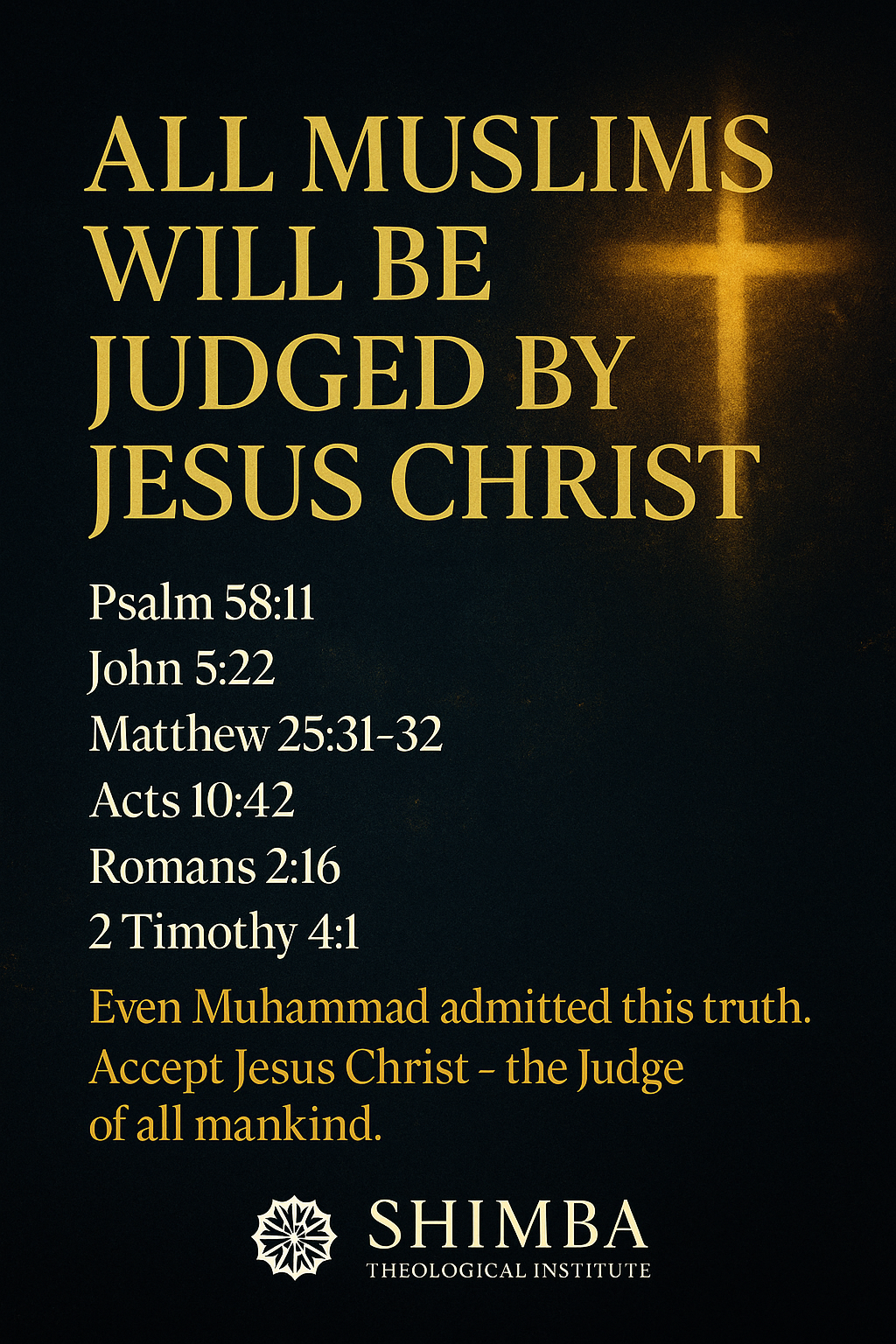
ALL MUSLIMS WILL BE JUDGED BY JESUS CHRIST


ALL MUSLIMS WILL BE JUDGED BY JESUS CHRIST

By Dr. Maxwell Shimba | Shimba Theological Institute

It is a remarkable and irrefutable truth revealed by both the Holy Bible and Islamic Hadith literature that Jesus Christ is the appointed judge of all mankind — both the living and the dead. What’s more astonishing is that even Muhammad, the prophet of Islam, admitted this fact.

Who Will Judge the World?

The Bible is unequivocal in declaring that Jesus Christ will one day judge the entire world, including Muhammad, Allah (as Muslims claim), all Muslims, all jinn, and every living and dead soul. Consider these scriptures:

  • Psalm 58:11"Surely there is a God who judges the earth."

  • Revelation 18:8"Therefore in one day her plagues will overtake her: death, mourning and famine. She will be consumed by fire, for mighty is the Lord God who judges her."

  • John 5:22"Moreover, the Father judges no one, but has entrusted all judgment to the Son."

  • Matthew 25:31-32"When the Son of Man comes in his glory, and all the angels with him, he will sit on his glorious throne. All the nations will be gathered before him, and he will separate the people one from another as a shepherd separates the sheep from the goats."

  • Acts 10:42"He commanded us to preach to the people and to testify that he is the one whom God appointed as judge of the living and the dead."

  • Romans 2:16"This will take place on the day when God judges people's secrets through Jesus Christ, as my gospel declares."

  • 2 Timothy 4:1"In the presence of God and of Christ Jesus, who will judge the living and the dead, and in view of his appearing and his kingdom, I give you this charge."

Islam’s Silent Admission: Jesus is the Righteous Judge

Interestingly, even in Islamic tradition, Jesus (Isa) is described as the one who will return to judge the world. The Sahih Muslim Hadith (Book 1, Hadith 293) states:

"By Him in Whose Hands my soul is, surely the son of Mary (Jesus) will soon descend among you and will judge mankind justly..."

This directly undermines the Islamic claim that Muhammad is the final authority or the last messenger with judgmental power. It raises a critical theological question: If Jesus is just a prophet according to Islam, why is He returning as the final righteous Judge of humanity?

Why Did Muhammad Seek Forgiveness 100 Times a Day?

Moreover, according to Sahih Muslim (Book 35, Hadith 6522), it is recorded that Muhammad himself admitted to having heavy sins weighing on his heart — seeking Allah’s forgiveness over a hundred times daily.

"Verily, sometimes I perceive a veil over my heart, and I supplicate Allah for forgiveness a hundred times a day."

If Muhammad was truly sinless and Allah’s greatest prophet, as Muslims assert, why did he fear his own sins and judgment to this extreme? This confession stands in stark contradiction to the nature of a true divine messenger, especially when compared to Jesus, who the Bible declares was without sin (Hebrews 4:15).

Is Allah the Judge or Is Jesus the Judge?

Another fundamental inconsistency lies within the Qur'an itself. If Allah is the supreme judge, why does the Qur'an and Hadith assign this monumental role to Jesus? Is Allah abdicating his divine role? Or is Islam inadvertently confirming that the true God has entrusted judgment to His Son, Jesus Christ, as the Bible consistently affirms?

This contradiction is not trivial — it reveals a foundational flaw within Islamic theology and challenges the credibility of Muhammad’s prophetic authority.

A Final Call

Why then reject Jesus Christ, the appointed judge of all creation, and follow a prophet who doubted his own salvation and begged for forgiveness repeatedly?

I urge all my Muslim brothers and sisters to reconsider the truth. The final judgment belongs to Jesus. It’s not a theological debate — it’s divine fact, confirmed by scripture and even acknowledged in Islamic tradition.

Accept Him now as your Lord and Savior while there is still grace. For on the day of judgment, it will be too late.

“For we must all appear before the judgment seat of Christ…” (2 Corinthians 5:10)


DO YOU KNOW WHY MUSLIMS PRAY FOR MUHAMMAD EVERY DAY?

 DO YOU KNOW WHY MUSLIMS PRAY FOR MUHAMMAD EVERY DAY?

Because Muhammad died with so many sins — more than any other creature.

In his book End of the Line, Reza Safa writes that in a Hadith, when Muhammad’s wife Khadijah asked him if his sins would be forgiven, Muhammad replied that he was not certain of his own forgiveness. How then could he forgive others’ sins?

MUHAMMAD SOUGHT FORGIVENESS 100 TIMES A DAY
In Sahih Muslim, Book 35, Hadith 6522, it says:
“The Messenger of Allah (peace be upon him) used to seek forgiveness from Allah 100 times a day.”

My brothers and sisters, every time I study Islam, I am filled with more and more doubts, because there seems to be no true good within this religion founded by Muhammad and Jibril (Gabriel).

What kind of sins did a man commit to the extent of seeking forgiveness from God 100 times a day?

Al-Agharr al-Muzani, one of the companions of the Prophet, reported that the Messenger of Allah (peace be upon him) said:
“Verily, sometimes a veil is cast over my heart, and I seek forgiveness from Allah a hundred times a day.”

Note — not only did tradition declare Muhammad a sinner, but he admitted to feeling a veil, or burden, upon his heart.
Yet the Qur'an declares Muhammad to be a perfect example of conduct.

So how could Muhammad have a sinful heart burdened with darkness?


Theological Argument Post by Dr. Maxwell Shimba, Shimba Theological Institute

Title:
Why Muhammad Cannot Be a True Prophet of the Holy God

As scholars of truth, we must test every religious claim against the revealed character of the one true God. Islam teaches that Muhammad was the final prophet, the “seal of the prophets.” Yet when we examine the foundational texts of Islam — the Qur'an and Hadith — what emerges is a troubling inconsistency.

1. A Prophet Plagued by Sin Cannot Be the Spokesman of a Holy God
The Bible teaches that God’s prophets were called to be blameless before Him. When prophets sinned (as David did), they publicly repented and pointed people to the Holy God. Yet, Muhammad confessed to being overwhelmed by sin — to the extent that he sought forgiveness over 100 times a day (Sahih Muslim 6522). A man so consumed with guilt cannot be the vessel for God’s perfect, final revelation.

2. Muhammad’s Uncertainty of Forgiveness Contradicts Divine Assurance
According to tradition, when Khadijah asked Muhammad if his sins were forgiven, he admitted uncertainty. This flies in the face of the biblical doctrine of a loving God who assures His servants of forgiveness (Isaiah 1:18, 1 John 1:9). A true prophet would have clarity about his standing before God.

3. The Qur'an’s Double Standard
The Qur'an calls Muhammad a “beautiful pattern of conduct” (Surah 33:21), yet he confesses to carrying a burden of sin and guilt. How can one both be the ultimate moral model and simultaneously admit to a veiled, sin-darkened heart? This contradiction is theological dissonance, undermining Muhammad’s claim to prophethood.

4. The Flawed Doctrine of Intercession
Islam claims Muhammad will intercede for Muslims on Judgment Day, yet if Muhammad was unsure of his own salvation, how could he plead for others? Hebrews 7:25 declares only Christ, the sinless Son of God, as able to intercede for humanity.

5. Is Allah the Father?
Islam denies the fatherhood of God. Yet Jesus called God His Father, spoke of His unique relationship with Him, and taught His followers to pray “Our Father” (Matthew 6:9). Islam’s refusal to acknowledge God as Father divorces it from the true revelation of God in Scripture and exposes its theological poverty.

Conclusion:
The evidence from Islamic texts themselves refutes Muhammad’s claim to be a true prophet of the living God. His daily desperation for forgiveness, his uncertainty of salvation, and his confession of a veiled heart are marks of a man in need of redemption — not the final messenger of a holy and perfect God.

Truth is not afraid of examination. The time to search is now.

By Dr. Maxwell Shimba
Founder, Shimba Theological Institute


A Theological Challenge to the Confusion in the Quran


📖 A Theological Challenge to the Confusion in the Quran

By Dr. Maxwell Shimba, Shimba Theological Institute

If the Qur’an is truly the literal, uncreated, direct words of Allah, then one glaring question emerges right from its very first chapter — Suratul Al-Fatihah:

👉 Why does Allah speak in the third person about Himself?

In Surah Al-Fatihah 1:2, it says:

“All praise is for Allah—Lord of all worlds.”

Wait — if Allah is speaking, why would He say ‘All praise is for Allah’ instead of ‘All praise is for ME’? Is Allah praising Himself from a distance? Or is another Allah being addressed? Or is someone else speaking here? This is a serious contradiction in the claim that every word of the Qur’an is directly from Allah.

It gets even more confusing in verse 6:

“Guide us along the Straight Path.”

Who is ‘us’ here?
Why would Allah pray to Himself for guidance?
Is this not an admission that even Allah needs guidance if He’s the one speaking? Or is someone else uttering these words? This verse completely contradicts the claim that it’s Allah Himself speaking directly throughout the Qur’an.

These inconsistencies raise disturbing theological problems for Islamic claims:

  • Is Allah praying to another Allah?

  • If it’s someone else speaking, then how can Muslims claim the Qur’an is entirely the unfiltered words of Allah?

  • If Jesus is called a Muslim by the Qur’an, why did He refer to God as ‘Father’ — something considered blasphemy in Islam?

  • Is Allah a Father? If not, how can Jesus, whom the Qur’an honors, break this core tenet?

These are not mere polemics — these are legitimate, necessary theological inquiries for truth seekers.

Islam claims consistency, yet the very foundation of its scripture contradicts itself in tone, voice, and narrative perspective.

We challenge our Muslim friends and scholars:
👉 Who is really speaking in Surah Al-Fatihah?
👉 Who is being praised?
👉 Who is being asked for guidance?

If the Qur'an is from Allah alone, these contradictions demand honest answers.

Truth withstands scrutiny. Lies collapse under it.

📚 By Dr. Maxwell Shimba
Shimba Theological Institute


Wednesday, May 14, 2025

The Spirit of Inconsistencies and Contradictions within the Quran

 The Spirit of Inconsistencies and Contradictions within the Quran: A Theological Review

By Dr. Maxwell Shimba, Shimba Theological Institute

The Quran, revered as the final revelation in Islam, claims to be free of contradictions, fully explanatory, and of divine origin. However, a careful examination of its text against logic, science, and divine revelation in the Torah and Injil reveals profound inconsistencies that question these claims. Below are a few theological issues requiring honest scrutiny:

1. The Moon Was Split (Quran 54:1)
The Quran alleges that the moon split in the time of Muhammad as a miracle. Historical, astronomical, and theological records — from Jewish, Christian, Roman, and Persian sources — report no such event. The absence of a globally witnessed cosmic occurrence undermines the claim of its factuality.

2. The Universe Has Two Easts and Two Wests (Quran 55:17)
Islamic texts present a cosmology inconsistent with observable science and the Torah's account of creation. The claim of two literal easts and wests contradicts both scriptural revelation and empirical reality.

3. Nobody Knows What is in the Womb (Quran 31:34)
Modern science has disproven this claim, with prenatal imaging and genetic testing offering detailed insights into fetal development and gender — a capability that, according to the Quran, should be beyond human reach.

4. Nobody Knows When it Will Rain (Quran 31:34)
While absolute precision in long-term forecasting is impossible, meteorology allows for accurate short-term predictions. The Torah and Injil attribute control over weather to YHWH but acknowledge man's ability to observe and forecast through wisdom imparted by God (Job 38:33-37).

5. No One Can Produce a Book Like the Quran (Quran 2:23)
This challenge is theological sophistry. The Torah and Injil contain far older, coherent, and doctrinally consistent revelations. The Quran itself borrows extensively from these texts while introducing contradictions and anthropomorphic errors.

6. The Sun Sets in a Muddy Spring (Quran 18:86)
This geocentric misconception contradicts established astronomy. The Bible, while employing phenomenological language, never ascribes literal geographic resting points to the sun.

7. The Quran is Self-Explanatory
Islamic scholars themselves concede the necessity of hadiths and tafsirs for interpretation — proving the Quran is neither fully clear nor internally explanatory.

8. The Quran Has No Contradictions
Doctrinal and narrative inconsistencies abound: from differing accounts of creation to conflicting teachings on salvation, divine nature, and scriptural integrity. The Torah and Injil uphold divine consistency (Numbers 23:19; James 1:17).

9. Allah is All-Knowing and All-Seeing
Islam claims Allah possesses omniscience, yet multiple verses depict him as unaware, surprised, or learning from human actions — contradicting the attributes of the eternal, unchanging God revealed in the Torah (Isaiah 46:9-10).

Conclusion:
The Quran's assertions not only contradict observable reality but often stand in opposition to the eternal, self-consistent revelation of God in the Torah and Injil. This critical theological examination invites Muslims and non-Muslims alike to reflect on the inconsistencies presented and earnestly seek the God revealed through the unchanging scriptures — the God who is both Father and has revealed His Son, worthy of all worship (Proverbs 30:4; John 1:1-14).

For more studies, visit:
Shimba Theological Institute


The Spirit of Inconsistencies and Contradictions within the Quran: A Theological Review

 The Spirit of Inconsistencies and Contradictions within the Quran: A Theological Review

By Dr. Maxwell Shimba, Shimba Theological Institute

The Quran, revered as the final revelation in Islam, claims to be free of contradictions, fully explanatory, and of divine origin. However, a careful examination of its text against logic, science, and divine revelation in the Torah and Injil reveals profound inconsistencies that question these claims. Below are a few theological issues requiring honest scrutiny:

1. The Moon Was Split (Quran 54:1)
The Quran alleges that the moon split in the time of Muhammad as a miracle. Historical, astronomical, and theological records — from Jewish, Christian, Roman, and Persian sources — report no such event. The absence of a globally witnessed cosmic occurrence undermines the claim of its factuality.

2. The Universe Has Two Easts and Two Wests (Quran 55:17)
Islamic texts present a cosmology inconsistent with observable science and the Torah's account of creation. The claim of two literal easts and wests contradicts both scriptural revelation and empirical reality.

3. Nobody Knows What is in the Womb (Quran 31:34)
Modern science has disproven this claim, with prenatal imaging and genetic testing offering detailed insights into fetal development and gender — a capability that, according to the Quran, should be beyond human reach.

4. Nobody Knows When it Will Rain (Quran 31:34)
While absolute precision in long-term forecasting is impossible, meteorology allows for accurate short-term predictions. The Torah and Injil attribute control over weather to YHWH but acknowledge man's ability to observe and forecast through wisdom imparted by God (Job 38:33-37).

5. No One Can Produce a Book Like the Quran (Quran 2:23)
This challenge is theological sophistry. The Torah and Injil contain far older, coherent, and doctrinally consistent revelations. The Quran itself borrows extensively from these texts while introducing contradictions and anthropomorphic errors.

6. The Sun Sets in a Muddy Spring (Quran 18:86)
This geocentric misconception contradicts established astronomy. The Bible, while employing phenomenological language, never ascribes literal geographic resting points to the sun.

7. The Quran is Self-Explanatory
Islamic scholars themselves concede the necessity of hadiths and tafsirs for interpretation — proving the Quran is neither fully clear nor internally explanatory.

8. The Quran Has No Contradictions
Doctrinal and narrative inconsistencies abound: from differing accounts of creation to conflicting teachings on salvation, divine nature, and scriptural integrity. The Torah and Injil uphold divine consistency (Numbers 23:19; James 1:17).

9. Allah is All-Knowing and All-Seeing
Islam claims Allah possesses omniscience, yet multiple verses depict him as unaware, surprised, or learning from human actions — contradicting the attributes of the eternal, unchanging God revealed in the Torah (Isaiah 46:9-10).

Conclusion:
The Quran's assertions not only contradict observable reality but often stand in opposition to the eternal, self-consistent revelation of God in the Torah and Injil. This critical theological examination invites Muslims and non-Muslims alike to reflect on the inconsistencies presented and earnestly seek the God revealed through the unchanging scriptures — the God who is both Father and has revealed His Son, worthy of all worship (Proverbs 30:4; John 1:1-14).

For more studies, visit:
Shimba Theological Institute


A THEOLOGICAL CHALLENGE TO ISLAM: JESUS AND THE “FATHER” QUESTION

 By Dr. Maxwell Shimba | Shimba Theological Institute

A THEOLOGICAL CHALLENGE TO ISLAM: JESUS AND THE “FATHER” QUESTION

How can Muslims claim that Jesus was a Muslim while simultaneously ignoring the fact that Jesus openly addressed God as His Father?

In Islam, calling Allah a “Father” is blasphemy, punishable by death under Sharia law. The Qur'an categorically denies the concept of Allah being a father to anyone (Qur’an 112:3, 5:18, 19:88-92).
So how could Jesus — whom they claim was a prophet of Islam — consistently address God as “My Father” and “Our Father” in the Torah and Injil (New Testament)?

Either:

  1. Jesus was not a Muslim, as the Qur'an falsely claims.
    OR

  2. Islam and the Qur'an are lying to us by trying to force Jesus into an identity He never claimed.

Questions Muslims must honestly answer:

  • If Jesus was a Muslim, why did He repeatedly call God “Father” (John 10:30, Matthew 6:9, John 14:2)?

  • Why did Jesus claim equality with God, something no prophet of Islam has ever done (John 10:33-36)?

  • Is Allah the Father? If not, why did Jesus, whom Muslims claim as a prophet, refer to God in such a way?

  • If Jesus is just a prophet in Islam, why does even the Qur'an ascribe to Him powers and miracles (like raising the dead and creating life from clay) that no other Islamic prophet is allowed (Qur’an 3:49)?

  • If Allah has no son (Qur’an 112:3), why does the Torah and Injil — which Islam claims to honor — consistently refer to the Son of God?

Islam cannot hold both positions without contradiction: Jesus cannot be a Muslim and call God “Father.”

It’s time to decide — either accept the Jesus of the Bible, the Son of God, or admit that the Qur'an misrepresents Him.

“For unto us a child is born, unto us a Son is given…” — Isaiah 9:6
“I and the Father are one.” — John 10:30

Truth demands honesty. Let the Muslims answer.

#JesusIsGod #FalseIslamicNarratives #MaxwellShimba #ShimbaTheologicalInstitute


Monday, May 12, 2025

The Origin of the Paper Quran: A Theological and Textual Critique

 The Origin of the Paper Quran: A Theological and Textual Critique

By Dr. Maxwell Shimba | Shimba Theological Institute

One of the significant theological dilemmas within Islamic scripture lies in its conflicting declarations about the nature of the Quran itself. A careful examination of several Quranic verses reveals profound contradictions that challenge the traditional Muslim claim that the Quran is the immutable, literal word of God delivered from heaven.

In Quran 6:7, the text reads:

“And if We had sent down to you a written scripture on paper, and they touched it with their hands, those who disbelieve would have said, ‘This is nothing but clear magic.’”

Here, Allah himself acknowledges that had the Quran been sent in tangible, written form — as sacred texts traditionally are — it would have been dismissed as mere witchcraft. This raises a theological question: if the physical manifestation of divine revelation was prone to be labeled as sorcery by its witnesses, how then did the Quran come to exist today in printed and paper-bound form across the Muslim world? Was not such a form explicitly described as a vehicle of deception according to the Quranic text itself?

Further supporting this critique is Quran 74:24–26, where it is stated:

“And he said, ‘This is nothing but magic passed down.’” (v.24)
“This is nothing but the word of a human being.” (v.25)
“I will cast him into Saqar (Hellfire).” (v.26)

These verses attribute accusations of human authorship and transmitted sorcery to what Muslims revere as divine scripture. This admission within the Quran of its perception as magic and human words invites a deeper textual and theological investigation.

From a biblical and Judeo-Christian scholarly perspective, divine revelation has always been entrusted to written text — from the tablets given to Moses (Exodus 31:18) to the recorded words of the prophets and apostles. Scripture is historically authenticated by eyewitness testimony, prophetic consistency, and divine preservation. The Bible acknowledges its textual transmission without the ambiguity or contradictory claims found in Islamic sources.

This raises an unavoidable theological contradiction: if the Quran itself anticipates its paper form being dismissed as witchcraft and human invention, how does Islam reconcile this with the current widespread veneration of the physical mushaf (written Quran)?

Conclusion:
The scholarly critique advanced here, grounded in both Quranic text and theological reasoning, demonstrates that the Quran undermines its own claim to divine origin. It inadvertently admits human interference and anticipates accusations of sorcery — admissions absent in the consistent, theologically sound narrative of biblical scripture.

As we continue this inquiry at Shimba Theological Institute, further evidence will be presented affirming that the Quran is not the immutable book of the Living God, but a human text interwoven with pre-Islamic magic traditions and folklore, later canonized into religious orthodoxy.

#TheologyOfTheText | #QuranicContradictions | #MaxwellShimba

Jesus Christ: Declared God by His Disciples, Affirmed by Himself

 Jesus Christ: Declared God by His Disciples, Affirmed by Himself

By Dr. Maxwell Shimba | Shimba Theological Institute

One of the most powerful and undeniable affirmations of the divinity of Jesus Christ in Scripture is found in John 20:28, where the apostle Thomas, upon encountering the risen Christ, exclaims:

“My Lord and my God!”

Notice carefully — Jesus did not rebuke Thomas for this declaration. In Jewish custom and theology, attributing divinity to anyone other than the one true God would have been considered blasphemy, a sin punishable by death (Leviticus 24:16). If Jesus were merely a prophet or a good moral teacher, as Islamic theology suggests, this would have been the moment for Him to correct Thomas. But instead, Jesus accepted this worship.

The acceptance of worship and divine titles is consistent throughout the New Testament narrative. In multiple instances:

  • Matthew 14:33 — After calming the storm, the disciples worshiped Him, saying, “Truly you are the Son of God.”

  • Hebrews 1:8 — The Father Himself declares of the Son, “Your throne, O God, is forever and ever.”

  • Revelation 5:13-14 — All creation offers worship to “Him who sits on the throne and to the Lamb.”

In contrast, faithful servants of God like angels and apostles consistently refused worship (Revelation 19:10, Acts 14:14-15). This highlights a crucial theological distinction: Jesus accepted what only God is due — worship and divine titles.

Islamic theology, as presented in the Quran, denies the divinity of Jesus (Surah 5:72), reducing Him to a prophet. Yet the New Testament, authenticated by apostolic witness and consistent prophetic revelation, firmly proclaims the deity of Christ. John 1:1 boldly declares, “In the beginning was the Word, and the Word was with God, and the Word was God.”

The testimony of Thomas represents the climax of Johannine Christology — acknowledging Jesus as both sovereign Lord and eternal God, a truth Jesus affirmed through His actions, teachings, and acceptance of divine worship.

Conclusion:
The biblical witness is unmistakable. Jesus is not a mere prophet; He is God incarnate. His resurrection, acceptance of worship, and divine authority confirm His eternal nature as both Lord and God. Any theology denying this truth stands in opposition to apostolic Christianity and the unbroken testimony of Scripture.


Another Clear Proof of the Man-Made Nature of Allah in the Quran

 Another Clear Proof of the Man-Made Nature of Allah in the Quran

By Dr. Maxwell Shimba | Shimba Theological Institute

One of the glaring theological inconsistencies found within the Quran is exposed in passages such as Surah 23:14 and Surah 37:125, where Allah is referred to as “the best of creators.”

Quran 23:14:

“…Blessed be Allah, the best of creators.”

Quran 37:125:

“Will you call upon Baal and forsake the best of creators?”

Now, this raises an unsettling theological question for any serious student of monotheism: If Allah is ‘the best of creators,’ who are the other creators he is competing against?

The very phrase “best of creators” presupposes the existence of multiple creators — a notion fundamentally incompatible with the pure monotheism (Tawhid) Islam claims to uphold. In biblical theology, the God of the Bible declares without ambiguity:

Isaiah 45:5 (ESV):

“I am the LORD, and there is no other, besides me there is no God.”

There is no suggestion of competing deities or creators — because in true monotheism, there can only be one Creator. The God of the Bible is exclusively sovereign over creation, without rival or peer.

The Quran’s wording betrays its human authorship, reflecting the polytheistic and syncretistic environment of 7th-century Arabia, where multiple deities and creators were commonly believed in. By inadvertently preserving this pluralistic language, the Quran confirms its own origins in the context of man-made, cultural mythology rather than divine revelation.

Conclusion:
Passages like these serve as theological proof that Allah, as presented in the Quran, is a product of human invention — a god competing within a pantheon rather than reigning alone in sovereign supremacy. This stands in sharp contrast to the consistent, absolute monotheism of the Bible.

Stay tuned for more scriptural and doctrinal contrasts as we continue to shed light on the differences between biblical truth and Quranic mythology.

Dr. Maxwell Shimba
Founder & President, Shimba Theological Institute

TRENDING NOW