Wednesday, May 21, 2025

Yahweh Answers. False gods stay silent. Choose wisely

 By Dr. Maxwell Shimba — Shimba Theological Institute

Yahweh, the one true and eternal God of Abraham, Isaac, and Jacob, boldly declares in Isaiah 45:5, “I am the LORD, and there is no other; apart from Me there is no God.” Yet today, Islam parades Allah as "the same God," while denying the Son, rewriting sacred history, and enticing its followers with a heaven of earthly sins — wine, women, and lust — things their god forbids on earth but apparently glorifies in the afterlife. A holy bribe, not holiness.

This isn’t new. In 1 Kings 18, the prophets of Baal called out to their god with no answer, while Elijah prayed once — and fire from heaven fell. Yahweh responds. False gods remain silent.

The Quran denies the crucifixion of Jesus Christ (Quran 4:157), suggesting a decoy was crucified in His place — a plot twist so absurd no historian or eyewitness testimony supports it. Over 500 people saw the risen Christ (1 Corinthians 15:6). Islam ignores fact in favor of fable.

And while claiming to be a religion of peace, the Quran curses Christians and Jews (Quran 9:30). It’s not peace — it’s a system of submission built on fear, denial of God’s Son, and counterfeit promises.

Revelation 18:4 warns: “Come out of her, My people, so that you will not share in her sins.” This is modern Babylon — a false religion built on rejecting the Son and exalting man’s desires.

And when Christ returns in Revelation 19, it won’t be for tolerance summits and coexist bumper stickers. The Rider on the white horse comes for judgment.

To every Muslim reading this: ask yourself — why would your god promise you in paradise the very sins he forbids on earth? A holy God doesn’t trade in hypocrisy.

Yahweh alone is God. Jesus is Lord. And no, He doesn’t need to borrow fables from desert legends.

Tuesday, May 20, 2025

HOW CAN A PROPHET WHO DOESN’T KNOW HIS OWN DESTINY LEAD OTHERS TO SALVATION?

 HOW CAN A PROPHET WHO DOESN’T KNOW HIS OWN DESTINY LEAD OTHERS TO SALVATION?

The Qur’an, in its own words, exposes a fatal contradiction at the very heart of Islam’s claim to finality in prophethood. In Surah Al-Ahqaf 46:9, Muhammad admits:

"Say: I am not something original among the messengers, nor do I know what will be done with me or with you. I only follow that which is revealed to me, and I am only a clear warner." (Qur'an 46:9)

Pause and consider this critically — how can Muhammad be declared the "Seal of the Prophets" (Qur'an 33:40) when he himself confesses uncertainty about his eternal fate? A prophet of the true God does not live in such tragic ignorance.

Every authentic prophet in the Bible knew their standing before the LORD. David declared with confidence, “Surely goodness and mercy shall follow me all the days of my life, and I will dwell in the house of the LORD forever” (Psalm 23:6). Paul proclaimed, “I have fought the good fight, I have finished the race, I have kept the faith. Now there is in store for me the crown of righteousness…” (2 Timothy 4:7-8).

But Muhammad? His own lips confessed uncertainty.

How then can he claim to bring assurance to anyone else?
How can Islam guarantee paradise when its very founder was left in the dark about his own eternal outcome?

This alone disqualifies Muhammad’s prophethood in its entirety. A prophet who doesn’t know his destiny, who was poisoned to death (Sahih al-Bukhari 4428), and whose revelations were tampered by Satan (as recorded in The History of Al-Tabari) is no prophet at all.

The true Prophet, Priest, and King is Jesus Christ, who declared with authority: "I am the resurrection and the life. Whoever believes in me will live, even though they die" (John 11:25). He knew His purpose, His destiny, and the salvation He secured for His followers.

To my Muslim friends — I urge you to weigh this reality. A prophet without assurance of his own fate cannot be your guide to eternity. It is time to seek the true and living God.

Dr. Maxwell Shimba
Shimba Theological Institute


HOW MUCH CLEARER DO YOU WANT IT TO BE?

 HOW MUCH CLEARER DO YOU WANT IT TO BE?

The evidence lies openly within Islam’s own texts. The Qur’an boldly declares in Surah Al-Haaqqa 69:44-46:

"And if Muhammad had made up about Us some [false] sayings, We would have seized him by the right hand; Then We would have cut from him the aorta."

Astonishingly, centuries later in Sahih al-Bukhari 4428, we find Muhammad himself on his deathbed confessing to Aisha:

"O Aisha! I still feel the pain caused by the food I ate at Khaibar, and at this time, I feel as if my aorta is being cut from that poison."

Is this mere coincidence — or divine fulfillment of the Qur'an’s own curse upon a false prophet? Islam's most authentic hadith confirms that Muhammad died in the precise manner foretold for one who would fabricate sayings against Allah.

Further damning evidence comes from The History of Al-Tabari (Vol. 6), where it’s recorded that Satan had infiltrated Muhammad’s so-called revelations — the infamous Satanic Verses episode. Muhammad admitted to fabricating verses under satanic influence, words Allah allegedly never spoke.

As Christians, we cannot stay silent. The God of Abraham, Isaac, and Jacob never contradicts Himself. His prophets were proven by their truthfulness, divine revelations, and miraculous works. In contrast, what Islam preserves is a tragic testimony to a self-confessed man claiming inspiration from a spirit he could not discern.

This is why we declare — Allah of Islam is not the God of the Bible. Muhammad was not a prophet of the Most High. This generation must be awakened to the truth.

Jesus Christ remains the Way, the Truth, and the Life (John 14:6). No other foundation stands.

Dr. Maxwell Shimba
Shimba Theological Institute


THE GOLDEN IMAGE OF BABYLON REBORN IN MECCA

 By Dr. Maxwell Shimba | Shimba Theological Institute

THE GOLDEN IMAGE OF BABYLON REBORN IN MECCA

In Daniel 3:18, the faithful men of God boldly declared to King Nebuchadnezzar:

“But even if He does not, we want you to know, Your Majesty, that we will not serve your gods or worship the image of gold you have set up.”

These courageous words were spoken in defiance of idol worship — a golden image set up by a king who demanded all people bow before it, an act that stood in total rebellion against the living God’s commandment:

“You shall not make for yourself a carved image, or any likeness of anything that is in heaven above, or that is in the earth beneath… you shall not bow down to them or serve them.” (Exodus 20:4-5)

Now, fast forward centuries later… what do we see in Mecca?

A black stone housed within the Kaaba — an object venerated by millions who circumambulate it, bow to it, and kiss it, believing it holds divine significance. And yet, no command from the true and living God was ever given to establish such an act.

Where did this practice originate?
History reveals that long before Prophet Muhammad, the Kaaba housed over 360 idols. Muhammad simply repurposed the structure, leaving the Black Stone, a pre-Islamic pagan relic, at its heart.

What Nebuchadnezzar commanded in Babylon has resurfaced in Mecca — men and women gathering around a man-made object, bowing, prostrating, and kissing a lifeless stone in the name of religion.

This is nothing less than idol worship.

Jesus taught us that “God is Spirit, and His worshipers must worship in Spirit and in truth.” (John 4:24) Not with stones, relics, or images.

To Christians and seekers of truth:
Understand that the living God is not confined to a stone in the desert. He reigns from heaven, and He abhors images and objects being revered in His name.

As in Daniel’s day, true believers must stand firm and declare:
“We will not bow to your Kaaba, nor kiss your stone, nor serve any gods made by human hands.”

The spirit of Babylon lives on — but so does the Spirit of the Most High God.

Choose this day whom you will serve.


Is the Qur'an Truly a Clear Explanation of All Things? A Theological Challenge

 Is the Qur'an Truly a Clear Explanation of All Things? A Theological Challenge

By Dr. Maxwell Shimba
Shimba Theological Institute

The Qur'an boldly claims in Surah An-Nahl 16:89:

"And We have sent down to you the Book (the Qur'an) as an explanation of everything, a guidance, a mercy, and glad tidings for those who submit to Allah."

Yet when tested against its own words, grave contradictions and omissions become unmistakably clear.

Take for example Surah As-Saffat 37:107, which says:

"And We redeemed him with a great sacrifice."

This verse raises critical theological and textual problems:

  1. Who is the "him"?
    The Qur'an refuses to name the son. Muslims claim it's Ishmael, but the text is silent. If the Qur'an is "a clear explanation of everything," why does it conceal this essential identity while the Bible openly names Isaac (Genesis 22:2)?

  2. To whom did Allah offer this sacrifice?
    In every act of sacrifice, a being greater or sovereign receives it. The Qur'an offers no answer. If Allah is supreme, to whom is He sacrificing? This silence unravels the claim of divine clarity.

  3. What was the 'great sacrifice'?
    No detail is given. Was it a ram? A lamb? If this is a pivotal prophetic moment, why does the Qur'an, which claims total explanation, leave it vague?

If Surah 16:89 asserts that the Qur'an explains everything, then by its own standard, it has failed this theological test. It neither identifies the person, the recipient, nor the nature of the sacrifice.

Unlike the Bible, where God speaks clearly to His prophets, names His subjects, and explains His actions in full context, the Qur'an remains riddled with ambiguities and gaps. The God of Abraham, Isaac, and Jacob never dealt in vague, unexplained messages. Every prophecy pointed to Christ — the Lamb of God — whose identity, mission, and sacrifice are unmistakably revealed.

Therefore, if a holy book claims to explain everything but cannot answer fundamental questions from its own verses, how reliable is it as a revelation from the true God?

This is not merely a critique — it is a theological invitation to those bound by tradition to examine the Scriptures that speak plainly, clearly, and redemptively through the person of Jesus Christ — Prophet, Priest, King, and God.


JESUS CHRIST: THE PROPHET, THE PRIEST, THE KING, AND GOD INCARNATE

 JESUS CHRIST: THE PROPHET, THE PRIEST, THE KING, AND GOD INCARNATE

By Dr. Maxwell Shimba
Shimba Theological Institute

Throughout Scripture, Jesus is revealed in His divine fullness — not merely as a prophet, nor simply a priest or king, but as God manifested in the flesh (1 Timothy 3:16). The testimony of the Bible is rich, consistent, and glorious in proclaiming His supreme identity:

1. JESUS IS THE PROPHET
Moses foretold His coming:
"The LORD your God will raise up for you a prophet like me from among you, from your fellow Israelites. You must listen to him." (Deuteronomy 18:15)
The New Testament confirms this in Acts 3:22–23 and John 6:14, where the people recognized Him as “the Prophet who is to come into the world.” Jesus didn’t merely bring the word of God — He is the Word of God (John 1:1).

2. JESUS IS THE PRIEST
Unlike the priests of old, who had to atone for their own sins, Jesus is the sinless High Priest who offered Himself as a perfect, once-for-all sacrifice for humanity’s redemption:
"We have a great high priest who has ascended into heaven, Jesus the Son of God." (Hebrews 4:14)
He stands in the eternal order of Melchizedek, whose priesthood is unending and superior (Hebrews 7:17).

3. JESUS IS KING OF KINGS
Not a mere earthly ruler, but the sovereign King who reigns eternally:
"On His robe and on His thigh He has this name written: KING OF KINGS AND LORD OF LORDS." (Revelation 19:16)
He alone holds dominion over every kingdom, power, and authority, and at His return, every knee will bow and every tongue confess His lordship (Philippians 2:10-11).

4. JESUS IS GOD THE WORD
The crowning glory of the Christian confession is that Jesus is God incarnate.
"The Word became flesh and made his dwelling among us." (John 1:14)
And as Titus 2:13 proclaims, “we wait for the blessed hope—the appearing of the glory of our great God and Savior, Jesus Christ.”
The deity of Christ is the cornerstone of biblical theology, distinguishing Christianity from every other world religion.


This is the Christ we proclaim at Shimba Theological Institute — the Prophet who speaks the truth, the Priest who mediates eternal redemption, the King who reigns supreme, and the eternal God who came to save.

Do you know Him? Have you made Him your Lord?

Dr. Maxwell Shimba
Founder & President, Shimba Theological Institute


Was Muhammad Truly a Prophet? A Theological Examination

 Was Muhammad Truly a Prophet? A Theological Examination

By Dr. Maxwell Shimba | Shimba Theological Institute

Throughout the Bible — from Genesis to Revelation — God spoke directly to His prophets. To Adam in the Garden (Genesis 3:9), to Noah about the flood (Genesis 6:13), to Abraham about the covenant (Genesis 17:1-4), to Moses face-to-face (Exodus 33:11), to Samuel (1 Samuel 3:10), to Isaiah in a vision (Isaiah 6:8), and to all prophets who boldly declared: “Thus says the LORD.” These men were marked by direct divine communication and prophetic utterance under God’s authority.

But when we turn to Muhammad and the Qur'an — a glaring contradiction emerges.
Nowhere in the Qur'an do we find a single instance of Allah speaking directly to Muhammad as the God of the Bible did to His prophets. The Qur'an claims that Jibreel (Gabriel) brought messages to Muhammad, yet — critically — there is no recorded dialogue between Allah and Jibreel within the Qur'an itself. The chain of transmission is ambiguous, undocumented, and theologically unstable.

Ask yourself: If Muhammad was the greatest prophet as Muslims claim, why did Allah never speak to him directly — not even once?
Even the Qur'an admits in Surah 42:51:
“It is not fitting for a man that Allah should speak to him except by inspiration, or from behind a veil, or by sending a messenger to reveal, with His permission, what He wills.”

Yet this contradicts the biblical record. The God of Abraham, Isaac, Jacob, Moses, David, and Jesus did not hide behind veils or intermediaries — He spoke directly to His chosen ones.

Furthermore — no Qur'anic verse documents Jibreel receiving messages from Allah. Who witnessed these communications? Where’s the verification? In biblical tradition, prophetic messages were public, confirmed, and accountable. Muhammad’s claimed revelations, on the other hand, were private and unverifiable, often changing according to convenience (Surah 2:106).

Moreover, if Allah is the same God of the prophets, why does the Qur'an deny key prophetic doctrines?

  • It denies the Sonship of Christ (Surah 4:171), while biblical prophecy centers on the coming Messiah, the Son of God (Isaiah 9:6, Psalm 2:7).

  • It rejects the atoning death of Jesus, the cornerstone of prophetic fulfillment (Isaiah 53, Daniel 9:26).

  • It reduces prophets like Jesus and Moses to mere messengers stripped of their biblical majesty.

Therefore, theological and scholarly evidence leads to a firm conclusion: Muhammad was not a prophet of the God of the Bible. He operated under a different theological framework, promoting a god alien to the prophetic line that culminated in Jesus Christ — the Judge of the living and the dead (Acts 10:42).

The God of the Bible speaks. Allah of the Qur'an hides. The God of Scripture verifies. The Qur'an speculates. The prophets of the Bible prophesy in public. Muhammad claimed secret revelations.

The true test of a prophet is his message's consistency with the eternal Word of God and the prophetic witness before him (Deuteronomy 18:20-22). On this test, Muhammad falls short.

Reject deception. Embrace the living God revealed in Jesus Christ.

Dr. Maxwell Shimba
Founder, Shimba Theological Institute


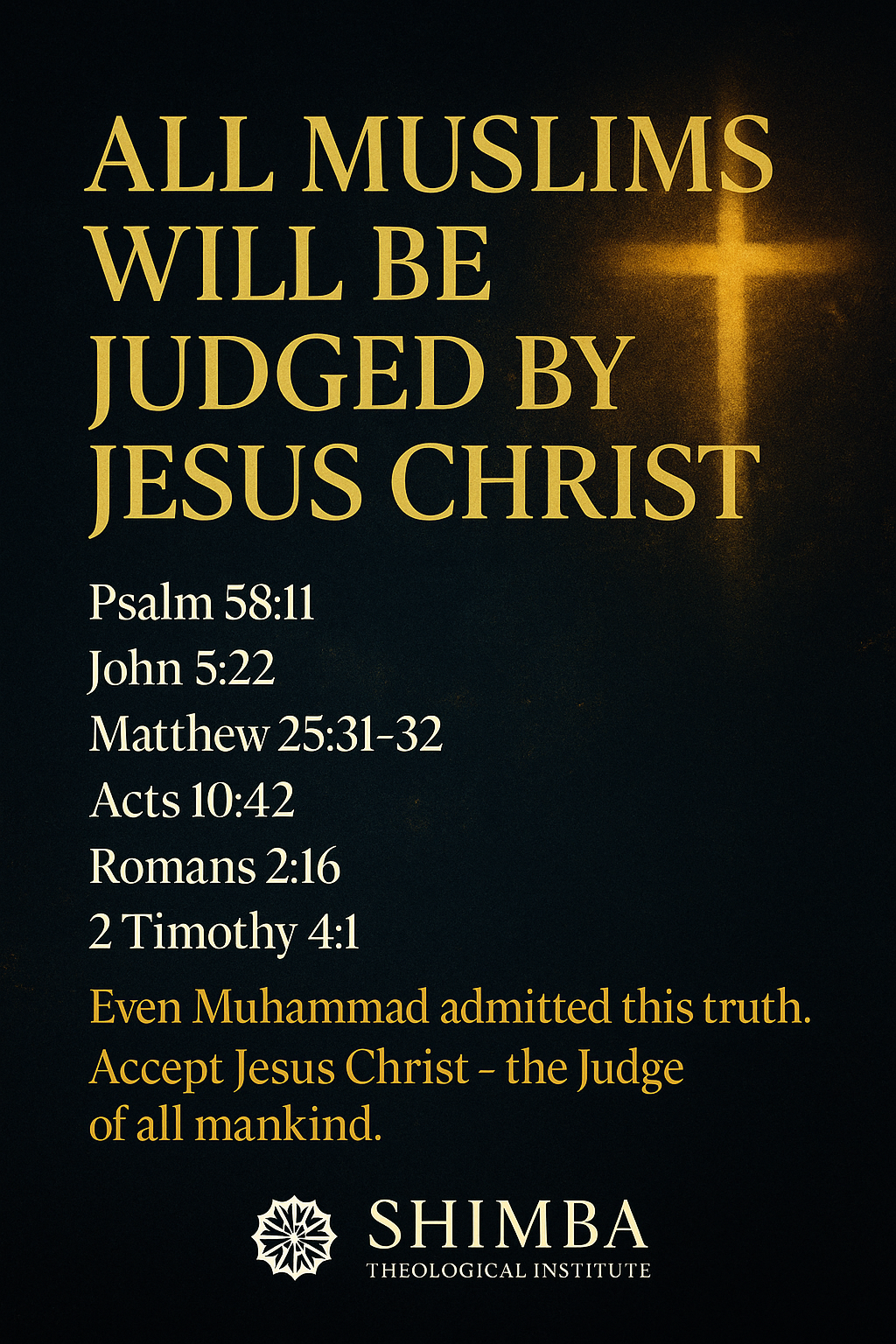
ALL MUSLIMS WILL BE JUDGED BY JESUS CHRIST


ALL MUSLIMS WILL BE JUDGED BY JESUS CHRIST

By Dr. Maxwell Shimba | Shimba Theological Institute

It is a remarkable and irrefutable truth revealed by both the Holy Bible and Islamic Hadith literature that Jesus Christ is the appointed judge of all mankind — both the living and the dead. What’s more astonishing is that even Muhammad, the prophet of Islam, admitted this fact.

Who Will Judge the World?

The Bible is unequivocal in declaring that Jesus Christ will one day judge the entire world, including Muhammad, Allah (as Muslims claim), all Muslims, all jinn, and every living and dead soul. Consider these scriptures:

  • Psalm 58:11"Surely there is a God who judges the earth."

  • Revelation 18:8"Therefore in one day her plagues will overtake her: death, mourning and famine. She will be consumed by fire, for mighty is the Lord God who judges her."

  • John 5:22"Moreover, the Father judges no one, but has entrusted all judgment to the Son."

  • Matthew 25:31-32"When the Son of Man comes in his glory, and all the angels with him, he will sit on his glorious throne. All the nations will be gathered before him, and he will separate the people one from another as a shepherd separates the sheep from the goats."

  • Acts 10:42"He commanded us to preach to the people and to testify that he is the one whom God appointed as judge of the living and the dead."

  • Romans 2:16"This will take place on the day when God judges people's secrets through Jesus Christ, as my gospel declares."

  • 2 Timothy 4:1"In the presence of God and of Christ Jesus, who will judge the living and the dead, and in view of his appearing and his kingdom, I give you this charge."

Islam’s Silent Admission: Jesus is the Righteous Judge

Interestingly, even in Islamic tradition, Jesus (Isa) is described as the one who will return to judge the world. The Sahih Muslim Hadith (Book 1, Hadith 293) states:

"By Him in Whose Hands my soul is, surely the son of Mary (Jesus) will soon descend among you and will judge mankind justly..."

This directly undermines the Islamic claim that Muhammad is the final authority or the last messenger with judgmental power. It raises a critical theological question: If Jesus is just a prophet according to Islam, why is He returning as the final righteous Judge of humanity?

Why Did Muhammad Seek Forgiveness 100 Times a Day?

Moreover, according to Sahih Muslim (Book 35, Hadith 6522), it is recorded that Muhammad himself admitted to having heavy sins weighing on his heart — seeking Allah’s forgiveness over a hundred times daily.

"Verily, sometimes I perceive a veil over my heart, and I supplicate Allah for forgiveness a hundred times a day."

If Muhammad was truly sinless and Allah’s greatest prophet, as Muslims assert, why did he fear his own sins and judgment to this extreme? This confession stands in stark contradiction to the nature of a true divine messenger, especially when compared to Jesus, who the Bible declares was without sin (Hebrews 4:15).

Is Allah the Judge or Is Jesus the Judge?

Another fundamental inconsistency lies within the Qur'an itself. If Allah is the supreme judge, why does the Qur'an and Hadith assign this monumental role to Jesus? Is Allah abdicating his divine role? Or is Islam inadvertently confirming that the true God has entrusted judgment to His Son, Jesus Christ, as the Bible consistently affirms?

This contradiction is not trivial — it reveals a foundational flaw within Islamic theology and challenges the credibility of Muhammad’s prophetic authority.

A Final Call

Why then reject Jesus Christ, the appointed judge of all creation, and follow a prophet who doubted his own salvation and begged for forgiveness repeatedly?

I urge all my Muslim brothers and sisters to reconsider the truth. The final judgment belongs to Jesus. It’s not a theological debate — it’s divine fact, confirmed by scripture and even acknowledged in Islamic tradition.

Accept Him now as your Lord and Savior while there is still grace. For on the day of judgment, it will be too late.

“For we must all appear before the judgment seat of Christ…” (2 Corinthians 5:10)


DO YOU KNOW WHY MUSLIMS PRAY FOR MUHAMMAD EVERY DAY?

 DO YOU KNOW WHY MUSLIMS PRAY FOR MUHAMMAD EVERY DAY?

Because Muhammad died with so many sins — more than any other creature.

In his book End of the Line, Reza Safa writes that in a Hadith, when Muhammad’s wife Khadijah asked him if his sins would be forgiven, Muhammad replied that he was not certain of his own forgiveness. How then could he forgive others’ sins?

MUHAMMAD SOUGHT FORGIVENESS 100 TIMES A DAY
In Sahih Muslim, Book 35, Hadith 6522, it says:
“The Messenger of Allah (peace be upon him) used to seek forgiveness from Allah 100 times a day.”

My brothers and sisters, every time I study Islam, I am filled with more and more doubts, because there seems to be no true good within this religion founded by Muhammad and Jibril (Gabriel).

What kind of sins did a man commit to the extent of seeking forgiveness from God 100 times a day?

Al-Agharr al-Muzani, one of the companions of the Prophet, reported that the Messenger of Allah (peace be upon him) said:
“Verily, sometimes a veil is cast over my heart, and I seek forgiveness from Allah a hundred times a day.”

Note — not only did tradition declare Muhammad a sinner, but he admitted to feeling a veil, or burden, upon his heart.
Yet the Qur'an declares Muhammad to be a perfect example of conduct.

So how could Muhammad have a sinful heart burdened with darkness?


Theological Argument Post by Dr. Maxwell Shimba, Shimba Theological Institute

Title:
Why Muhammad Cannot Be a True Prophet of the Holy God

As scholars of truth, we must test every religious claim against the revealed character of the one true God. Islam teaches that Muhammad was the final prophet, the “seal of the prophets.” Yet when we examine the foundational texts of Islam — the Qur'an and Hadith — what emerges is a troubling inconsistency.

1. A Prophet Plagued by Sin Cannot Be the Spokesman of a Holy God
The Bible teaches that God’s prophets were called to be blameless before Him. When prophets sinned (as David did), they publicly repented and pointed people to the Holy God. Yet, Muhammad confessed to being overwhelmed by sin — to the extent that he sought forgiveness over 100 times a day (Sahih Muslim 6522). A man so consumed with guilt cannot be the vessel for God’s perfect, final revelation.

2. Muhammad’s Uncertainty of Forgiveness Contradicts Divine Assurance
According to tradition, when Khadijah asked Muhammad if his sins were forgiven, he admitted uncertainty. This flies in the face of the biblical doctrine of a loving God who assures His servants of forgiveness (Isaiah 1:18, 1 John 1:9). A true prophet would have clarity about his standing before God.

3. The Qur'an’s Double Standard
The Qur'an calls Muhammad a “beautiful pattern of conduct” (Surah 33:21), yet he confesses to carrying a burden of sin and guilt. How can one both be the ultimate moral model and simultaneously admit to a veiled, sin-darkened heart? This contradiction is theological dissonance, undermining Muhammad’s claim to prophethood.

4. The Flawed Doctrine of Intercession
Islam claims Muhammad will intercede for Muslims on Judgment Day, yet if Muhammad was unsure of his own salvation, how could he plead for others? Hebrews 7:25 declares only Christ, the sinless Son of God, as able to intercede for humanity.

5. Is Allah the Father?
Islam denies the fatherhood of God. Yet Jesus called God His Father, spoke of His unique relationship with Him, and taught His followers to pray “Our Father” (Matthew 6:9). Islam’s refusal to acknowledge God as Father divorces it from the true revelation of God in Scripture and exposes its theological poverty.

Conclusion:
The evidence from Islamic texts themselves refutes Muhammad’s claim to be a true prophet of the living God. His daily desperation for forgiveness, his uncertainty of salvation, and his confession of a veiled heart are marks of a man in need of redemption — not the final messenger of a holy and perfect God.

Truth is not afraid of examination. The time to search is now.

By Dr. Maxwell Shimba
Founder, Shimba Theological Institute


A Theological Challenge to the Confusion in the Quran


📖 A Theological Challenge to the Confusion in the Quran

By Dr. Maxwell Shimba, Shimba Theological Institute

If the Qur’an is truly the literal, uncreated, direct words of Allah, then one glaring question emerges right from its very first chapter — Suratul Al-Fatihah:

👉 Why does Allah speak in the third person about Himself?

In Surah Al-Fatihah 1:2, it says:

“All praise is for Allah—Lord of all worlds.”

Wait — if Allah is speaking, why would He say ‘All praise is for Allah’ instead of ‘All praise is for ME’? Is Allah praising Himself from a distance? Or is another Allah being addressed? Or is someone else speaking here? This is a serious contradiction in the claim that every word of the Qur’an is directly from Allah.

It gets even more confusing in verse 6:

“Guide us along the Straight Path.”

Who is ‘us’ here?
Why would Allah pray to Himself for guidance?
Is this not an admission that even Allah needs guidance if He’s the one speaking? Or is someone else uttering these words? This verse completely contradicts the claim that it’s Allah Himself speaking directly throughout the Qur’an.

These inconsistencies raise disturbing theological problems for Islamic claims:

  • Is Allah praying to another Allah?

  • If it’s someone else speaking, then how can Muslims claim the Qur’an is entirely the unfiltered words of Allah?

  • If Jesus is called a Muslim by the Qur’an, why did He refer to God as ‘Father’ — something considered blasphemy in Islam?

  • Is Allah a Father? If not, how can Jesus, whom the Qur’an honors, break this core tenet?

These are not mere polemics — these are legitimate, necessary theological inquiries for truth seekers.

Islam claims consistency, yet the very foundation of its scripture contradicts itself in tone, voice, and narrative perspective.

We challenge our Muslim friends and scholars:
👉 Who is really speaking in Surah Al-Fatihah?
👉 Who is being praised?
👉 Who is being asked for guidance?

If the Qur'an is from Allah alone, these contradictions demand honest answers.

Truth withstands scrutiny. Lies collapse under it.

📚 By Dr. Maxwell Shimba
Shimba Theological Institute


Contradictions in the Quran: A Theological and Textual Examination

Contradictions in the Quran: A Theological and Textual Examination By Dr. Maxwell Shimba, Shimba Theological Institute Introduction Muslims ...

TRENDING NOW