Wednesday, May 21, 2025

The Creation Contradictions of the Quran vs. The Infallible Consistency of the Bible

 The Creation Contradictions of the Quran vs. The Infallible Consistency of the Bible

By Dr. Maxwell Shimba | Shimba Theological Institute

It’s astounding how easily overlooked the contradictions within the Quran become when weighed against the flawless, divinely preserved narrative of the Bible. Let’s examine one such fundamental doctrine: the origin of man.

The Quran, often hailed as a book of perfection, presents no fewer than seven conflicting accounts of what man was created from:

  1. From Nothing (Surah 19:67)

  2. From a Clot of Blood (Surah 96:2)

  3. From Water (Surah 21:30)

  4. From a Small Seed (Surah 16:4)

  5. From Clay and Mud (Surah 15:26)

  6. From Dust (Surah 3:59)

  7. From Earth (Surah 11:61)

The unavoidable question remains — which one is true? A book that claims divine origin should not contradict itself on something so foundational as the creation of humanity.

In stark contrast, the Bible delivers a single, consistent, and profoundly theological account:

Genesis 2:7“Then the LORD God formed man from the dust of the ground and breathed into his nostrils the breath of life, and the man became a living being.”

One narrative, one truth, one Creator — Yahweh. The Biblical account is not only harmonious but also deeply spiritual, connecting man’s creation to the very breath of God. It paints a relational picture: man is not just matter, but a divine image-bearer (Genesis 1:27), crafted with purpose and destined for fellowship with his Creator.

Why does the Quran suffer such inconsistencies?
Because it lacks divine inspiration. A true word from God, like the Bible, is infallible, coherent, and unified from Genesis to Revelation. Its fulfilled prophecies, archaeological confirmations, historical integrity, and unbroken narrative affirm its heavenly authorship.

The Quran, cobbled together over 23 years through situational revelations and political motives, inevitably falls into contradiction and confusion. Even Muslim scholars debate these inconsistencies.

Why trust the Bible?
Because it is “God-breathed and useful for teaching, rebuking, correcting, and training in righteousness” (2 Timothy 3:16). It withstands the tests of time, science, history, and logic. It reveals a loving, personal God who offers salvation through Jesus Christ — not a distant deity obsessed with submission and fear.

To every truth-seeker: abandon the contradictions and step into the light of eternal truth. The Bible is the unshaken Word of God, Yahweh the true Creator, and Jesus the only Savior.


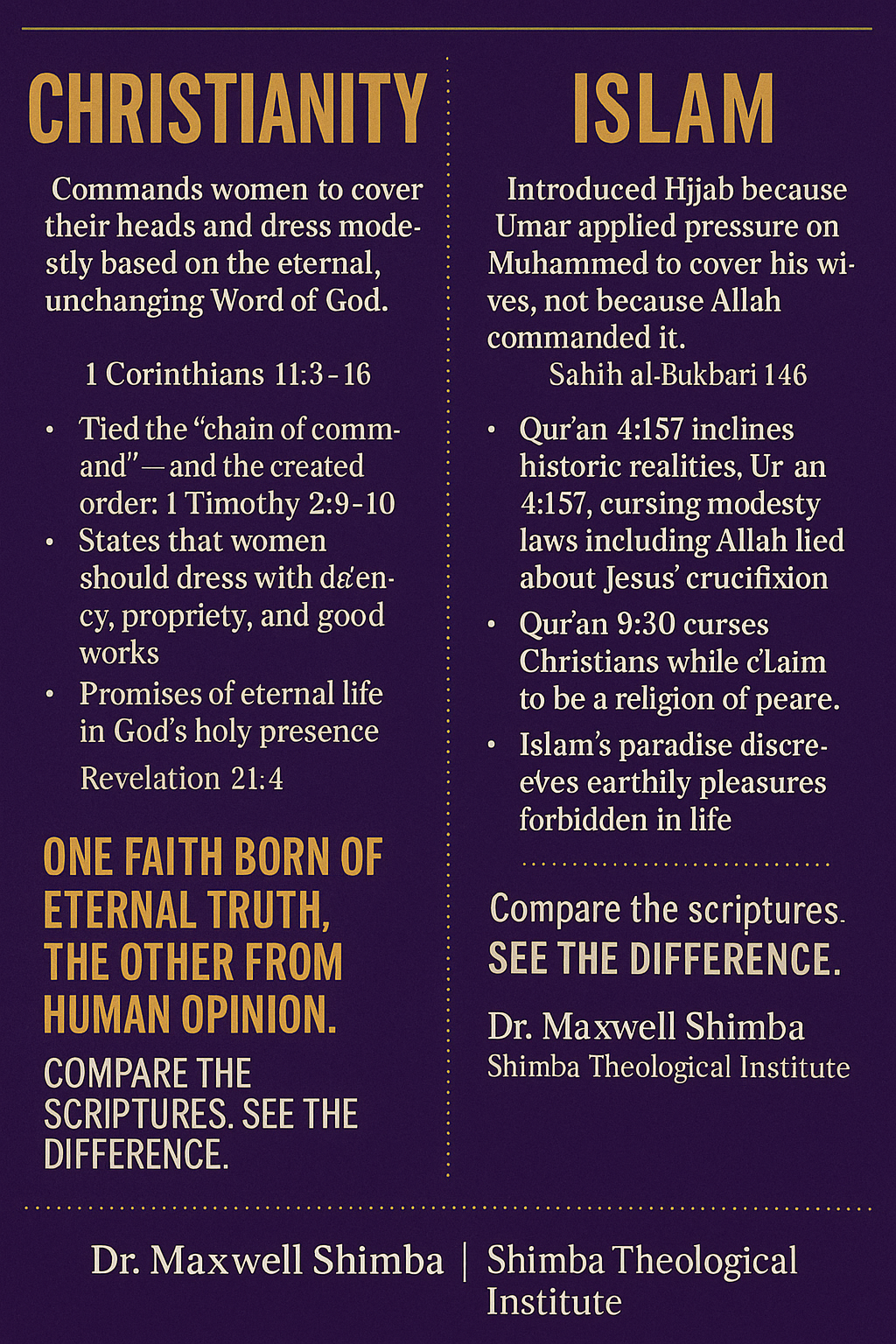
Christianity vs. Islam: A Matter of Truth, Authority, and Divine Integrity

 Christianity vs. Islam: A Matter of Truth, Authority, and Divine Integrity

By Dr. Maxwell Shimba | Shimba Theological Institute

When we examine Christianity and Islam side by side, it becomes clear that one faith rests on the eternal, unchanging Word of God, while the other is built on flawed traditions and inconsistent revelations.

In Christianity, the command for women to dress modestly and cover their heads isn’t rooted in the whims of man but in divine order and eternal truth. 1 Corinthians 11:3-16 establishes a heavenly “chain of command”: God, Christ, man, woman. The Apostle Paul ties this teaching to creation itself — woman was made for man (Genesis 2:21-23), and her long hair is given as a covering, a symbol of glory and submission to God’s design. Furthermore, 1 Timothy 2:9-10 calls women to dress with decency, propriety, and good works, reflecting godly character, not merely external appearance.

In Islam, however, modesty laws were not divinely ordained from eternity past but introduced due to the human intervention of Umar ibn Al-Khattab. According to Sahih al-Bukhari 146, it was Umar who spied on Muhammad’s wife, Sauda, and pressured Muhammad to have women cover themselves. Only after this did the so-called “revelation” about Hijab come down. This is not the act of an omniscient God but a reaction to social pressures — proof that Islam’s moral codes are circumstantial, not transcendent.

Moreover, the Quran contradicts itself and historic realities:

  • Qur'an 4:157 denies the crucifixion of Jesus, despite overwhelming eyewitness testimony recorded in all four Gospels and confirmed by secular historians like Tacitus and Josephus.

  • Qur'an 9:30 curses Jews and Christians, calling for hostility, while Matthew 5:44 teaches Christians to love their enemies and pray for those who persecute them — a higher, divine ethic unmatched in the Quran.

  • Islam’s paradise promises earthly pleasures forbidden in life (wine, countless women), revealing a carnal, man-centered religion, whereas Christianity offers eternal life in God’s holy presence, where “there will be no more death, mourning, crying, or pain” (Revelation 21:4).

Christianity stands on prophetic fulfillment, historical integrity, and divine revelation unchanged for millennia. Islam, by contrast, is a patchwork of tribal customs, contradictory hadiths, and altered doctrines aimed to consolidate power, not reveal God’s heart.

The Verdict?
Yahweh is the eternal, unchanging, holy God. His Word stands forever (Isaiah 40:8). Jesus is Lord, the final and greatest revelation (Hebrews 1:1-3). Islam’s shifting standards and flawed origins betray its human authorship.

Choose the truth. Choose Christ.

Caption suggestion for graphic:
“One Faith Born of Eternal Truth, the Other from Human Opinion. Compare the Scriptures, See the Difference.”


Is the Islamic Night Journey (Isra and Mi'raj) a credible divine event or a patched-up legend?

 By Dr. Maxwell Shimba — Shimba Theological Institute

Debate Topic: Is the Islamic Night Journey (Isra and Mi'raj) a credible divine event or a patched-up legend?

Muslim Claim:
Muslims assert that Muhammad was miraculously taken from Mecca to Jerusalem and ascended to heaven in a single night, encountering prophets and receiving commands, including the five daily prayers.

Theological Problem:
According to Sahih al-Bukhari Hadith 7517, the Night Journey is said to have occurred before the Divine Inspiration was revealed to him. That alone disqualifies the event’s divine legitimacy — how could a man not yet declared a prophet be taken on a prophetic journey?

Islamic scholars themselves scrambled to fix this blunder. Notice the highlighted addition: “i.e. after The Divine Inspiration was revealed to him” — clearly a later correction to mask the inconsistency.

Biblical Standard:
In Scripture, prophetic missions and heavenly encounters occur after divine calling and commissioning — Moses at the burning bush (Exodus 3), Isaiah’s heavenly vision (Isaiah 6), and Paul’s Damascus encounter (Acts 9). No man entered God’s council chambers without first being appointed and sanctified.

Logical Flaw:
If Muhammad wasn’t yet commissioned by God, who took him? By whose authority did he ascend? In 1 Kings 22:19-23, even lying spirits need permission from Yahweh. The unverified timing in Hadith 7517 reveals this was no divine mission but a crafted legend, later corrected to avoid theological embarrassment.

Christian Response:
God operates with order and clarity, not confusion (1 Corinthians 14:33). The Night Journey contradicts both biblical patterns and its own sources. The absence of prophetic commissioning prior to such an event makes it void by divine law and biblical precedent.

Closing Argument:
The so-called Night Journey stands as an artificial narrative, inconsistent with both scriptural authority and Islamic authenticity. It’s another case of retrofitting doctrine to fix doctrinal fractures.

To those in pursuit of truth — Yahweh’s ways are transparent, His Word unchanging, and His Son the only true Mediator between God and man (1 Timothy 2:5). No fabricated tales or retroactive edits can substitute the eternal gospel.

Caption suggestion:
“The Night Journey: A Legend Built on Contradiction. Truth doesn’t need fixing.”


Yahweh Answers. False gods stay silent. Choose wisely

 By Dr. Maxwell Shimba — Shimba Theological Institute

Yahweh, the one true and eternal God of Abraham, Isaac, and Jacob, boldly declares in Isaiah 45:5, “I am the LORD, and there is no other; apart from Me there is no God.” Yet today, Islam parades Allah as "the same God," while denying the Son, rewriting sacred history, and enticing its followers with a heaven of earthly sins — wine, women, and lust — things their god forbids on earth but apparently glorifies in the afterlife. A holy bribe, not holiness.

This isn’t new. In 1 Kings 18, the prophets of Baal called out to their god with no answer, while Elijah prayed once — and fire from heaven fell. Yahweh responds. False gods remain silent.

The Quran denies the crucifixion of Jesus Christ (Quran 4:157), suggesting a decoy was crucified in His place — a plot twist so absurd no historian or eyewitness testimony supports it. Over 500 people saw the risen Christ (1 Corinthians 15:6). Islam ignores fact in favor of fable.

And while claiming to be a religion of peace, the Quran curses Christians and Jews (Quran 9:30). It’s not peace — it’s a system of submission built on fear, denial of God’s Son, and counterfeit promises.

Revelation 18:4 warns: “Come out of her, My people, so that you will not share in her sins.” This is modern Babylon — a false religion built on rejecting the Son and exalting man’s desires.

And when Christ returns in Revelation 19, it won’t be for tolerance summits and coexist bumper stickers. The Rider on the white horse comes for judgment.

To every Muslim reading this: ask yourself — why would your god promise you in paradise the very sins he forbids on earth? A holy God doesn’t trade in hypocrisy.

Yahweh alone is God. Jesus is Lord. And no, He doesn’t need to borrow fables from desert legends.

Tuesday, May 20, 2025

HOW CAN A PROPHET WHO DOESN’T KNOW HIS OWN DESTINY LEAD OTHERS TO SALVATION?

 HOW CAN A PROPHET WHO DOESN’T KNOW HIS OWN DESTINY LEAD OTHERS TO SALVATION?

The Qur’an, in its own words, exposes a fatal contradiction at the very heart of Islam’s claim to finality in prophethood. In Surah Al-Ahqaf 46:9, Muhammad admits:

"Say: I am not something original among the messengers, nor do I know what will be done with me or with you. I only follow that which is revealed to me, and I am only a clear warner." (Qur'an 46:9)

Pause and consider this critically — how can Muhammad be declared the "Seal of the Prophets" (Qur'an 33:40) when he himself confesses uncertainty about his eternal fate? A prophet of the true God does not live in such tragic ignorance.

Every authentic prophet in the Bible knew their standing before the LORD. David declared with confidence, “Surely goodness and mercy shall follow me all the days of my life, and I will dwell in the house of the LORD forever” (Psalm 23:6). Paul proclaimed, “I have fought the good fight, I have finished the race, I have kept the faith. Now there is in store for me the crown of righteousness…” (2 Timothy 4:7-8).

But Muhammad? His own lips confessed uncertainty.

How then can he claim to bring assurance to anyone else?
How can Islam guarantee paradise when its very founder was left in the dark about his own eternal outcome?

This alone disqualifies Muhammad’s prophethood in its entirety. A prophet who doesn’t know his destiny, who was poisoned to death (Sahih al-Bukhari 4428), and whose revelations were tampered by Satan (as recorded in The History of Al-Tabari) is no prophet at all.

The true Prophet, Priest, and King is Jesus Christ, who declared with authority: "I am the resurrection and the life. Whoever believes in me will live, even though they die" (John 11:25). He knew His purpose, His destiny, and the salvation He secured for His followers.

To my Muslim friends — I urge you to weigh this reality. A prophet without assurance of his own fate cannot be your guide to eternity. It is time to seek the true and living God.

Dr. Maxwell Shimba
Shimba Theological Institute


HOW MUCH CLEARER DO YOU WANT IT TO BE?

 HOW MUCH CLEARER DO YOU WANT IT TO BE?

The evidence lies openly within Islam’s own texts. The Qur’an boldly declares in Surah Al-Haaqqa 69:44-46:

"And if Muhammad had made up about Us some [false] sayings, We would have seized him by the right hand; Then We would have cut from him the aorta."

Astonishingly, centuries later in Sahih al-Bukhari 4428, we find Muhammad himself on his deathbed confessing to Aisha:

"O Aisha! I still feel the pain caused by the food I ate at Khaibar, and at this time, I feel as if my aorta is being cut from that poison."

Is this mere coincidence — or divine fulfillment of the Qur'an’s own curse upon a false prophet? Islam's most authentic hadith confirms that Muhammad died in the precise manner foretold for one who would fabricate sayings against Allah.

Further damning evidence comes from The History of Al-Tabari (Vol. 6), where it’s recorded that Satan had infiltrated Muhammad’s so-called revelations — the infamous Satanic Verses episode. Muhammad admitted to fabricating verses under satanic influence, words Allah allegedly never spoke.

As Christians, we cannot stay silent. The God of Abraham, Isaac, and Jacob never contradicts Himself. His prophets were proven by their truthfulness, divine revelations, and miraculous works. In contrast, what Islam preserves is a tragic testimony to a self-confessed man claiming inspiration from a spirit he could not discern.

This is why we declare — Allah of Islam is not the God of the Bible. Muhammad was not a prophet of the Most High. This generation must be awakened to the truth.

Jesus Christ remains the Way, the Truth, and the Life (John 14:6). No other foundation stands.

Dr. Maxwell Shimba
Shimba Theological Institute


THE GOLDEN IMAGE OF BABYLON REBORN IN MECCA

 By Dr. Maxwell Shimba | Shimba Theological Institute

THE GOLDEN IMAGE OF BABYLON REBORN IN MECCA

In Daniel 3:18, the faithful men of God boldly declared to King Nebuchadnezzar:

“But even if He does not, we want you to know, Your Majesty, that we will not serve your gods or worship the image of gold you have set up.”

These courageous words were spoken in defiance of idol worship — a golden image set up by a king who demanded all people bow before it, an act that stood in total rebellion against the living God’s commandment:

“You shall not make for yourself a carved image, or any likeness of anything that is in heaven above, or that is in the earth beneath… you shall not bow down to them or serve them.” (Exodus 20:4-5)

Now, fast forward centuries later… what do we see in Mecca?

A black stone housed within the Kaaba — an object venerated by millions who circumambulate it, bow to it, and kiss it, believing it holds divine significance. And yet, no command from the true and living God was ever given to establish such an act.

Where did this practice originate?
History reveals that long before Prophet Muhammad, the Kaaba housed over 360 idols. Muhammad simply repurposed the structure, leaving the Black Stone, a pre-Islamic pagan relic, at its heart.

What Nebuchadnezzar commanded in Babylon has resurfaced in Mecca — men and women gathering around a man-made object, bowing, prostrating, and kissing a lifeless stone in the name of religion.

This is nothing less than idol worship.

Jesus taught us that “God is Spirit, and His worshipers must worship in Spirit and in truth.” (John 4:24) Not with stones, relics, or images.

To Christians and seekers of truth:
Understand that the living God is not confined to a stone in the desert. He reigns from heaven, and He abhors images and objects being revered in His name.

As in Daniel’s day, true believers must stand firm and declare:
“We will not bow to your Kaaba, nor kiss your stone, nor serve any gods made by human hands.”

The spirit of Babylon lives on — but so does the Spirit of the Most High God.

Choose this day whom you will serve.


Is the Qur'an Truly a Clear Explanation of All Things? A Theological Challenge

 Is the Qur'an Truly a Clear Explanation of All Things? A Theological Challenge

By Dr. Maxwell Shimba
Shimba Theological Institute

The Qur'an boldly claims in Surah An-Nahl 16:89:

"And We have sent down to you the Book (the Qur'an) as an explanation of everything, a guidance, a mercy, and glad tidings for those who submit to Allah."

Yet when tested against its own words, grave contradictions and omissions become unmistakably clear.

Take for example Surah As-Saffat 37:107, which says:

"And We redeemed him with a great sacrifice."

This verse raises critical theological and textual problems:

  1. Who is the "him"?
    The Qur'an refuses to name the son. Muslims claim it's Ishmael, but the text is silent. If the Qur'an is "a clear explanation of everything," why does it conceal this essential identity while the Bible openly names Isaac (Genesis 22:2)?

  2. To whom did Allah offer this sacrifice?
    In every act of sacrifice, a being greater or sovereign receives it. The Qur'an offers no answer. If Allah is supreme, to whom is He sacrificing? This silence unravels the claim of divine clarity.

  3. What was the 'great sacrifice'?
    No detail is given. Was it a ram? A lamb? If this is a pivotal prophetic moment, why does the Qur'an, which claims total explanation, leave it vague?

If Surah 16:89 asserts that the Qur'an explains everything, then by its own standard, it has failed this theological test. It neither identifies the person, the recipient, nor the nature of the sacrifice.

Unlike the Bible, where God speaks clearly to His prophets, names His subjects, and explains His actions in full context, the Qur'an remains riddled with ambiguities and gaps. The God of Abraham, Isaac, and Jacob never dealt in vague, unexplained messages. Every prophecy pointed to Christ — the Lamb of God — whose identity, mission, and sacrifice are unmistakably revealed.

Therefore, if a holy book claims to explain everything but cannot answer fundamental questions from its own verses, how reliable is it as a revelation from the true God?

This is not merely a critique — it is a theological invitation to those bound by tradition to examine the Scriptures that speak plainly, clearly, and redemptively through the person of Jesus Christ — Prophet, Priest, King, and God.


JESUS CHRIST: THE PROPHET, THE PRIEST, THE KING, AND GOD INCARNATE

 JESUS CHRIST: THE PROPHET, THE PRIEST, THE KING, AND GOD INCARNATE

By Dr. Maxwell Shimba
Shimba Theological Institute

Throughout Scripture, Jesus is revealed in His divine fullness — not merely as a prophet, nor simply a priest or king, but as God manifested in the flesh (1 Timothy 3:16). The testimony of the Bible is rich, consistent, and glorious in proclaiming His supreme identity:

1. JESUS IS THE PROPHET
Moses foretold His coming:
"The LORD your God will raise up for you a prophet like me from among you, from your fellow Israelites. You must listen to him." (Deuteronomy 18:15)
The New Testament confirms this in Acts 3:22–23 and John 6:14, where the people recognized Him as “the Prophet who is to come into the world.” Jesus didn’t merely bring the word of God — He is the Word of God (John 1:1).

2. JESUS IS THE PRIEST
Unlike the priests of old, who had to atone for their own sins, Jesus is the sinless High Priest who offered Himself as a perfect, once-for-all sacrifice for humanity’s redemption:
"We have a great high priest who has ascended into heaven, Jesus the Son of God." (Hebrews 4:14)
He stands in the eternal order of Melchizedek, whose priesthood is unending and superior (Hebrews 7:17).

3. JESUS IS KING OF KINGS
Not a mere earthly ruler, but the sovereign King who reigns eternally:
"On His robe and on His thigh He has this name written: KING OF KINGS AND LORD OF LORDS." (Revelation 19:16)
He alone holds dominion over every kingdom, power, and authority, and at His return, every knee will bow and every tongue confess His lordship (Philippians 2:10-11).

4. JESUS IS GOD THE WORD
The crowning glory of the Christian confession is that Jesus is God incarnate.
"The Word became flesh and made his dwelling among us." (John 1:14)
And as Titus 2:13 proclaims, “we wait for the blessed hope—the appearing of the glory of our great God and Savior, Jesus Christ.”
The deity of Christ is the cornerstone of biblical theology, distinguishing Christianity from every other world religion.


This is the Christ we proclaim at Shimba Theological Institute — the Prophet who speaks the truth, the Priest who mediates eternal redemption, the King who reigns supreme, and the eternal God who came to save.

Do you know Him? Have you made Him your Lord?

Dr. Maxwell Shimba
Founder & President, Shimba Theological Institute


Was Muhammad Truly a Prophet? A Theological Examination

 Was Muhammad Truly a Prophet? A Theological Examination

By Dr. Maxwell Shimba | Shimba Theological Institute

Throughout the Bible — from Genesis to Revelation — God spoke directly to His prophets. To Adam in the Garden (Genesis 3:9), to Noah about the flood (Genesis 6:13), to Abraham about the covenant (Genesis 17:1-4), to Moses face-to-face (Exodus 33:11), to Samuel (1 Samuel 3:10), to Isaiah in a vision (Isaiah 6:8), and to all prophets who boldly declared: “Thus says the LORD.” These men were marked by direct divine communication and prophetic utterance under God’s authority.

But when we turn to Muhammad and the Qur'an — a glaring contradiction emerges.
Nowhere in the Qur'an do we find a single instance of Allah speaking directly to Muhammad as the God of the Bible did to His prophets. The Qur'an claims that Jibreel (Gabriel) brought messages to Muhammad, yet — critically — there is no recorded dialogue between Allah and Jibreel within the Qur'an itself. The chain of transmission is ambiguous, undocumented, and theologically unstable.

Ask yourself: If Muhammad was the greatest prophet as Muslims claim, why did Allah never speak to him directly — not even once?
Even the Qur'an admits in Surah 42:51:
“It is not fitting for a man that Allah should speak to him except by inspiration, or from behind a veil, or by sending a messenger to reveal, with His permission, what He wills.”

Yet this contradicts the biblical record. The God of Abraham, Isaac, Jacob, Moses, David, and Jesus did not hide behind veils or intermediaries — He spoke directly to His chosen ones.

Furthermore — no Qur'anic verse documents Jibreel receiving messages from Allah. Who witnessed these communications? Where’s the verification? In biblical tradition, prophetic messages were public, confirmed, and accountable. Muhammad’s claimed revelations, on the other hand, were private and unverifiable, often changing according to convenience (Surah 2:106).

Moreover, if Allah is the same God of the prophets, why does the Qur'an deny key prophetic doctrines?

  • It denies the Sonship of Christ (Surah 4:171), while biblical prophecy centers on the coming Messiah, the Son of God (Isaiah 9:6, Psalm 2:7).

  • It rejects the atoning death of Jesus, the cornerstone of prophetic fulfillment (Isaiah 53, Daniel 9:26).

  • It reduces prophets like Jesus and Moses to mere messengers stripped of their biblical majesty.

Therefore, theological and scholarly evidence leads to a firm conclusion: Muhammad was not a prophet of the God of the Bible. He operated under a different theological framework, promoting a god alien to the prophetic line that culminated in Jesus Christ — the Judge of the living and the dead (Acts 10:42).

The God of the Bible speaks. Allah of the Qur'an hides. The God of Scripture verifies. The Qur'an speculates. The prophets of the Bible prophesy in public. Muhammad claimed secret revelations.

The true test of a prophet is his message's consistency with the eternal Word of God and the prophetic witness before him (Deuteronomy 18:20-22). On this test, Muhammad falls short.

Reject deception. Embrace the living God revealed in Jesus Christ.

Dr. Maxwell Shimba
Founder, Shimba Theological Institute


Jesus demonstrated He is God


TRENDING NOW