Wednesday, May 21, 2025

The Love of Jesus: A Reflection on Divine Compassion and Sacrifice


The Love of Jesus: A Reflection on Divine Compassion and Sacrifice

The love of Jesus Christ is the foundation of the Christian faith, embodying sacrificial, unconditional, and transformative love. This love transcends human understanding and offers salvation, healing, and eternal life to all who believe in Him. Below, we explore the profound love of Jesus with supporting Bible verses.


1. Unconditional Love

Jesus' love is not based on human merit but freely given to everyone, regardless of their past or current state. He loves us at our worst and calls us to experience His grace.

Romans 5:8:
"But God demonstrates his own love for us in this: While we were still sinners, Christ died for us."

This verse highlights that Jesus loved humanity so deeply that He gave His life even when we were undeserving.


2. Sacrificial Love

The ultimate demonstration of Jesus' love is found in His sacrificial death on the cross. This act paid the penalty for humanity's sins and reconciled us with God.

John 15:13:
"Greater love has no one than this: to lay down one’s life for one’s friends."

Jesus willingly bore the weight of sin and death, showing the greatest act of love through His sacrifice.

John 3:16:
"For God so loved the world that he gave his one and only Son, that whoever believes in him shall not perish but have eternal life."

This well-known verse captures the essence of Jesus' love for humanity, a love that leads to eternal life for those who believe in Him.


3. Healing and Compassionate Love

Throughout His ministry, Jesus demonstrated love through acts of compassion, healing the sick, feeding the hungry, and comforting the brokenhearted.

Matthew 14:14:
"When Jesus landed and saw a large crowd, he had compassion on them and healed their sick."

His love was not only spiritual but also tangible, addressing the immediate needs of those around Him.

Luke 19:10:
"For the Son of Man came to seek and to save the lost."

Jesus’ mission was driven by His love for the lost, showing that no one is beyond the reach of His care.


4. A Love That Forgives

Jesus’ love is forgiving, erasing the sins of those who repent and believe. His forgiveness extends even to those who wronged Him, as seen during His crucifixion.

Luke 23:34:
"Jesus said, ‘Father, forgive them, for they do not know what they are doing.’"

This prayer demonstrates that Jesus' love is unyielding, even in the face of rejection and suffering.

Ephesians 1:7:
"In him we have redemption through his blood, the forgiveness of sins, in accordance with the riches of God’s grace."


5. Everlasting Love

Jesus’ love is eternal and unchanging. It provides hope and assurance for believers, promising a future with Him in glory.

Romans 8:38-39:
"For I am convinced that neither death nor life, neither angels nor demons, neither the present nor the future, nor any powers, neither height nor depth, nor anything else in all creation, will be able to separate us from the love of God that is in Christ Jesus our Lord."

This passage reassures us that no force in existence can separate us from the love of Jesus.


6. A Love That Calls for Imitation

Jesus calls His followers to emulate His love in their relationships with others.

John 13:34-35:
"A new command I give you: Love one another. As I have loved you, so you must love one another. By this everyone will know that you are my disciples, if you love one another."

Through loving others, believers reflect the love of Jesus and serve as a testament to His transformative power.


Conclusion

The love of Jesus Christ is the ultimate example of divine love—sacrificial, forgiving, healing, eternal, and unconditional. It is a love that saves and sustains, offering hope and purpose to all who receive it.

As believers, we are called to dwell in this love and share it with the world. The Apostle Paul beautifully summarizes this in Ephesians 3:17-19:
"And I pray that you, being rooted and established in love, may have power, together with all the Lord’s holy people, to grasp how wide and long and high and deep is the love of Christ, and to know this love that surpasses knowledge—that you may be filled to the measure of all the fullness of God."

Jesus' love is an invitation to a relationship with God, a source of comfort in trials, and the key to eternal life. Let us cherish and proclaim this love daily.

Understanding "Ehyeh Asher Ehyeh"

 The phrase "I AM WHO I AM" from Exodus 3:14 in the Hebrew text is written as אֶהְיֶה אֲשֶׁר אֶהְיֶה (Ehyeh Asher Ehyeh). This phrase is deeply significant in biblical theology and reveals profound truths about God's nature and existence.

Understanding "Ehyeh Asher Ehyeh"

  1. Literal Translation:

    • Ehyeh: This is the first-person singular form of the Hebrew verb "to be" (hayah), which means "I am," "I will be," or "I exist."

    • Asher: This is a relative pronoun in Hebrew, which can mean "who," "that," or "which."

    • Together, Ehyeh Asher Ehyeh can be translated as:

      • "I Am Who I Am"

      • "I Will Be Who I Will Be"

      • "I Exist Because I Exist"

  2. Theological Implication:

    • This phrase underscores God's eternality and self-existence. He is not caused or dependent on anything; He simply is.

    • It conveys that God's nature is unchanging and infinite. He is always present and active in His creation, transcending time and space.

  3. Name of God:

    • In this passage, God identifies Himself to Moses with a name tied to His being. The name YHWH (Yahweh), often translated as "The LORD" in English Bibles, is derived from the same root verb (hayah, "to be"). Thus, "Ehyeh Asher Ehyeh" is a declaration of God's name and essence.


The Link to Jesus as "I AM"

When Jesus declares in John 8:58, “Before Abraham was, I AM,” He uses the Greek equivalent (Ego Eimi), directly connecting Himself to the divine name revealed in Exodus 3:14. This statement caused outrage among the Jews, as they understood it as a claim to deity. Jesus was asserting that He is eternal and self-existent, just as Yahweh revealed Himself to Moses.


Key Lessons from "Ehyeh Asher Ehyeh"

  1. God's Self-Sufficiency:

    • God is not reliant on anything in creation. He is complete in Himself.

  2. God's Eternal Presence:

    • Whether in the past, present, or future, God is always I AM. He is timeless and unchanging.

  3. Our Dependency on God:

    • While God exists independently, all creation relies on Him for its existence and sustenance.

In essence, Ehyeh Asher Ehyeh reveals the profound mystery and majesty of God's eternal nature, while Jesus' use of the title "I AM" confirms His divinity as the eternal, self-existent God.

The Love of God: An Everlasting Assurance


The love of God is central to the Christian faith, reflecting His nature and purpose for humanity. God's love is unparalleled, unconditional, and eternal, expressed through His actions, His Word, and His presence in our lives.


1. God's Love is Unconditional

God loves humanity not because of what we have done but because of who He is. His love is freely given, regardless of our flaws or failures.

Bible Reference:

  • Romans 5:8
    "But God demonstrates his own love for us in this: While we were still sinners, Christ died for us."

This verse reveals that God's love is proactive, reaching out to us even in our sinfulness.


2. God’s Love is Sacrificial

The ultimate demonstration of God's love is seen in the sacrifice of Jesus Christ, His only Son, to save humanity from sin and death.

Bible Reference:

  • John 3:16
    "For God so loved the world that he gave his one and only Son, that whoever believes in him shall not perish but have eternal life."

God's love led Him to give His most precious gift, ensuring salvation for those who believe in Him.


3. God’s Love is Everlasting

Unlike human love, which may waver, God's love endures forever. His commitment to His people is unwavering, and His promises are eternal.

Bible Reference:

  • Jeremiah 31:3
    "The LORD appeared to us in the past, saying: 'I have loved you with an everlasting love; I have drawn you with unfailing kindness.'"

This verse highlights the enduring and kind nature of God's love.


4. God's Love is Transformational

God’s love has the power to change lives, offering forgiveness, redemption, and a new beginning. It calls us to love others as He has loved us.

Bible Reference:

  • 1 John 4:19
    "We love because he first loved us."

Our ability to love stems from experiencing and understanding God's love.


5. God’s Love Provides Comfort and Protection

God's love is a refuge in times of trouble, a source of strength and peace. He watches over His children and is always present.

Bible Reference:

  • Psalm 36:7
    "How priceless is your unfailing love, O God! People take refuge in the shadow of your wings."

Here, God's love is depicted as a safe haven, offering security and comfort.


6. God’s Love is Patient and Kind

God’s love is patient, not wanting anyone to perish but for all to come to repentance. He shows compassion and mercy even when we stray.

Bible Reference:

  • 2 Peter 3:9
    "The Lord is not slow in keeping his promise, as some understand slowness. Instead, he is patient with you, not wanting anyone to perish, but everyone to come to repentance."

His patience demonstrates His deep love and desire for a relationship with us.


7. God’s Love is Inclusive

God's love extends to all people, regardless of race, nationality, or background. He desires for everyone to know Him and experience His love.

Bible Reference:

  • Galatians 3:28
    "There is neither Jew nor Gentile, neither slave nor free, nor is there male and female, for you are all one in Christ Jesus."

This verse affirms the inclusivity of God's love.


Conclusion: God’s Love Calls Us to Respond

God’s love invites us to trust in Him, live according to His ways, and share His love with others. It is a love that heals, restores, and gives eternal hope.

Final Bible Reference:

  • Romans 8:38-39
    "For I am convinced that neither death nor life, neither angels nor demons, neither the present nor the future, nor any powers, neither height nor depth, nor anything else in all creation, will be able to separate us from the love of God that is in Christ Jesus our Lord."

This assurance reminds us that God's love is unshakable and ever-present in every circumstance. Let us embrace His love and reflect it in our lives.

JESUS EXISTED BEFORE HE WAS BORN


The following is biblical evidence that JESUS CHRIST is God.

John 8:58
Jesus said to them, "Truly, truly, I say to you, before Abraham was, I AM."

"I AM" is a name that belongs to God alone. We first encounter this name when Moses spoke with God and was sent to deliver the Israelites from Egypt. It is written:

Exodus 3:13-14
Moses said to God, “Suppose I go to the Israelites and say to them, ‘The God of your fathers has sent me to you,’ and they ask me, ‘What is his name?’ Then what shall I tell them?” God said to Moses, “I AM WHO I AM. This is what you are to say to the Israelites: ‘I AM has sent me to you.’”

A human exists because God caused them to exist. A car exists because an engineer or designer caused it to exist. A house exists because a builder caused it to exist. But God simply EXISTS without being caused by anyone! That is why He says, "I AM WHO I AM!"

Jesus is "I AM." Therefore, He is God.

THOMAS DECLARES JESUS AS GOD, AND JESUS DOES NOT DENY BEING CALLED GOD


John 20:28

Thomas answered Him, “My Lord and my God!”

When Thomas said this, the Lord Jesus did not refute it or say, “I am not God.” Instead, Jesus responded:
“Because you have seen Me, you have believed; blessed are those who have not seen and yet have believed.” (John 20:29).

If Thomas was lying or mistaken, why didn’t Jesus correct him? Instead, Jesus affirmed Thomas’s declaration of faith.

All faith traditions agree that Jesus never sinned and had no sin. To claim divinity falsely would have been blasphemous and sinful. Therefore, by accepting Thomas’s declaration, Jesus affirmed His divine identity. This serves as undeniable biblical evidence that Jesus is God.

A Thanksgiving Message: "A Grateful Heart Pleases God"


A Thanksgiving Message: "A Grateful Heart Pleases God"

As we gather this Thanksgiving, let us reflect on the heart of gratitude that God desires from us. Gratitude is not just about saying "thank you"; it is a lifestyle that honors God, strengthens our faith, and reminds us of His goodness.

1. Gratitude in All Circumstances
The Bible says, "Give thanks in all circumstances; for this is God’s will for you in Christ Jesus" (1 Thessalonians 5:18). This verse encourages us to remain thankful not just in good times, but also in trials. Remember Paul and Silas in Acts 16:25. Despite being beaten and imprisoned, they prayed and sang hymns to God. Their gratitude opened the doors of deliverance. Gratitude has the power to break chains and bring freedom.

2. The Power of Remembering God's Goodness
In Luke 17:11-19, we read about the ten lepers healed by Jesus. While all ten were healed, only one—a Samaritan—returned to thank Him. Jesus said, "Were not all ten cleansed? Where are the other nine?" (Luke 17:17). This man received not only physical healing but also spiritual restoration. Thanksgiving draws us closer to God and deepens our relationship with Him.

3. God’s Faithfulness in Provision
The story of the Israelites wandering in the wilderness reminds us of God's faithfulness. Though they often complained, God still provided manna, quail, and water from a rock (Exodus 16). Let us not forget to thank Him for His daily provisions in our lives. Psalm 100:4 says, "Enter his gates with thanksgiving and his courts with praise; give thanks to him and praise his name." Thanksgiving opens the door to God's presence.

4. Jesus' Gratitude as Our Example
Even Jesus, the Son of God, showed us the importance of thanksgiving. Before feeding the 5,000, He gave thanks and multiplied the loaves and fish (John 6:11). Before raising Lazarus, He prayed, "Father, I thank you that you have heard me" (John 11:41). Jesus teaches us that gratitude precedes miracles.

Call to Action: Cultivating a Grateful Heart

This Thanksgiving, let us reflect on these questions:

  • Have we thanked God for His daily blessings, big and small?

  • Are we grateful even in the challenges, trusting that God is working for our good?

  • How can we express our gratitude through service, prayer, and praise?

Psalm 107:1 reminds us, "Give thanks to the LORD, for he is good; his love endures forever." Let this be our anthem as we gather with loved ones. Share testimonies, reflect on His goodness, and commit to living a life of thanksgiving.

Closing Prayer:
"Father, we come before You with grateful hearts, acknowledging Your love, mercy, and faithfulness. Thank You for the gift of salvation through Jesus Christ, for Your provision, and for Your presence in our lives. Help us to cultivate hearts of gratitude every day. May our thanksgiving glorify You and inspire others to know Your goodness. In Jesus' name, Amen."

This Thanksgiving, may we, like the one leper, return to Jesus with hearts full of gratitude, proclaiming, "Bwana wangu na Mungu wangu" (John 20:28). Amen.

The Creation Contradictions of the Quran vs. The Infallible Consistency of the Bible

 The Creation Contradictions of the Quran vs. The Infallible Consistency of the Bible

By Dr. Maxwell Shimba | Shimba Theological Institute

It’s astounding how easily overlooked the contradictions within the Quran become when weighed against the flawless, divinely preserved narrative of the Bible. Let’s examine one such fundamental doctrine: the origin of man.

The Quran, often hailed as a book of perfection, presents no fewer than seven conflicting accounts of what man was created from:

  1. From Nothing (Surah 19:67)

  2. From a Clot of Blood (Surah 96:2)

  3. From Water (Surah 21:30)

  4. From a Small Seed (Surah 16:4)

  5. From Clay and Mud (Surah 15:26)

  6. From Dust (Surah 3:59)

  7. From Earth (Surah 11:61)

The unavoidable question remains — which one is true? A book that claims divine origin should not contradict itself on something so foundational as the creation of humanity.

In stark contrast, the Bible delivers a single, consistent, and profoundly theological account:

Genesis 2:7“Then the LORD God formed man from the dust of the ground and breathed into his nostrils the breath of life, and the man became a living being.”

One narrative, one truth, one Creator — Yahweh. The Biblical account is not only harmonious but also deeply spiritual, connecting man’s creation to the very breath of God. It paints a relational picture: man is not just matter, but a divine image-bearer (Genesis 1:27), crafted with purpose and destined for fellowship with his Creator.

Why does the Quran suffer such inconsistencies?
Because it lacks divine inspiration. A true word from God, like the Bible, is infallible, coherent, and unified from Genesis to Revelation. Its fulfilled prophecies, archaeological confirmations, historical integrity, and unbroken narrative affirm its heavenly authorship.

The Quran, cobbled together over 23 years through situational revelations and political motives, inevitably falls into contradiction and confusion. Even Muslim scholars debate these inconsistencies.

Why trust the Bible?
Because it is “God-breathed and useful for teaching, rebuking, correcting, and training in righteousness” (2 Timothy 3:16). It withstands the tests of time, science, history, and logic. It reveals a loving, personal God who offers salvation through Jesus Christ — not a distant deity obsessed with submission and fear.

To every truth-seeker: abandon the contradictions and step into the light of eternal truth. The Bible is the unshaken Word of God, Yahweh the true Creator, and Jesus the only Savior.


Christianity vs. Islam: A Matter of Truth, Authority, and Divine Integrity

 Christianity vs. Islam: A Matter of Truth, Authority, and Divine Integrity

By Dr. Maxwell Shimba | Shimba Theological Institute

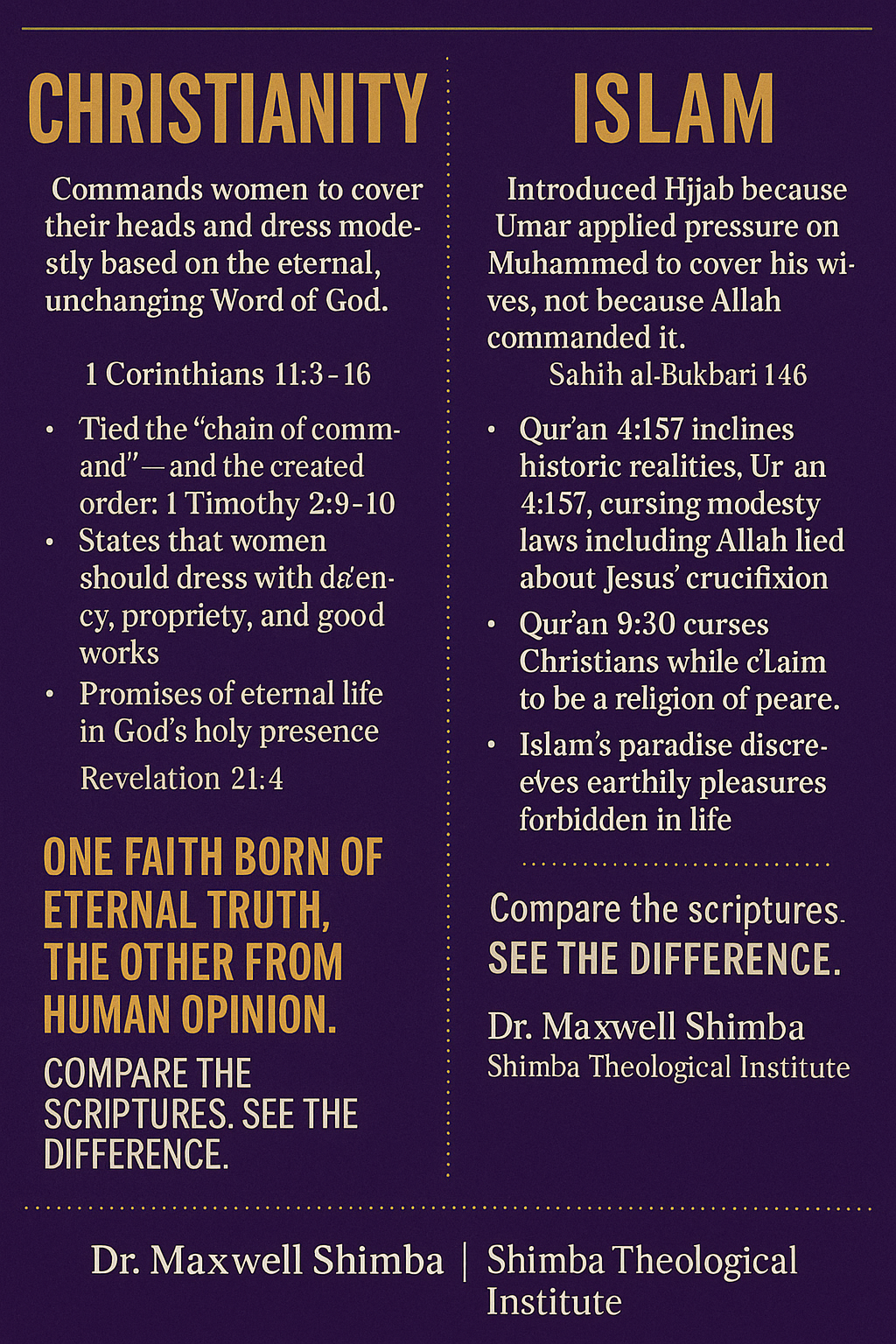
When we examine Christianity and Islam side by side, it becomes clear that one faith rests on the eternal, unchanging Word of God, while the other is built on flawed traditions and inconsistent revelations.

In Christianity, the command for women to dress modestly and cover their heads isn’t rooted in the whims of man but in divine order and eternal truth. 1 Corinthians 11:3-16 establishes a heavenly “chain of command”: God, Christ, man, woman. The Apostle Paul ties this teaching to creation itself — woman was made for man (Genesis 2:21-23), and her long hair is given as a covering, a symbol of glory and submission to God’s design. Furthermore, 1 Timothy 2:9-10 calls women to dress with decency, propriety, and good works, reflecting godly character, not merely external appearance.

In Islam, however, modesty laws were not divinely ordained from eternity past but introduced due to the human intervention of Umar ibn Al-Khattab. According to Sahih al-Bukhari 146, it was Umar who spied on Muhammad’s wife, Sauda, and pressured Muhammad to have women cover themselves. Only after this did the so-called “revelation” about Hijab come down. This is not the act of an omniscient God but a reaction to social pressures — proof that Islam’s moral codes are circumstantial, not transcendent.

Moreover, the Quran contradicts itself and historic realities:

  • Qur'an 4:157 denies the crucifixion of Jesus, despite overwhelming eyewitness testimony recorded in all four Gospels and confirmed by secular historians like Tacitus and Josephus.

  • Qur'an 9:30 curses Jews and Christians, calling for hostility, while Matthew 5:44 teaches Christians to love their enemies and pray for those who persecute them — a higher, divine ethic unmatched in the Quran.

  • Islam’s paradise promises earthly pleasures forbidden in life (wine, countless women), revealing a carnal, man-centered religion, whereas Christianity offers eternal life in God’s holy presence, where “there will be no more death, mourning, crying, or pain” (Revelation 21:4).

Christianity stands on prophetic fulfillment, historical integrity, and divine revelation unchanged for millennia. Islam, by contrast, is a patchwork of tribal customs, contradictory hadiths, and altered doctrines aimed to consolidate power, not reveal God’s heart.

The Verdict?
Yahweh is the eternal, unchanging, holy God. His Word stands forever (Isaiah 40:8). Jesus is Lord, the final and greatest revelation (Hebrews 1:1-3). Islam’s shifting standards and flawed origins betray its human authorship.

Choose the truth. Choose Christ.

Caption suggestion for graphic:
“One Faith Born of Eternal Truth, the Other from Human Opinion. Compare the Scriptures, See the Difference.”


Is the Islamic Night Journey (Isra and Mi'raj) a credible divine event or a patched-up legend?

 By Dr. Maxwell Shimba — Shimba Theological Institute

Debate Topic: Is the Islamic Night Journey (Isra and Mi'raj) a credible divine event or a patched-up legend?

Muslim Claim:
Muslims assert that Muhammad was miraculously taken from Mecca to Jerusalem and ascended to heaven in a single night, encountering prophets and receiving commands, including the five daily prayers.

Theological Problem:
According to Sahih al-Bukhari Hadith 7517, the Night Journey is said to have occurred before the Divine Inspiration was revealed to him. That alone disqualifies the event’s divine legitimacy — how could a man not yet declared a prophet be taken on a prophetic journey?

Islamic scholars themselves scrambled to fix this blunder. Notice the highlighted addition: “i.e. after The Divine Inspiration was revealed to him” — clearly a later correction to mask the inconsistency.

Biblical Standard:
In Scripture, prophetic missions and heavenly encounters occur after divine calling and commissioning — Moses at the burning bush (Exodus 3), Isaiah’s heavenly vision (Isaiah 6), and Paul’s Damascus encounter (Acts 9). No man entered God’s council chambers without first being appointed and sanctified.

Logical Flaw:
If Muhammad wasn’t yet commissioned by God, who took him? By whose authority did he ascend? In 1 Kings 22:19-23, even lying spirits need permission from Yahweh. The unverified timing in Hadith 7517 reveals this was no divine mission but a crafted legend, later corrected to avoid theological embarrassment.

Christian Response:
God operates with order and clarity, not confusion (1 Corinthians 14:33). The Night Journey contradicts both biblical patterns and its own sources. The absence of prophetic commissioning prior to such an event makes it void by divine law and biblical precedent.

Closing Argument:
The so-called Night Journey stands as an artificial narrative, inconsistent with both scriptural authority and Islamic authenticity. It’s another case of retrofitting doctrine to fix doctrinal fractures.

To those in pursuit of truth — Yahweh’s ways are transparent, His Word unchanging, and His Son the only true Mediator between God and man (1 Timothy 2:5). No fabricated tales or retroactive edits can substitute the eternal gospel.

Caption suggestion:
“The Night Journey: A Legend Built on Contradiction. Truth doesn’t need fixing.”


Yahweh Answers. False gods stay silent. Choose wisely

 By Dr. Maxwell Shimba — Shimba Theological Institute

Yahweh, the one true and eternal God of Abraham, Isaac, and Jacob, boldly declares in Isaiah 45:5, “I am the LORD, and there is no other; apart from Me there is no God.” Yet today, Islam parades Allah as "the same God," while denying the Son, rewriting sacred history, and enticing its followers with a heaven of earthly sins — wine, women, and lust — things their god forbids on earth but apparently glorifies in the afterlife. A holy bribe, not holiness.

This isn’t new. In 1 Kings 18, the prophets of Baal called out to their god with no answer, while Elijah prayed once — and fire from heaven fell. Yahweh responds. False gods remain silent.

The Quran denies the crucifixion of Jesus Christ (Quran 4:157), suggesting a decoy was crucified in His place — a plot twist so absurd no historian or eyewitness testimony supports it. Over 500 people saw the risen Christ (1 Corinthians 15:6). Islam ignores fact in favor of fable.

And while claiming to be a religion of peace, the Quran curses Christians and Jews (Quran 9:30). It’s not peace — it’s a system of submission built on fear, denial of God’s Son, and counterfeit promises.

Revelation 18:4 warns: “Come out of her, My people, so that you will not share in her sins.” This is modern Babylon — a false religion built on rejecting the Son and exalting man’s desires.

And when Christ returns in Revelation 19, it won’t be for tolerance summits and coexist bumper stickers. The Rider on the white horse comes for judgment.

To every Muslim reading this: ask yourself — why would your god promise you in paradise the very sins he forbids on earth? A holy God doesn’t trade in hypocrisy.

Yahweh alone is God. Jesus is Lord. And no, He doesn’t need to borrow fables from desert legends.

Contradictions in the Quran: A Theological and Textual Examination

Contradictions in the Quran: A Theological and Textual Examination By Dr. Maxwell Shimba, Shimba Theological Institute Introduction Muslims ...

TRENDING NOW