Friday, October 12, 2018

Mohammedans will be crying O Allah, Save us! O Allah, Save us!


● "Fear the Day when ye shall be brought back to Allah." (Qur'an 2:281)

● "The angel of  Death appointed over "you" will take away "your" soul then "you" will be sent back to "your" Lord." (Qur'an 32:11)

● "Allah will come to them and say: "I am your Lord." They will say: 'We shall stay in this place till our Lord comes to us and when our Lord will come, we will recognize Him. Then Allah will come to them (((again))) and say: "I am your Lord." They will say: "You are our Lord." Allah will call them, and As-Sirat (a bridge) will be laid across 🔥 Hell 🔥 and I (Muhammad) shall be the first amongst the Apostles to cross it with my 👉🏾 followers [Muslims]. Nobody except the Apostles will then be able to speak and they will be saying then ➔ "O Allah, Save us! O Allah, Save us!" (Sahih Bukhari Volume 1, Book 12, Hadith 770)
Image may contain: 1 person

JESUS IS GOD

No automatic alt text available.


● "Hear O Israel: The Lord our ➞ God is one 👉Lord." (Deuteronomy 6:4)

● "Ye call Me (Jesus) Master and 👉 Lord and ye say well for so ➞ "I AM." (John 13:13)

● "Jesus said unto them: Verily, verily, I say unto you, → Before ← Abraham (((was))) ➞ "I AM." (John 8:58) ➡️ [Exodus 3:14]

● "Therefore the Jews sought the more to kill Him, because He not only had broken the sabbath, but said also that God was His Father, making Himself → equal ← with ➞ God." (John 5:18)

● "The Jews answered Him (Jesus), saying: For a good work we stone Thee not; but for blasphemy; and because that Thou, being a man, makest Thyself ➞ God." (John 10:33)

YESU NI MUNGU

YESU NI MUNGU
No automatic alt text available.
Naanza na aya ambayo inatumiwa sana na Waislam kupinga Uungu wa Yesu. "MUNGU WETU NI MMOJA"

Kumbukumbu la Torati Mlango 6: 4 Sikiza, Ee Israeli; Bwana, Mungu wetu, Bwana ndiye mmoja. 

SASA TUANZE KUZISOMA AYA KWA UMAKINI, JE, YESU NI BWANA? MAANA KATIKA KUMBUKUMBU LA TORATI INATUFUNDISHA KUWA "BWANA NDIYE MMOJA NA BWANI NDIYE MUNGU, BASI YESU LAZIMA NA YEYE AWE NA HIZO SIFA ZA KIPEKEE"

Yohana Mlango 13:13 Ninyi mwaniita, Mwalimu, na, Bwana; nanyi mwanena vema, maana ndivyo nilivyo.

Wanafunzi wa Yesu walimuita "BWANA" kama ambayo Kumbukumbu la Torati inavyo sema. YESU AKASEMA WAMENENA VYEMA NA NDIVYO ALIVYO.

Je, Yesu ni Bwana Mungu?

Endelea kusoma:

Yohana Mlango 20: 28 Tomaso akajibu, akamwambia, Bwana wangu na Mungu wangu!

Tomaso anasadiki na kukiri kuwa Yesu ni "BWANA" na "MUNGU"

Je, Yesu alikataa kuitwa hivyo?

Yohana Mlango 20: 29 Yesu akamwambia, Wewe, kwa kuwa umeniona, umesadiki; wa heri wale wasioona, wakasadiki.

Yesu anamjibu kuwa "WEWE TOMASO UNASADIKI KWA KUWA UMENIONA" Kumbe Yesu hakukataa kuitwa Mungu bali thibitisha yeye ni Mungu na ni Bwana.

Endelea kusoma aya:

Yohana Mlango 10: 33 Wayahudi wakamjibu, Kwa ajili ya kazi njema hatukupigi kwa mawe; bali kwa kukufuru, na kwa sababu wewe uliye mwanadamu wajifanya mwenyewe u Mungu.

Wayahudi walio ishi na Yesu walisadiki kuwa "YESU ALIJIFANYA MUNGU. Kumbe basi Yesu alithibitisha yeye ni Mungu wakati alipo kuwa hapa hapa duniani.

Endelea kusoma aya:

Yohana Mlango 5: 18 Basi kwa sababu hiyo Wayahudi walizidi kutaka kumwua, kwa kuwa hakuivunja sabato tu, bali pamoja na hayo alimwita Mungu Baba yake, akijifanya sawa na Mungu. Basi Yesu akajibu, akawaambia, Amin, amin, nawaambia,

Kumbe moja ya sababu ya Wayahudi kutaka kumuua Yesu ni vile Yesu alimuita Mungu BABA YAKE na zaidi ya hapo Yesu alijifanya SAWA NA MUNGU.

Biblia ipo kamili na haina shaka ndani yake. Leo tumejifunza kuwa Yesu ni Mungu. Haya yalithibitishwa na Yesu mwenyewe pamoja na Wayahudi walio taka kumuua kwa kwasababu Yesu alimuita Mungu Baba yake na Kujifanya sawa na Mungu. Zaidi ya hapo, hata wanafunzi wake walimuita Bwana na Mungu.

Shalom

Max Shimba mtumwa wa Yesu Kristo Mungu Mkuu. TITO 2:13

Thursday, October 4, 2018

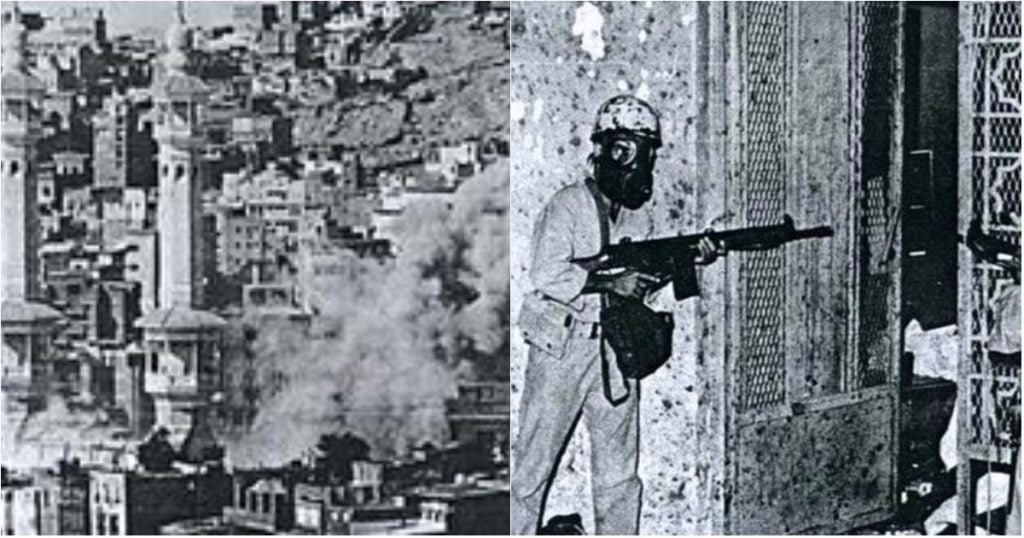
All About The Day When Kaaba Was Attacked, 20 November 1979

All About The Day When Kaaba Was Attacked 20 November 1979

20 November 1979 one of the darkest day for the Muslims all around the world as this day is known as the day when Kaaba was held, hostage.
It was a pleasant day of 20 November 1979 in Makkah, everything seemed to normal. But all of a sudden this pleasant day turns into a darker one when a guy named Juhayman ibn Muhammad ibn Sayf al-Otaybi along with his terrorist group enters Kaaba and held hostage Kaaba for many days, during this period, many lives were lost and blood was shed in the house of Allah SWT.

(Left): Juhayman al-Otaybi – (Right): His followers who later surrendered and executed publically by Saudi Government –
Photos: Wikipedia

Who helped Saudi Arabia fight the war against this terrorist?

There are two countries which came to the rescue of the house of Kaaba and fought alongside Saudi Forces to tear that terrorist down. Those two countries were;
  1. Pakistan (SSG).
  2. France (GIGN).
These two forces fought a long war with these group of terrorist who claimed to be the Mahdi from 20 November 1979 till 4th of December, as per Wikipedia.
Almost 300 to 600 terrorists had held Kaaba (The house of Allah SWT) hostage, while, 117 killed and many wounded, and the rest were surrendered and Saudi Government had executed them publically. and the videos and images of all these incidents can easily be seen on Youtube and Google Images

Full History of Attack on Kaaba (Masjid Al Haram) on 20 November 1979

If you want to know about what had happened on that day, This video will tell you the whole timeline of what had happened in Kaaba (Masjid Al Haram) that day and how did all of this stopped. Watch this informative video and pass to it your friends and family as well.
Photos: Wikipedia

How the 1979 Siege of Mecca Haunts the House of Saud

Image result for MACCA IS BURNING
Saudi Arabia is in a familiar, if unpleasant, position. On June 23, security forces in the kingdom disrupted an impending attack on the Grand Mosque in Mecca, according to Saudi Arabia's Interior Ministry. The event triggered an avalanche of international commentary about the terrorist plot, which reportedly involved three cells ready to attack security forces and worshippers at the mosque. And though the Interior Ministry's statement did not allude to it, the foiled conspiracy doubtless brought back uncomfortable memories for the Saudi royal family of the siege of the Grand Mosque in November 1979. 
Despite the incident's gravity and its lingering influence on Islamist terrorism, the Grand Mosque's siege is a historical footnote nearly 40 years later. Saudi Arabia quickly shut down its communication channels to the outside world as the event unfolded. Since then, it has had no desire to discuss the most destabilizing and embarrassing moment in its history, when militants seized and held Islam's holiest shrine for 15 days, and Riyadh had to rely on clandestine members of the French special forces to regain control. But as the recent plot and the kingdom's enduring fight against radicalism underscore, the legacy of the 1979 Grand Mosque siege lives on.

The Keys to the Kingdom

One of the pillars upholding the House of Saud has long been its relationship with Islamic fundamentalists, most notably Wahhabi clerics and their followers. Members of the sect gave the kingdom's founding monarch, Abdulaziz Ibn Saud, the decisive edge in his ambitious campaign to unify vast tracts of the Arabian Peninsula under his rule after World War I. (The discovery of oil and natural gas in Saudi Arabia in 1938 helped cement the House of Saud's authority, pacifying the kingdom's disparate tribes and generating significant interest from foreign powers such as the United States, the United Kingdom and France.) The ruling family's ties with Islamic fundamentalism have been well-documented through the years, though the relationship hasn't always been harmonious. At times, the demands of running a modern state have clashed with the Wahhabis' ascetic beliefs.
By the 1970s, some members of Saudi Arabia's hard-line Islamist community thought that power and patronage had profoundly warped the Saudi establishment and began agitating for systemic change in the kingdom. The flood of petrodollars into Saudi Arabia, coupled with signs of increasing liberalization there — women appearing on television without headscarves, for instance — widened the divide between the royal family and the conservative society it ruled. In time, a growing threat emerged around Juhayman al-Otaibi, a former corporal in the Saudi armed forces and a bastion of conservative ideology. Al-Otaibi, armed with his religious education and military training, set about recruiting other believers from the sea of alienated worshippers throughout the kingdom. As his underground clout grew, so did his belief that he was uniquely positioned to bring about the coming of the Mahdi, who, according to Islamic theology, will save Islam and the world after an apocalyptic battle. His desire to overthrow the House of Saud rose in turn. 

The Siege Commences

The year 1979 proved a momentous one for the Muslim world. The ailing Shah of Iran fled the country in January. Long-running protests and the erosion of his government precipitated the rise of Ayatollah Ruholla Khomeini and set the Iranian Revolution in motion. The ferment inspired Shiites in Saudi Arabia's restive Qatif region to take to the streets, prompting government crackdowns. Then in December, the Soviet Union intervened in Afghanistan to prop up its socialist client state, galvanizing Muslims around the world to lend support against the communist onslaught. And in the intervening months, al-Otaibi and his rebels set their sights on capturing the Grand Mosque in Mecca in hopes of unseating the Saudi royal family.
Yaroslav Trofimov, a journalist for The Wall Street Journal, describes the scene that played out in the Grand Mosque in his book The Siege of Mecca — perhaps the lone work dedicated to the incident. On Nov. 20, 1979, al-Otaibi and his followers made their way into the mosque's inner sanctum, well-armed. Before any of the thousands of pilgrims there could comprehend what had happened, the rebel leader took control of the microphones at the front of the mosque, announcing that his brother-in-law was the Mahdi. (Interviews with survivors of the siege indicate that the brother-in-law bore several physical traits that the Mahdi supposedly would have.) Some Islamic scholars trapped inside the holy site then dialed their superiors for help as the rebels closed the Grand Mosque's massive gates and snipers took up defensive positions in several of its minarets. Mecca police responded hours later, only to be repelled by successive rounds of fire from militants hiding in the upper reaches of the Grand Mosque.
The official Saudi response to the crisis was sluggish. The delay was likely due to a combination of disbelief, slow communications, the absence of important members of the royal family — Crown Prince Fahd and Prince Abdullah, commander of the national guard, were traveling abroad — and confusion over how to counter the siege. Bloodshed in the Grand Mosque, after all, would constitute a grave sin. In addition, King Khalid was suffering from long-term health problems. Hostage rescue teams were still in their infancy at the time, especially in Saudi Arabia, where such situations seldom occurred. When security forces finally were cleared to assault the Grand Mosque, they met with gunfire from all sides of the ancient building, resulting in high casualties and low morale. Soon rumors of coups, Iranian meddling and the return of the Mahdi seeped out of Mecca, forcing the government to shut off all communications in and out of the kingdom.
The rumors of Iran's interference coincided with mass demonstrations by Shiites in Qatif protesting their treatment at the hands of Saudi authorities. During the demonstrations, which resulted in dozens of deaths, protesters looted several businesses in the region, including the offices of the Saudi British Bank. The ensuing instability raised fears in the Saudi and U.S. governments alike that Iran's supreme leader was behind the unrest. Khomeini, meanwhile, blamed the siege of Islam's holiest shrine on the United States, an accusation that prompted rioters in Pakistan to burn the U.S. Embassy in Islamabad to the ground, killing two Americans and two Pakistani staff members.
Most of the gunmen who were arrested in the wake of the siege on Mecca's Grand Mosque were later executed. The incident's influence on Islamic terrorism lingers.
(AFP/Getty Images)

France to the Rescue

As the siege wore on, the Saudi government grew more desperate. Interior Minister Prince Nayef bin Abdulaziz concluded that his security forces were no match for the rebels cached in the Grand Mosque's manifold nooks and crannies. Consequently, he called on France's elite counterterrorism and hostage rescue force, the National Gendarmerie Intervention Group (GIGN) to help end the crisis. The kingdom maintained a close intelligence relationship with France, and the GIGN had reportedly impressed bin Abdulaziz at a recent demonstration. The interior minister likely realized, moreover, that the kingdom needed discretion above all else, something that the United States — by then mired in the early stages of the Iranian hostage crisis — probably couldn't give them. Four members of the French force were soon traveling to Saudi Arabia in secret to devise a viable counterassault before the world caught wind that the House of Saud had lost control of the mosque, one of the bases of its legitimacy. (Their journey allegedly included a conversion to Islam so that the Frenchmen could enter the holy city of Mecca.)
As former head of the GIGN Paul Barril tells it, the ill-equipped Saudi military needed to disrupt the rebels from a distance to avoid another bloodbath. The French operatives settled on using a gas that caused vomiting and temporary blindness to incapacitate the militants, allowing Saudi security forces and a contingent of Pakistani commandos to penetrate the Grand Mosque. Many of the rebels retreated into the recesses underneath the structure, and from there, a brutal battle erupted. Saudi forces indiscriminately threw grenades, killing untold numbers of pilgrims, military personnel and rebels. Official estimates put the death toll at around 255, but sources outside the Saudi government say that as many as 1,000 people died in the fight.

Damage Control

After 15 days, Saudi security forces managed to neutralize the militants and kill the proclaimed Mahdi. The government even kept news of the siege mostly under wraps, though the incident would become fodder for the growing jihadist movement in the decades ahead. Security forces captured al-Otaibi, along with several of his confederates, and paraded them in front of Saudi media before most of them were beheaded. Some of the rebels who survived their sentences went on to join al Qaeda.
The events of Nov. 20-Dec. 4, 1979, drove home an uncomfortable reality for the House of Saud: The Islamic fundamentalists that it had so often relied on presented a threat to its dynastic rule. From then on, Trofimov notes, the Saudi government strove to expunge the siege from public memory and to channel the energies of its more hostile citizens to crises afflicting the Islamic world beyond its borders, such as the war in Afghanistan. At the same time, the House of Saud invested millions of dollars to upgrade the Grand Mosque's security, while cracking down on dissent and rolling back social reforms in an effort to shore up its support among the Wahhabi clergy. Facing accusations that it wasn't pious enough, and threatened by the revolutionary Shiite administration just across the Persian Gulf, the Saudi royal family resolved to become the unequivocal leader in Islamic thought by exporting its ideology around the world. But so long as it courts the support of Islamic fundamentalists, the House of Saud will keep encountering threats to its legitimacy when it inevitably falls short of the hard-liners' expectations.

Friday, September 28, 2018

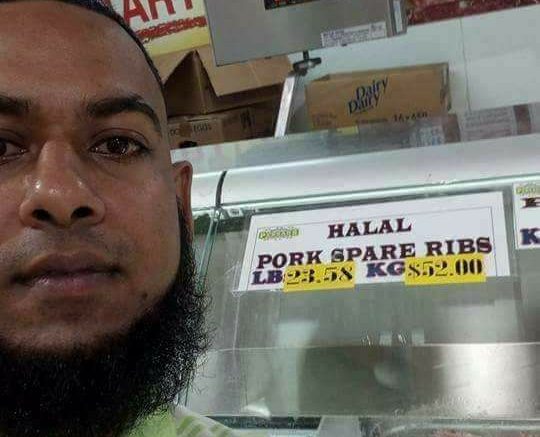
IN TRINIDAD, MOHAMMADANS ARE EATING HALAL PORK


Trinidad Supermarket Advertises Pork For Muslims

This selfie has been making the rounds on social media. It advertises “halal pork” for sale. For Muslims, halal is permissible or lawful to eat.

Pork is explicitly forbidden or unlawful to eat (haram) in Muslim religious law. “Forbidden to you (for food) are: dead meat, blood, the flesh of swine..”(Qur’an, 5:3). That which is forbidden by God’s Guidance in the Quran cannot be be made permissible for Muslims by any human being.

Dr Waffie Mohammed, founder and Principal of Markaz Al Ihsaan of Trinidad & Tobago, said “it is wrong and it’s unfortunate that sometimes non-Muslims do this with the intention to attract Muslim sale.” Dr. Mohammed advised the Muslim Community that their reaction should not be one of anger or emotion. He counseled that the offending party should be educated and informed to ensure that it is not repeated in the future. Dr. Waffie said the supermarket should be educated that “for Muslims that the eating of pork, drinking of alcohol and other unclean blood issues are grave sins”.

Persad’s Supermarket spokesperson Sharaz Mohammed in a Facebook post said, “Assalmu Alaikum! On behalf of my team at Persads, we do humbly apologise for the error made by a new member of staff on the wrong use of the words in the signage of the product. Being Muslim as well, I observed the sign whilst doing my routine walk through and immediately corrected the issue and also initiated a retraining on the individual responsible for making this sign. Again we do accept responsibility for what was published and systems will be put in place to ensure that such never reoccurs. To the Muslim community and by extension the national community to please accept our sincerest apologies as it was not intentional.”

This story is circulating widely on WhatsApp and was also picked up by Trinidad’s Newsday Online Edition here.

https://www.caribbeanmuslims.com/trinidad-supermarket-advertises-pork-for-muslims/

Did Muhammad Die while Making Love to Aisha?


Proof that he died during an explosive moment:
Ibn Hisham page 682:
….that he heard Aisha say: “The apostle died on my bosom during my turn: [of having sex with]. It was due to my ignorance and extreme youth that the apostle died in my arms
Narrated ‘Aisha:He died on the day of my usual turn ( of having sex) at my house. Allah took him unto him while his head was between my chest and my neck and his saliva was mixed with my SALIVA. Sahih Bukhari, Volume 7, Book 62, Number 144:
Aisha is blaming her youth and ignorance for causing Prophet’s death . Aisha’s eager cooperation excited Prophet immensely which lead to a wild session of foreplay and tongue action followed by intensive sex . Due to her inexperience she could not see the danger of an old man performing sex with a young woman during his serious illness. Timely slowing down or stopping him could have saved his life. Prophet had an expolsive climax which his old and sick heart could not handle and went in a cardiac arrest. She saw him die and slump on her bosom during his moment of extreme pleasure. ( which is not uncommon in such cases). That is why she felt guilty of causing his death..
He did not recite KALIMA at death
The hadiths indicate that instead of having kalima on his mouth like a good muslim during his last moments , prophet’s mouth was busy in tongue action and and French kissing.
Hard facts
His body must have stiffened as he died during his pleasure moment in an “as is” condition. The fact that they tried to cover him with triple shroud indicates an embarrassing bulge which they must have tried to even out by extra layers of clothings. They wouldn’t have wanted all to know what their prophet was upto when he died.
Narrated Abdullah ibn Abbas: The Apostle of Allah (pbuh) was shrouded in three garments made in Najran: two garments and one shirt in which he died. Dawood, Book 20, Number 3147
Apparently neither the three clothing layers nor the reported delay in burial helped in the situation and he was buried quietly where he was making love

Wednesday, September 26, 2018

Local Muslims Stone Three Christians to Death During Protest


(International Christian Concern) – On September 22, 2018, a family in western Kenya laid one of their kin to rest after he and two other men were attacked by a Muslim mob and stoned to death. Fredrick Mukanda Bahati was a mason in Elwak, Mandera, a town close to the Kenya-Somalia border. He worked in Elwak for six months before his death.
The Muslim residents of Elwak were engaging the police after three suspected al-Shabaab militants were found killed outside of town. In retaliation, the irate protesters turned their anger toward three non-local Christians at the construction site.
A witness, who requested to remain anonymous, told International Christian Concern (ICC), “Fredrick was on top of a new house he was contracted to build. His two assistants were on the ground mixing mortar when the mob arrived in [a] hurry, chanting takbir, takbir, takbir. From a distance, I saw the men hurling construction stones towards Fredrick and his coworkers.”
He continued, “The three managed to flee into a nearby hotel for safety, although they had been badly injured. The Muslims relentlessly followed them up and stoned them to death.”
This attack came only four months after al-Shabaab militants killed four non-locals who were working at stone quarries in Mandera on May 3, 2018. Security officers in northeastern Kenya have been on high alert regarding the terrorism that has claimed over 200 Christians in the past three years.
“He always reminded us to pray and trust God even in difficult times. That is what is keeping us going after losing him.”
“I am shocked by the killing of the three innocent Christians who had come from outside Mandera county to earn a livelihood. We are not safe at all and this incident shows how Muslims hate believers in Christ. We have known it is the armed militants belonging to the al-Shabaab that kill people, but now we have discovered that even our close Muslim friends can commit atrocities against us,” said a local pastor.
Fredrick’s family laments their loss, and believes that he would not have died if police had intervened as soon as the protest began turning violent.
Wycliffe Mukanda, Fredrick’s brother, stated, “This is a sad day in our family. We have lost a man who was skilled in construction and loved all of us. He always reminded us to pray and trust God even in difficult times. That is what is keeping us going after losing him. We were expecting to see him before the end of the year but now what we have is the memories, a widow, and two children to take care of.”
He ended with a poignant question that many of us have been asking as these attacks keep recurring in Mandera, “Where were the police to protect [them]?”
For interviews with Nathan Johnson, Regional Manager, please contact Olivia Miller, Communications Coordinator: press@persecution.org

Monday, September 24, 2018

Come to Pray, Stop to Shop': Saudis Open More Malls in Mecca

Image result for mall in mecca saudi arabia
[DUBAI] Mecca: Come to fulfill your religious duty. Stay for the shopping.
Saudi Arabia, and its developers and retailers, are set to cash in on a spending bonanza fueled by the unique position of having a city that every able-bodied Muslim in the world must visit once in their lifetime. Helped by state investment, Mecca is set to see shopping-mall space almost triple by 2025, according to Colliers International.
As part of a government plan to wean the economy off oil, the state aims to boost the number of foreign pilgrims to 30 million per year by 2030 from 7 million last year, realizing the potential of a sector that currently makes up 20 per cent of the kingdom's non-oil economy, according to Oxford Business Group.
The holy city is currently under-served by malls due to a shortage of plots and high costs, with many shoppers opting to head to nearby Jeddah, Colliers said in a report last week. But that's expected to change and mall space is set to grow to 804,000 square meters (8.7 million square feet) by 2025. Mecca's biggest developers are likely to construct a sizable portion of the future mall supply, it said.
https://www.businesstimes.com.sg/real-estate/come-to-pray-stop-to-shop-saudis-set-to-triple-malls-in-mecca
The US$9.6 billion Jabal Omar Development Co. is already taking advantage by building homes and malls as well as a project near the Grand Mosque that will include 38 hotels and some of the country's largest malls. The kingdom's wealth fund has also jumped on the bandwagon with a new company to aid an expansion project that it says will contribute US$2.1 billion annually to the national economy. Another company likely to benefit is Makkah Construction and Development Co., which focuses on projects near the mosque.
Spending by pilgrims during the five-day Hajj season alone is set to reach US$5.6 billion by 2022, up from US$4.2 billion last year, according to a research report cited in Saudi-owned Asharq Al-Awsat newspaper. The minor Umrah pilgrimage to the city is voluntary and takes place all year around.
Mecca has undergone a transformation as Saudis seek to accommodate an ever-growing number of pilgrims that make up the vast majority of the country's tourism industry. Some of the world's biggest hotels have opened up or are under construction in the city, where towers and cranes crowd the horizon outside the world's biggest Mosque.
A project to expand the capacity of the Grand Mosque to 2.5 million people from 1.5 million has recommenced after it was halted following a crane collapse in 2015 killed more than 100 people. Other projects that stalled after a drop in oil prices hit the economy are also resuming across the country.
Revenue from pilgrims could rival and even exceed the kingdom's vast oil returns in the long term, Jabal Omar's Chief Executive Officer Yasser Al-Sharif told a conference in Riyadh last year. Oil is a commodity that can be substituted, he said, "pilgrimage is not."
BLOOMBERG

Mosque Loudspeakers Catch Fire: 3 Dead…70 suffer burns

Image result for mosque loudspeaker burning
Ashura, the 10th day of Mohurram marking the martyrdom of the Prophet’s grandson Imam Hussain, turned out to be tragic as at least three persons died and around 70 mourners were burnt in different incidents across Uttar Pradesh.
Three mourners died in Ballia, one was critically injured in Gorakhpur and many more were burnt in Moradabad and Amroha.
In Moradabad, 50 mourners from Jayantipur village suffered burns when the loudspeaker mounted on top of the 16-ft tall taziyas hit electricity wires and caught fire. Thirty-six of them are battling for their lives in the district hospital. 
All the incidents followed the same pattern – tall taziyas (replica of the mausoleum of the Imam Hussain), which is symbolically buried in local Karbalas across cities, touching hanging high-tension wires and causing death and burn injuries by electrocution.
In Gorakhpur, mourners turned violent and beat up two policemen and tried to set ablaze the Bhathat police post when the taziya touched a high-tension wire.

John chapter 10 that clearly highlight Jesus’ divinity, His unity with the Father, and His sovereign authority

Suggested Captions from John 10 “I am the Good Shepherd” — a divine title Yahweh reserved for Himself (John 10:11; cf. Psalm 23). Jesus does...

TRENDING NOW