Monday, September 5, 2022

Are men and women equal in Islam?


Are two female witnesses equal to one in Islam?

Gender equality is one issue that critics of Islam bring up quite often. In order to paint the narrative that Islam discriminates and oppresses women, many critics bring up the example of testimony, alleging that the testimony of a woman is considered half of that of a man. The verse that is presented by them is:

یٰۤاَیُّہَا الَّذِیۡنَ اٰمَنُوۡۤا اِذَا تَدَایَنۡتُمۡ بِدَیۡنٍ اِلٰۤی اَجَلٍ مُّسَمًّی فَاکۡتُبُوۡہُ ؕ وَ لۡیَکۡتُبۡ بَّیۡنَکُمۡ کَاتِبٌۢ بِالۡعَدۡلِ ۪ وَ لَا یَاۡبَ کَاتِبٌ اَنۡ یَّکۡتُبَ کَمَا عَلَّمَہُ اللّٰہُ فَلۡیَکۡتُبۡ ۚ وَ لۡیُمۡلِلِ الَّذِیۡ عَلَیۡہِ الۡحَقُّ وَ لۡیَتَّقِ اللّٰہَ رَبَّہٗ وَ لَا یَبۡخَسۡ مِنۡہُ شَیۡئًا ؕ فَاِنۡ کَانَ الَّذِیۡ عَلَیۡہِ الۡحَقُّ سَفِیۡہًا اَوۡ ضَعِیۡفًا اَوۡ لَا یَسۡتَطِیۡعُ اَنۡ یُّمِلَّ ہُوَ فَلۡییُّہٗ بِالۡعَدۡلِ ؕ وَ اسۡتَشۡہِدُوۡا شَہِیۡدَیۡنِ مِنۡ رِّجَالِکُمۡ ۚ فَاِنۡ لَّمۡ یَکُوۡنَا رَجُلَیۡنِ فَرَجُلٌ وَّ امۡرَاَتٰنِ مِمَّنۡ تَرۡضَوۡنَ مِنَ لشُّہَدَآءِ اَنۡ تَضِلَّ اِحۡدٰٮہُمَا فَتُذَکِّرَ اِحۡدٰٮہُمَا الۡاُخۡرٰی ؕ وَ لَا یَاۡبَ الشُّہَدَآءُ اِذَا مَا دُعُوۡا
“O ye who believe, when you take a loan, one from another, for a term, reduce the transaction to writing; and let a scribe record it in your presence faithfully. And no scribe should refuse to set it down in writing, because Allah has taught him, so he should write. And let him who undertakes the liability dictate; and he should fear Allah, his Lord, and not diminish anything therefrom. But if the person incurring the liability should be of defective intelligence, or a minor, or unable to dictate then let his guardian dictate faithfully. And procure two witnesses from among your men; and if two men be not available, then one man and two women, of such as you like as witnesses, so that if either of the two women should be in danger of forgetting, the other may refresh her memory. And the witnesses should not refuse to testify when they are called upon to do so.” (Surah al-Baqarah, Ch:2: V.283)

The bold portion of this verse above is often presented as “proof” to allege that, in Islam, the weight of two female witnesses is equated to the weight of a single male witness. What is further alleged is that this is due to Islam not considering women “wise enough” or “intelligent enough” to give proper testimony.
In this article, we shall focus primarily on the issue at hand, that is, witness testimony, and explore the issue comprehensively, without distracting ourselves with other verses or Ahadith which speak of gender differences.
First of all, Hazrat Khalifatul Masih IV, may Allah have mercy on him, has noted that these verses apply to financial matters only and do not at all mean that in all legal and other affairs, two women should be requested in case a male witness is not available. Secondly, he has listed the following important points which are necessary to fully understand their true import:
The verses do not at all require both women to testify

The role of the second woman is clearly specified and confined to be that of an assistant

If the second woman who is not testifying finds any part of the statement of the witness as indicative of the witness not having fully understood the spirit of the bargain, she may remind her and assist the witness in revising her understanding or refreshing her memory
It is entirely up to that woman who is testifying to agree or disagree with her assistant. Her testimony remains as a single independent testimony and in case she does not agree with her partner, she would have the last word. (Islam’s Response to Contemporary Issues, p. 198)

One female witness equal to one male witness

The first point that Hazrat Khalifatul Masih IVrh has brought up is that the verse does not imply anywhere that two female testimonies are equal in weight to one male testimony. The relevant portion of the verse only implies testimony from a single female witness, not two. It is only when she requires assistance and needs any help in recalling something that she can employ the help of her assistant. Evidently, the role of the assistant is to “refresh her memory” as the verse notes, not to provide testimony in her own right.

If a single female witness had not been considered enough, or had been deemed deficient in some way, it would have applied to several other scenarios and circumstances. For instance, in Chapter 4, verse 16 of the Holy Quran, when witnesses are mentioned, the language used is gender-neutral and there is no qualifier given in regard to maintaining a ratio of one male witness to two female witnesses. It implies that a single female testimony is indeed equal to a single male testimony. The same is the case in terms of receiving testimony of a wife against her husband regarding inappropriate behaviour, as discussed in Chapter 24, verses 7-9. Here, too, the weight of a single female witness (the wife) is considered sufficient and equal to a single male witness (the husband).

Moreover, giving testimony in religious matters is far more important than giving testimony in worldly matters. When it comes to religious matters, such as those found in Ahadith, we find that one of the most common narrators is Hazrat Aishara, the wife of the Holy Prophetsa. Many other women have also narrated traditions from Prophet Muhammadsa. In none of these cases has a Muslim ever suggested that the testimony of a woman is not acceptable unless corroborated or confirmed by another woman.

In fact, many companions and others from the early days of Islam often consulted Hazrat Aishara in matters of religious significance. If the testimony of a single woman was only half of that of a man, none of the narrations from single a woman would have ever been accepted. Yet, they are not just accepted, but also revered. It is important to understand the significance of this matter. The verse under discussion, chapter 2, verse 283, is in relation to financial matters only, pertaining to worldly wealth, and these are not as important as religious matters, where a person’s salvation and connection with God is at stake. However, in every case – and there are hundreds of them – a single woman’s testimony about what the Prophet Muhammadsa said or did, is accepted without question!

The prime witness and the assistant
Commenting on Hazrat Khalifatul Masih IV’srh four-point summary of chapter 2, verse 283, one critic has attempted to raise some doubts. For instance, he alleges that the Holy Quran does not have any evidence for the differentiation made between the “prime witness” and the “assistant witness”. He also asks why there is a need for a female witness in the first place? Further making an attempt to make his case, he questions why the English translation of the verse under discussion use the words, “either of the two women”, without identifying which one of the two is the main witness and which one is the assistant.
The problem is that critics who make such allegations do not have a good grasp of Arabic. It should be noted that the Quranic language is what is called mubeen – eloquent, articulate and powerful. Multiple meanings can be driven from a single phrase, even a single word. Keeping this in mind, we turn to the questions raised by such critics, which are directed towards the following phrase of the Holy Quran:

اَنۡ تَضِلَّ اِحۡدٰٮہُمَا فَتُذَکِّرَ اِحۡدٰٮہُمَا الۡاُخۡرٰی
The words translated as “either of the two women” are “ihdaa humaa” and they appear twice in the above phrase. A literal translation of ihdaa humaa is “one of the two women”. Consequently, a literal translation of the entire phrase above would be:

“If one of the two women should be in danger of forgetting, one of the two women may refresh the memory of the other woman.”
To make it easier and lucid for modern English readers, the translation writes out the full sentence as follows:

“If either of the two women should be in danger of forgetting, the other may refresh her memory.”

However, regardless of the above adjustment for easier reading, the phrase “ihdaa humaa” literally means “one of the two women” and has been used in other parts of the Quran such as the following verse:

فَجَآءَتۡہُ اِحۡدٰٮہُمَا تَمۡشِیۡ عَلَی اسۡتِحۡیَآءٍ ۫ قَالَتۡ اِنَّ اَبِیۡ یَدۡعُوۡکَ لِیَجۡزِیَکَ اَجۡرَ مَا سَقَیۡتَ لَنَا
“And one of the two women came to him, walking bashfully. She said, ‘My father calls thee that he may reward thee for thy having watered our flocks for us.’ So when he came to him and told him the story, he said, ‘Fear not; thou hast escaped from the unjust people.’”(Surah al-Qasas, Ch.28: V.26]
Here, the translation does not require the adjustment to “either” and is written out as follows:

“And one of the two women came to him, walking bashfully. She said, ‘My father calls thee that he may reward thee for thy having watered our flocks for us.’”

The word ihdaa comes from the root letters A-H-D (a-ha-da), meaning “one”. Hence, the literal translation of ihdaa is “one” and an implied interpretation is “either”. This does not mean that the translation, “either of the two women”, is wrong. It simply means that what Hazrat Khalifatul Masih IVrh has concluded from the actual Arabic wording of this verse is perfectly valid and an accurate understanding and interpretation of this verse. In fact, it is closer to the literal meaning of the phrase ihdaa humaa.

What he has essentially argued is that the Quran does not directly say that either one of the two women can remind the other. The Quran instead says that one of the two women may remind the other. This may seem trivial in the English language, but it is an extremely important difference clearly seen in the original Arabic wording. Without having some rudimentary knowledge of Arabic, a person cannot truly appreciate this subtle difference.  
As far as the issue of identifying the prime witness and her assistant is concerned, the Quran has indicated this arrangement by adding the word “Al-Ukhraa” at the end of the phrase. The word “Al-Ukhraa” means, “the latter, ultimate, last, other” (Lane’s Lexicon).
Hence, the prime witness is pointed out in the phrase ihdaa humaa (mentioned at the beginning), and the assistant is qualified by using the phrase ihdaa humal-ukhraa (i.e., one of the two women who is the other/latter/last).
In fact, the wording of the full phrase even provides a chronology that further elaborates this issue. Dividing the verse into four portions, it goes as follows:

An-Tadhilla – if she forgets
Ihdaa humaa – one of the two women(Let’s call her Aisha)

Fa-tuzakkira – she may remind
Ihdaa humal-ukhraa – the other one among the two(Let’s call her Maryam)

In essence, the phrase is saying: “If Aisha forgets, Maryam may remind her.” This is something that a literal, plain reading of the Arabic verse of the Holy Quran easily reveals. Here, Aisha is the prime witness and Maryam is the assistant.

Why the need for an assistant in the first place?

Why has the Quran felt the need to have two female witnesses – one prime and one assistant – in financial transactions? Are women deficient in some way in regard to business? Are they considered less efficient in remembering numbers?

All these questions seem fair but draw from a lack of understanding of what the Quran is teaching at a broader level. It should be noted that there indeed do exist differences in the genders in terms of how they remember things. As a result, the premise of the Quran is indeed correct. Men and women remember things differently. While men have the upper hand in keeping certain types of memory, women have the upper hand in other types of memory.
Those who have researched this subject argue that in general terms, neither gender is superior in memory. However, subtle differences appear in the way things are remembered by men and women.

One researcher, Elizabeth Loftus, makes the following observation:

“The results were clear-cut. Males were more accurate and less suggestible about the male-oriented items while females were more accurate and less suggestible about the female-oriented items. This finding provided clear support for the hypothesis that females and males tend to be accurate on different types of items, perhaps indicating their differential interest in particular items and corresponding differential amounts of attention paid to those items.” (Who Remembers What? Gender Differences in Memory. Michigan Quarterly Review, 26, pp. 64-85)

It is quite remarkable that the premise the Quran uses for providing an assistant to the female witness is pointing to a memory difference between the genders, something that is only being researched and proven 1400 years after the revelation of the Quran. However subtle the differences, there is no denying that they do exist.

This brings us to the broader question of acknowledging gender differences which Islam speaks about. Islam teaches gender equality in the best sense, acknowledging the strengths and weaknesses of both genders, and not turning a blind eye to them.

All this does not mean that Islam teaches that women are deficient in their memories of certain items such as those related to financial matters. It only means that Islam creates a social climate which intends to empower and favour women.

Empowerment of women

By ensuring that a female prime witness has an assistant, Islam has empowered women and taught them to work together in the face of patriarchy. There is no denying the fact that patriarchy has always existed and many argue that even in the free societies of the West today, it continues to persist. In light of this fact of life, Islam has dismissed any notion that women should be deprived of being part of the process of witnessing financial transactions. At the same time, it has recognised that patriarchy may come in the way and discourage women from being part of such proceedings. As a result, women are told to go as a pair and not feel any intimidation in such proceedings. This however remains as an option for the prime witness, who, as pointed out earlier, may not choose to accept any help from the assistant witness.

Islamic social climate

Secondly, it must be noted that Islam is a religion where men and women do not interact in a free manner as is done in some cultures. Islam safeguards women and men from promiscuity and other evils by ensuring that there is some distance between the two in social gatherings.

All of this points to an Islamic social climate as an ideal for Muslim men and women to seek. As such, if a financial transaction is taking place where several men are involved, a single female witness may feel uncomfortable in such an environment, given the social climate that Islam seeks. Hence, she is empowered through the presence of the second assistant witness. It is essentially a supportive system which Islam seeks to establish not to oppress but to empower women. Due to the revelations brought about by the #MeToo movement in recent years, we are no strangers to the fact that women are sometimes exploited in certain situations, and feel more comfortable, relaxed, and empowered when they are in the company of other women. 

We must also acknowledge that the Quran was revealed initially to an Arab society where women were treated very badly and had no rights at all. It was necessary then to consider the circumstances of such women and to create the means for what Khalil calls “breaking down barriers for women in Islamic society”. A new civilisation was being born with the coming of Islam where women were going to enjoy equal status with men. This change was going to take great courage and efforts to challenge the norms.

Conclusion

In conclusion, it is completely wrong to assume that Islam considers the testimony of a woman as half of that of a man. The one verse where this teaching is supposed to have come from does not imply this at all. It only speaks of a prime witness and her assistant, who may help her with some details if the prime witness deems it necessary. Such a teaching is there in Islam to help empower women as part of an Islamic social climate.

Shalom

Dr. Max Shimba for Max Shimba Ministries Org

Saturday, September 3, 2022

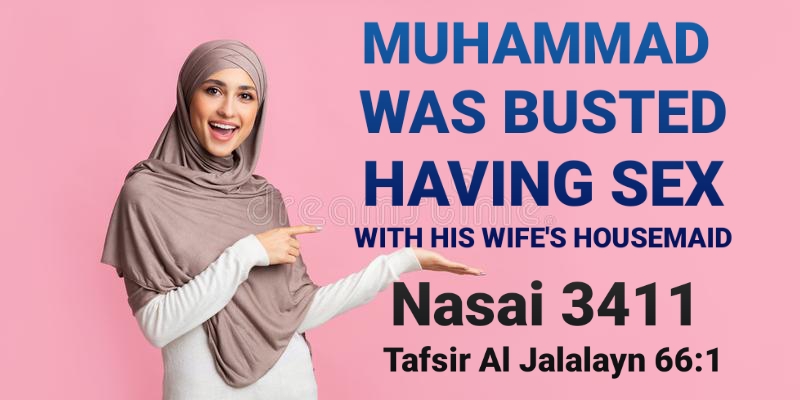
MUHAMMAD WAS BUSTED HAVING SEX WITH HIS WIFE'S HOUSEMAID MARIA


Muhammad is caught by wife Hafsa having sex with his slave Maria in Hafsa’s bed on Hafsa’s day. Muhammad tells Hafsa not to tell anyone and makes an oath to her that he won’t have sex with Maria anymore. Hafsa ends up telling Aisha the secret. All hell breaks loose when all the wives find out. (Nasai 3411, Tafsir al-Jalalayn 66:1)


Shalom 


Dr. Max Shimba for Max Shimba Ministries Org
DO YOU KNOW WHY MOHAMMAD DIVORCED HAFSA


“Muhammad: the Best of All Husbands” divorces Hafsa (after Hafsa reveals his “secret” that she caught him having sex with his slave in Hafsa’s bed)


In this revealing hadith, Muhammad divorces his wife Hafsa.


In Islam, for a man to divorce a woman, all he must say is, “I divorce you.” He must say it three times, ideally over three menstrual cycles, for it to be finalized.


Muhammad gave Hafsa one divorce, but he took her back:


Narrated Qais bin Zaid:


The Prophet ﷺ divorced Hafsah bint Umar. Her maternal uncles, Qudamah and Uthman, the sons of Maz‘un, visited her. She cried and said, “By Allah, he did not divorce me on account of satiation.” The Prophet ﷺ came and said, “Gabriel, peace be upon him, said to me, ‘Go back to Hafsah, for she fasts often and prays often at night, and she shall be your wife in Paradise.’”


(Al-Hakim, Al-Mustadrak 6753. Classed hasan by al-Albani.)


It is consensus among the ulama that Muhammad divorced Hafsa because she revealed Muhammad’s "secret." This is what is discussed in Quran 66:1-5, some of the most extraordinarily self-serving verses in the entire Quran. (Allah warns Hafsa and Aisha that He's Muhammad protector and they had better stop ganging up on Muhammad. Then He threatens all of Muhammad's wives that Muhammad will divorce them if they don't shape up.)


The exegete al-Tabari also arrives at that conclusion in an interesting (to me) linguistic discussion on the term arrafa found in 66:3:


He arafa (without the shadda on the letter "r") what Ḥafṣa did when she revealed the secret that he confided in her, meaning: The Prophet ﷺ was angry with her and for that he punished her. Like the saying of one to someone who wronged him: “For I will penalize you (u’arrifanna) for what you did, meaning that I will punish you for it.


They said: And the Prophet ﷺ punished her for what she did by divorcing her.


(Tafsir al-Tabari 23/91-92)


So what was Muhammad’s secret? There are two different sahih stories on what happened. The first one makes sense. The second one makes no sense.


Scholars typically say that both stories are true, which I find implausible. In any case, the two stories are:


Muhammad is caught by wife Hafsa having sex with his slave Maria in Hafsa’s bed on Hafsa’s day. Muhammad tells Hafsa not to tell anyone and makes an oath to her that he won’t have sex with Maria anymore. Hafsa ends up telling Aisha the secret. All hell breaks loose when all the wives find out. (Nasai 3411, Tafsir al-Jalalayn 66:1)


Wives Aisha and Hafsa want Muhammad to stop eating honey with his wife Zainab bint Jahsh. They falsely tell Muhammad that he smells bad after eating honey at Zainab’s. Muhammad then makes an oath that he won’t eat honey with Zainab anymore, and this needs to be kept a secret. Hafsa tells some other wife this. All hell breaks loose when all the wives find out. (Bukhari 6691)


Muhammad behaves like a petulant man-child in divorcing Hafsa. After getting caught having sex with his slave on Hafsa’s bed, he should be begging Hafsa for forgiveness every single day. Instead, he divorces her.


But thankfully the angel Gabriel (or Hafsa’s father Umar) got Muhammad to take Hafsa back.


Funny enough, there is a book called The Prophet Muhammad: the Best of All Husbands. That Muhammad divorced Hafsa or had sex with his slave in Hafsa's bed is mentioned nowhere in the book.


• HOTD #268: Sunan Abu Dawud 2283. Classed sahih by al-Albani and al-Arna’ut.


For 2018, I am counting down the 365 worst hadiths, ranked from least worst to absolute worst. This is our journey so far: HOTD list.

Friday, September 2, 2022

Muslim Wife Beating

 Muslim Wife Beating

MOHAMMAD WAS BEATING BABY AISHA 


The Quran:


Sura (4:34) - "Men are the maintainers of women because Allah has made some of them to excel others and because they spend out of their property; the good women are therefore obedient, guarding the unseen as Allah has guarded; and (as to) those on whose part you fear desertion, admonish them, and leave them alone in the sleeping-places and beat them; then if they obey you, do not seek a way against them; surely Allah is High, Great."


A husband has the legal right and religious obligation to beat a wife if she disobeys him, is disloyal to him or simply does not please him. The concept of wife abuse does not exist in Islam.  According to Islamic law, a husband may strike his wife for any one of the following four reasons:    


·                          She does not attempt to make herself beautiful for him (i.e. "let's herself go")

·                          She refuses to meet his sexual demands

·                          She leaves the house without his permission or a "legitimate reason"

·                          She neglects her religious duties


Any of these are also sufficient grounds for divorce.


From the Hadith:


Muslim (4:2127) - Muhammad struck his favorite wife, Aisha, in the chest one evening when she left the house without his permission. Aisha narrates, "He struck me on the chest which caused me pain."


Bukhari (7:72:715) - A woman came to Muhammad and begged her to stop her husband from beating her. Her skin was bruised so badly that she it is described as being "greener" than the green veil she was wearing. Muhammad did not admonish her husband, but instead ordered her to return to him and submit to his sexual desires.


Abu Dawud (2141) - "Iyas bin ‘Abd Allah bin Abi Dhubab reported the Apostle of Allah (may peace be upon him) as saying: Do not beat Allah’s handmaidens, but when ‘Umar came to the Apostle of Allah (may peace be upon him) and said: Women have become emboldened towards their husbands, he (the Prophet) gave permission to beat them. Then many women came round the family of the Apostle of Allah (may peace be upon him) complaining against their husbands. So the Apostle of Allah (may peace be upon him) said : Many women have gone round Muhammad’s family complaining against their husbands. They are not the best among you." At first, Muhammad forbade men from beating their wives, but he rescinded this once it was reported that women were becoming emboldened toward their husbands. Beatings are sometimes necessary to keep women in their place.


Abu Dawud (2142) - "The Prophet said: A man will not be asked as to why he beat his wife."


Shalom 


Dr. Max Shimba for Max Shimba Ministries Org

MUSLIM WOMEN: ISLAM’S DOMESTIC ANIMALS


“Now then, O people, you have a right over your wives and they have a right over you. You have [the right] that they should not cause anyone of whom you dislike to tread your beds, and that they should not commit any open indecency (fahishah). If they do, then God permits you to shut them in separate rooms and to beat them, but not severely. If they abstain from [evil], they have the right to their food and clothing in accordance with custom (bi’l-maruf). Treat women well, for they are [like] domestic animals (‘awan) with you and do not possess anything for themselves. You have taken them only as a trust from God, and you have made the enjoyment of their persons lawful by the word of God, so understand and listen to my words, O people. I have conveyed the Message, and have left you with something which, if you hold fast to it, you will never go astray: that is, the Book of God and the sunnah of His Prophet. Listen to my words, O people, for I have conveyed the message and understand [it]… It was reported [to me] that the people said, “O God, yes.” And the Messenger of God said, “O God, bear witness.”


Reference: Al-Tabari, Abu Ja’far Muhammad b. Jarir. The History of al-Tabari. Vol.IX: The Last Years of the Prophet. Translated and annotated by Ismail K. Poonawala. State University of NewYork Press, Albany, 1990. (Pages 112-114. Bold emphasis is mine) 


Eve was created from the rib of Adam but all of humankind is created from the womb of women.  Women therefore deserve equal, if not greater, respect and right than men in society. Reducing women to a vile, psychologically impaired and inferior being to men is a criminal injustice against women's natural place in society. Muhammad, a sex-crazed, brutal, criminal engendered 1,400 years of repression and degradation of billions of Muslim mothers and daughters.  Because these Quranic teachings are eternal, this repression and degradation of both Muslim and kafir women will continue forever.


It is important to understand that a Muslim man has the full right to obedience from his Muslim wife including beheading her if she continues to displease him. Verse 4:15 states that a disgraced woman is condemned to a solitary confinement till death. The alternative is the judgment of Allah. The Qur’an is not clear what that judgment of Allah could be. There are various interpretations on this. Therefore, a Muslim man may do to his woman whatever he wishes, including ending her life. 


According to Islam, if a Muslim woman disobeys her husband she is disgraced. Therefore, when a Muslim woman resorts to the Western justice system to seek protection from her menacing husband, she has certainly broken the Islamic tenet of complete surrender to the wishes of her husband. Thus, she has dishonored her husband, his reputation and, most importantly, the Islamic code of conduct for an obedient wife. Therefore, it is not surprising that her husband can end her life islamically, to restore his pride, honor and religious conviction.


Please note that in verse 4:34 Allah permits a husband to punish his disobedient wife. It is worthy to observe that this verse says if the husband suspects or fears disobedience and rebellion; that the actual acts might not have taken place. This verse also says that the men are the protectors of women. Thus, islamically, a Muslim wife, foolish enough to seek the protection of man’s law is a clear violation of Quranic injunction of verse 4:34, a challenge to Islam. And, as per the Islamic law, if anyone violates the Quranic command the only punishment is death by beheading. Thus, we may conclude that a Muslim man beheading his wife has acted in the manner that Quran commands him.


So vile, depraved, unjust and deplorable are the position and treatment of women in Islamic scriptures and teachings. Allah (the AntiGod) and his messenger Muhammad are male, chauvinist, pigs. A God of Moral Perfection is not a sexist. He believes in the complete equality of men and women. A God permitting the murder of Muslim women and the rape/enslavement of kafir women is not a God but a beast. All these teachings are morally and therefore, not from a God of Moral Perfection and therefore (repeating countless times) being not the teachings of a God of Moral Perfection Islam is totally and completely fraudulent. 


Shalom 


Dr. Max Shimba for Max Shimba Ministries Org

WHY DO THE BIBLE AND THE QURAN NOT AGREE?


Despite similarities, stemming from the same subject matter, history and persons mentioned, the Bible and the Quran differ widely on fundamental concepts of faith and practice in religion.


There are at least two possible reasons:


The Bible and the Quran do not stem from the same source, i.e. one of the two, or both, are of human or spiritist origin.


The Bible or the Quran, or both, have undergone editing and consequently the original nature and message has become lost.


In that case one of the two books, or both, contain error and cannot be termed reliable and trustworthy. Both Muslims and Christians are absolutely convinced of the divine origin, reliability and total trustworthiness of their respective book. One (or both) must be false. In that case very many millions of followers of the respective faiths base their hopes for eternity on error or even deception.


Representatives of both faiths have set out to prove their point, but since everyone is already committed to a definite conviction, objectivity is hardly possible. I, as a Christian, most probably am not as objective towards Islam as I should be - and neither will the Muslim reader be unbiased towards the Bible.


Within the framework of these studies we shall look only at scriptural and historical facts that are established, and will not engage in philosophical polemics. We do not want to argue about theological concepts either, but desire rather to discuss those that can be checked tested and verified by anyone, anywhere - provided one is able to turn to the sources mentioned. For that reason an attempt has been made to document all assertions as thoroughly as possible.


In recent years the Quran has undergone a process of spiritualisation. Some Muslims actually use Christian concepts, foreign to Quranic and traditional thinking, and explain that this is the spirit of Islam. These sentiments are difficult to accept unless they can be substantiated in the Islamic literature of old.

Since the Bible existed before the Quran, the difference between the two may be solved by providing:


Evidence that proves that the Quran is based on a false or poor understanding and knowledge of the earlier revelation (God cannot change, and will not give contradictory statements to different prophets!);


Evidence that proves a change was made in the message of the Bible by Jews and/or Christians, with acceptable reasons for doing so.


The Quran repeatedly and emphatically states that the Torah and Gospel - we take this to stand for the Old and New Testaments - are revelations by the same God as the God of the Quran.

What the Quran teaches about the Bible


"Say ye: 'We believe in Allah, and the revelation given to us, and to Abraham, Ismail, Jacob, and the Tribes, and that given to Moses, and Jesus, and that given to all prophets from their Lord: WE MAKE NO DIFFERENCE BETWEEN ONE AND ANOTHER OF THEM." (S. Baqara 2:136).

"Allah! There is no God but He, - the Living, the Selfsubsisting, Eternal ... He sent down Law (of Moses) and the Gospel (of Jesus) ... as a guide to mankind." (S. Al-i-Imran 3:2-3).

"0 ye who believe! Believe in Allah, and His Apostle - and the scripture which He sent before them". (S. Nisaa 4:136).

"It was We who revealed the Law (to Moses); therein was guidance and light ... if any do fail to judge by the light of what Allah hath revealed, they are (no better than) unbelievers ... We sent Jesus, the son of Mary, confirming the Law that had come before him: We sent him the Gospel: Therein was guidance and light ... a guidance and an admonition to those who fear Allah. LET THE PEOPLE OF THE GOSPEL JUDGE BY WHAT ALLAH HATH REVEALED THERElN. IF ANY DO FAIL TO JUDGE BY THE LIGHT OF WHAT ALLAH HATH REVEALED, THEY ARE (no better than) THOSE WHO REBEL. Judge. . . what Allah hath revealed, and follow not their vain desires ... "(S. Ma-ida 5:44,46,47,49).

"People of the Book! ... Stand fast by the Law, the Gospel, and all the revelation that hath come to you from YOUR LORD. It is the revelation that has come to thee from THY LORD." (ibid. vs. 68).

"The Quran is ... a confirmation of (revelations) that went before it". (S. Yi'inus 10:37).

"If thou wert in doubt as to what We have revealed unto thee, then ask those who have been reading the Book from before thee. The truth had indeed come to thee from thy Lord." (ibid. vs. 94).

"AND DISPUTE YE NOT WITH THE PEOPLE OF THE BOOK ... BUT SAY: WE BELIEVE IN THE REVELATION WHICH HAS COME DOWN TO US AND THAT WHICH CAME DOWN TO YOU". (S. Ankabut 29:46).

"This is a book which We have revealed, bringing blessings, and confirming (the revelations) which came before it: that thou mayest warn the Mother of Cities and all around her." (Sura 6:92).

What else does this mean, than that Mohammed claims to bring revelation to Mecca and the Arabs, confirming and establishing what was sent before him?


"Before thee, also, the apostles We sent were but men, to whom We granted inspiration: If ye realize this not, ASK OF THOSE WHO POSSESS THE MESSAGE (Sura 21:7).

We can clearly see that the Quran presupposes the divine revelation of "the Book" and its unpolluted content at the time of the prophet Mohammed. The Quran criticises, however, the twisting and misinterpretation of "the Book":


"Ye People of the Book! Why do ye clothe truth with falsehood and conceal the truth, while ye have knowledge? (S. Al-i-Imran 3:71).

"There is among them a section who distort the Book with their tongues: (as they read) you would think it is part of the Book, but it is no part of the Book." (S. ibid. vs. 78). (All emphasis in the quotations is my own).

If there is anything that comes out very clearly, it is that the Quran is emphatic that the Torah and the Gospel are revelation from God. This is what Christians believe too. The Quran says in this regard:


"No change can there be in the words of Allah" (Sura 10:64)

"There is none that can alter the words of Allah" (Sura 6:34).

Besides that, history and archaeology prevent one from arguing that the Bible has undergone any change since its official canonisation in A.D. 324. In fact almost all portions of the New Testament in their present form were in general circulation among the churches of the Second Century A.D. It was by general agreement at a Council of the bishops of 318 churches that all these were fully recognized and accepted as Apostolic and inspired. When Mohammed referred to "the Book" or "Taurat" or "Injil", he referred, no doubt, to what was in circulation in Arabia in his day and age. If words mean anything at all, then Mohammed referred to this "Book" (al-Kitab) as revelation. We take this as an established fact on the strength of the above evidence, unless it can be proved wrong.

Why should a Jew or Christian before or after the time of Mohammed be interested in changing God's revelation? Does he want to go to hell?


"I warn every one who hears the words of the prophecy of this book; if any one adds to them, God will add to him the plagues described in this book, and if any one takes away from the words of the book of this prophecy, God will take away his share in the tree of life and in the holy city, which are described in this book." (Revelation 22:18-19).

These are virtually the last verses of the Bible. The only conceivable reason to bring about changes would be that the Quran differs from the "Book". Consequently there are two possibilities: either the Christians refusing to accept the Quran tried to change all similarities between the Bible and the Quran; or Muslims seeing that the "Book" was in contrast to the Quran, expediently claim that the Bible must have been corrupted. The first assumption is against all evidence and logic.


QUESTION: Why do Muslims keep on claiming that the Bible is corrupt? When was the Bible allegedly polluted? Why does the Quran not clearly state that it was polluted?

There are differences between the Bible and the Quran.

The Quran states that both the Torah and Gospel are revealed. But in contrast, it also claims that Jesus was not crucified:


"They (the Jews) said (in boast), 'We killed Christ Jesus the son of Mary, the Apostle of Allah', - but they killed him not, nor crucified him, but so it was made to appear to them ... " (Sura 4:157).

The crucifixion receives the widest attention in the Gospel and was unmistakably prophesied in the Old Testament some 700-1000 years before it happened. See "Christians Answer Muslims", pages 48 ff., 97 ff.

In Sura 19:35 we are informed that


"it beseemeth not God to beget a son"

and near the end of the Quran (Sura 112:3) it says:


"He begetteth not, nor is He begotten",

which is also part of the Rak'at.

This again, is in contrast to the Bible. The words "it is not befitting Allah that He should beget a son" (Sura 19:35 and 92) suggest a physical act, which is as outrageous to Christians as it is to Muslims.

Jesus was born of a virgin. She asked:


" 'How shall I have a son, seeing that no man has touched me, and I am not unchaste?' He (an angel) said: 'So (it will be): Thy Lord saith, 'That is easy for me: and (We wish) to appoint him as a sign unto men and a mercy from Us.' " (Sura 19:2-21).


This, as in the Bible, does not indicate a begetting act. The whole concept of the "begotten" son is based on a misconception. In the original Greek the word "monogenes" is used, which means "only born". That God by the word of His power was the initiator of the pregancy of Mary is as clearly reflected in the Qur'an (Sura 19:16-22) as it is in the Bible. Even so, Islam assumed the Bible to teach that Jesus was "begotten", i.e. sexually conceived, an act which cannot possibly perceived of God: "It is not befitting to (the majesty of) Allah that He should beget a son", we read. But immediately the biblical position is presented: "Glory be to Him! When He determines a matter, he only says to it 'be', and it is." (Sura 19:35).

A very similar misunderstanding we find in the concept of the "Trinity", which according to the Quran is understood to consist of Jesus and Mary besides God, God being one of three (Sura 5:116). This is in no way in keeping with the biblical texts. Christians believe in what the Bible teaches. In both the Old Testament (B.C.) and the New Testament we know of ONE God only. ("Christians Answer Muslims, pp. 92 ff.). It is a tragedy that many Muslims think that Christians worship three gods. This is indeed not the case.


There are, moreover, many other differences between the Quran and the Bible, which are more of an historical nature than doctrinal:

Noah escaped the flood, but his son drowned (Sura 11:42-46) according to the Quran narrative, but he (Noah) escaped with his wife, three sons and their wives (Genesis 6:7,18) in the Bible.


The angel, announcing the birth of John the Baptist (Yahya) to his father, says:


"We bring thee tidings of a son, whose name shall be John: we have not caused any to bear the same name before him" (Sura 19:7 according to George Sale's translation).

or


"No namesake have We given him aforetime" (according to A.J. Arberry's translation).

or


"that name we have given to none before him" (Palmer's and Rodwell's translation).

This is incorrect. Johanan, the Hebrew form of John (Jahveh's Gift) was quite a common name, mentioned in the Old Testament. Yusuf Ali in his translation transliterates this statement therefore as "on none by that name have We conferred distinction before." His explanation:


"... for we read of a Johanan ... in II Kings 25:23."

Is a "translator" allowed to change a text like this to correct an error?


Abraham was the son of Azar in Sura 6:74 and the son of Terah in Genesis 11:27. Who would change a name from early history at random? What purpose would it serve? None. Only an error can be responsible. Does Azar stand for Eliezer? He is mentioned in Genesis 15:2 as a servant of Abraham.


Worse differences occur in the narrative about Moses. We are rightly told that Imran (Biblical Amram) was the father of Moses, Aaron and Miriam (by implication in Suras 19:28, 66:12, 20:25-30).


But that this Miriam (or Mary) is the mother of Jesus (who was actually born 1500 years later!) is rather unlikely.


The explanation offered by Yusuf Ali that she and her cousin Elizabeth were called "sisters of Aaron", because they were (in the case of Mary, "presumably": comm. 375) of a priestly family, is rather vague. The phrase, it is suggested, was derived from Luke 1:5, where Elizabeth, the mother of John the Baptist, being of priestly descent, was called "of the daughters of Aaron". What Yusuf Ali does not explain, is that the father of Aaron and Mary, the mother of Jesus, happens to be Imran according to the Quran. This, no doubt, shows human error which can hardly be regarded as a copying mistake. It is based on lack of knowledge of, or information about, the Bible.


That Moses was adopted by Pharaoh's wife (Sura 28:9) is contradicted by Exodus 2:10, where he was adopted by Pharaoh's daughter (otherwise he would also have been adopted by Pharaoh himself).


Moses' wife - we understand from the context (in Sura 28:22-28), that this must be Zipporah the daughter of Jethro - was given to Moses in exchange for 8-10 years' service. The Bible does not account for this (Exodus 2:16-22). We are, however, strongly reminded of Genesis 29:18 where Jacob pledges to serve Laban 7 years in exchange for Rachel. This was approximately 220 years prior to the time of Moses. Again we should like to inquire what possible purpose could any man have in changing the words of the Bible in historical narratives like these? Or could it have been Mohammed who confused some the stories he had heard?


The same applies to the statement that Haman was a servant of Pharaoh. According to the Quran, he is ordered by Pharaoh to light a kiln to bake bricks out of clay to "build me a lofty palace" (Sura 28:38, Yusuf Ali); or "high tower that I may ascend unto the God of Moses" (G. Sales); or "a tower, that I may reach the avenues of the heavens and ascend unto the God of Moses" (by Palmer and Rodwell); or "and make me a tower that I may mount up to Moses' god" (by Arberry).


We do recall the building of the tower of Babel in the Bible. But this event in Genesis 11 occurred 750 years before the time of Pharaoh in Exodus, and Haman (Book of Esther) lived 1100 years after Pharaoh. Yusuf Ali suggests (comm. 3331) that this refers to another Haman, but there is none other by that name in the Bible. We find it strange that Yusuf Ali in contrast to all other translators, speaks of a lofty palace, rather than a tower. Did he want to obscure the obvious similarities, which are embarrassing because they are historical misfits?


In the Bible (Judges 7) we read how God made Gideon select his small army of 300 from 32,000 men, for a special task. In Sura 2:249 we read of a very similar event, but this time under King Saul. Yusuf Ali in his commentary is aware of this, and remarks "as Gideon did before Saul" (comm. 284). This deed of Saul's is not found in the Bible and we take it to be another error.


Muslims believe that Ishmael was the son to be offered by Abraham on the altar. The Bible states that it was Isaac. This incidence highlights the whole concept of sacrifice, where a wide difference between the two Books can be detected.


Idu'l-Azha is based on Sura 22:34-37 where it says, inter alia:


"We have appointed for every nation a holy rite that they may mention Allah's name over such beasts of the flocks as He has provided them ... And the beasts of sacrifice - We have appointed them for you as among Allah's waymarks; therein is good for you ... The flesh of them shall not reach Allah, neither their blood (!). But godliness from you shall reach Him."


The Christian reader immediately notices in the above a total contradiction of the Biblical message.


"Where I see the blood, I will pass over you." (Exodus 12:13).


These are the words of God to Moses and the Jews after telling them that by applying the blood of a sacrifice to the lintels and doorposts of their homes, their families would escape the judgment of God that would strike Egypt.


"The life of the flesh is in the blood; and I have given it for you upon the altar to make an atonement for your souls; for it is the blood that makes atonement, by reason of the life." (Leviticus 17:11).


This is a concise statement, representing the very heart of the Law given to Moses. Although this ultimately points to the sacrifice of Jesus, who ratified all the offerings presented by the people under the Old Covenant, the demand of God still stands:


"Without the shedding of blood there is no forgiveness of sins (Hebrews 9:22).

It is a misjudgment of God's holiness and man's sinful nature to assume that our good deeds will ever be able to compensate for the evil in our lives.


The origin of Idu'l-Azha can be traced back to the year when, a few months after the Hejira, Mohammed observed the Jews of Medina celebrating the Day of Atonement (Leviticus 16) and he saw the role that sacrifice played among the people of the Book, the Jews. A Tradition records that Mohammed asked them why they kept the fast. He was informed that it was a memorial to the deliverance of Israel under Moses from the hands of the Egyptians.

"We have a greater right in Moses than they" said Mohammed and fasted with the Jews, commanding his followers to do the same.

The following year the initially friendly atmosphere between the Muslims and Jews had deteriorated and with it the Qibla was changed from Jerusalem to Mecca. Mohammed and his followers did not participate in the "Yom Kippur" (Day of Atonement) celebrated then. Instead, he instituted the Idu'l-Azha. He killed two young goats, one for himself and his family and one for the people (See Leviticus 16), still remaining true to Biblical demands. Idolatrous Arabs had been performing the annual Hajj to Mecca at this time of the year. The sacrifice of animals was also part of their ceremonial, so the institution of Idu'l-Azha may be seen also as a well-timed token of goodwill towards the Arabs of Mecca.


Although there is no reference in the Quran to the fact, it is generally accepted by Muslims that this feast was instituted to commemorate Abraham's sacrifice of his son Ishmael on Mount Mina near Mecca.


The reason for the above assumption is as follows: if Abraham's "only son" (Genesis 22:2) was offered, Isaac could not have been born at that stage, for Ishmael could not have been the only son anymore. But Genesis 22:2 is quite clear on this point. It actually states the name Isaac. In Sura 37:100-111 the story of the sacrifice of Abraham's son is recorded without naming the son: "We gave him the good news of a boy ready to suffer and forbear". Although this Sura deviates somewhat from the Biblical narrative, the event of the sacrifice is reported. As a parallel passage we should mention Sura 11:71, where, however, the chronology of the event has been somewhat mixed up.

The reference in Sura 37 culminates in the words:


"We ransomed him (the son) with (another) momentous (or noble) sacrifice." (My emphasis).


The Islamic concept that Ishmael was on the altar can be supported only by the Traditions (Yusuf Ali Commentary, note 4096, 4101) ("Dictionary of Islam", page 219). Bearing everything in mind we are tempted to conclude that the Islamic view is motivated by expediency.


Regarding the meaning of the sacrifice (Qurban = "approaching near", to whom? How? Why?), 


Muslims deny any implication of Biblical concepts whatsoever; we hold that this is not legitimate, since we are dealing with Biblical narrative and content. To the Muslim the Qurban is merely a remembrance rite to make one think of Ishmael. But even in the Quran, although denied in other passages (Sura 22:37), the issue is clear: "Ransomed by sacrifice"! Liberated from death by someone else stepping in, a momentous, noble sacrifice to redeem Isaac (or Ishmael, if you wish).


Here is Biblical ground. Here is the pointer to the sacrifice of Jesus Christ. He became the momentous noble sacrifice to die in our stead! 


Today Idu'l-Azha is a feast of rejoicing. But the sacrifice is not interpreted as being a ransom! Muslims claim that Abraham took Hagar and Ishmael, as a baby yet unweaned, to Paran (believed by Muslims to be near Mecca). This clashes with the Genesis account in the following respects:


a)Hagar and Ishmael were sent away, unaccompanied by Abraham, when

b)Isaac had already been born, i.e. Ishmael was at least 14 years old (and not weaned!).

c)Paran is not near Mecca but is south of Israel in the Sinai Peninsula.


We noted that in Genesis 22:2 Isaac is called Abraham's only son. This is biologically incorrect, but legally correct, for it obviously refers to:


i)the covenant bearer (Genesis 21:12); and

ii)Abraham's marriage to Sarah (Hagar was Abraham's concubine)


A Muslim may contend that the given Quranic text is "nazil", or has come as revelation from heaven: God knows about the matter and it need not have been reported in the Bible for Him to know. Of course God knows all things, past present and future. He revealed many events of the future comprehensively through the prophets in the Bible to demonstrate His authorship, and every reader is able to check and test if the facts reveal the divine imprint. But judging unemotionally, just guided by the evidence, Christians fail to see any divine imprint in the Quran. See pp. 39 ff.


QUESTION: How can one, in the light of the opening text of this chapter, account for these differences?


Shalom 


Dr. Max Shimba for Max Shimba Ministries Org

Saturday, August 13, 2022

MOHAMMAD LUST AND EVIL ACTS


Rape Sanctioned By Allah AKA Muhammad


Sunan Abu Dawud:  Abu Sa'id al-Khudri said: The Apostle of Allah (may peace be upon him) sent a military expedition to Awtas on the occasion of the battle of Hunain. They met their enemy and fought with them.  They defeated them and took them captives.  Some of the Companions of the Apostle of Allah (may peace be upon him) were reluctant to have intercourse with the female captives in the presence of their husbands who were  unbelievers. 


 So Allah, the Exalted, send down the Qur'anic verse: "And all married women (are forbidden) unto you save those (captives) whom your right hand possess."[Surah

4:24] ...Sunan Abu Dawud, Book V, Chapter 711, Number 2150


TORTUROUS PUNISHMENT


 Hands Must Be Cut Off For Theft


Volume 8, Book 81, Number 780:

Narrated 'Aisha: The Prophet said, "The hand should be cut off for stealing something that is worth a quarter of a Dinar or more."


The Quran says:

5:38 “Cut off the hands of thieves, whether they are male or female, as punishment for what they have done-a deterrent from God: God is almighty and wise.” 39 “But if anyone repents after his wrongdoing and makes amends, God will accept his repentance: God is most forgiving and merciful. (Haleem)”


MUHAMMAD WAS A TORTURER


Muhammad Ordered Feet And Hands Cut Off And Eyes Burnt Out, And Left To Suffer A Horrendous Death


From Sahih Bukhari, 1.234

Narrated Abu Qilaba: Anas said, "Some people of 'Ukl or 'Uraina tribe came to Medina and its climate did not suit them. So the Prophet ordered them to go to the herd of (Milch) camels and to drink their milk and urine (as a medicine). So they went as directed and after they became healthy, they killed the shepherd of the Prophet and drove away all the camels. The news reached the Prophet early in the morning and he sent (men) in their pursuit and they were captured and brought at noon. He then ordered to cut their hands and feet (and it was done), and their eyes were branded with heated pieces of iron. They were put in 'Al-Harra' and when they asked for water, no water was given to them." Abu Qilaba said, "Those people committed theft and murder, became infidels after embracing Islam and fought against Allah and His Apostle."


Allah AKA Muhammad Approved


5.33 The punishment of those who wage war against Allah and His apostle and strive to make mischief in the land is only this, that they should be murdered or crucified or their hands and their feet should be cut off on opposite sides or they should be imprisoned [Pickthall and Yusuf Ali have “exiled” rather than “imprisoned”]


BOOTY


Ishaq: 307 “The ‘Spoils of War’ Surah came down from Allah to His Prophet concerning the distribution of the booty when the Muslims showed their evil nature. Allah took it out of their hands and gave it to the Apostle.”


Bukhari V1B7N1331 “The Prophet said, ‘I have been given five things which were not given to any one else before me. 1. Allah made me victorious by awe by His terrorizing my enemies. 2. The earth has been made for me. 3. Booty has been made lawful for me yet it was not lawful for anyone else before me. 4. I have been given the right of intercession. 5. Every Prophet used to be sent to his nation only but I have been sent to all mankind.’”


Allah AKA Muhammad: Mafia Chieftain of the Universe


Quran-8:1— “They ask thee concerning (things taken as) spoils of war (booty). Say: "(such) spoils are at the disposal of Allah and the Messenger: So fear Allah, and keep straight the relations between yourselves: Obey Allah and His Messenger, if ye do believe."


Quran-8:41— “And know that out of all the booty that ye may acquire (in war), a fifth share is assigned to Allah, - and to the Messenger, and to near relatives, orphans, the needy, and the wayfarer, - if ye do believe in Allah and in the revelation We sent down to Our servant on the Day of Testing, - the Day of the meeting of the two forces. For Allah hath power over all things.”


According to verse 8:41, a fifth share of the booty


STONING


Narrated Abu Huraira and Zaid bin Khalid Al-Juhani:

“A bedouin came and said, "O Allah's Apostle! Judge between us according to Allah's Laws." His opponent got up and said, "He is right. Judge between us according to Allah's Laws." The bedouin said, "My son was a laborer working for this man, and he committed illegal sexual intercourse with his wife. The people told me that my son should be stoned to death; so, in lieu of that, I paid a ransom of one hundred sheep and a slave girl to save my son. Then I asked the learned scholars who said, "Your son has to be lashed one-hundred lashes and has to be exiled for one year." The Prophet said, "No doubt I will judge between you according to Allah's Laws. The slave-girl and the sheep are to go back to you, and your son will get a hundred lashes and one year exile." He then addressed somebody, "O Unais! go to the wife of this (man) and stone her to death" So, Unais went and stoned her to death.”


Allah AKA Muhammad  Approves (The only reason stoning is not in the Quran is because when Muhammad was dying a billy goat came into his room and ate the stoning laws of Muhammad AKA Allah. Unfortunately Billy did not eat the entire Quran) 


24:2 “The woman and the man guilty of adultery or fornication, - flog each of them with a hundred stripes: Let not compassion move you in their case, in a matter prescribed by God, if ye believe in God and the Last Day: and let a party of the Believers witness their punishment


Shalom 


Dr. Max Shimba for Max Shimba Ministries

RAPE AND GANG RAPE IS HALAL IN ISLAM


Bukhari (62:137) - An account of women taken as slaves in battle by Muhammad's men after their husbands and fathers were killed.  The woman were raped with Muhammad's approval.


Bukhari (34:432) - Another account of females taken captive and raped with Muhammad's approval.  In this case it is evident that the Muslims intend on selling the women after raping them because they are concerned about devaluing their price by impregnating them.  Muhammad is asked about coitus interruptus.


Rape Sanctioned By Allah AKA Muhammad


Sunan Abu Dawud:  Abu Sa'id al-Khudri said: The Apostle of Allah (may peace be upon him) sent a military expedition to Awtas on the occasion of the battle of Hunain. They met their enemy and fought with them.  They defeated them and took them captives.  Some of the Companions of the Apostle of Allah (may peace be upon him) were reluctant to have intercourse with the female captives in the presence of their husbands who were  unbelievers. 


 So Allah, the Exalted, send down the Qur'anic verse: "And all married women (are forbidden) unto you save those (captives) whom your right hand possess."[Surah


4:24] ...Sunan Abu Dawud, Book V, Chapter 711, Number 2150


TORTUROUS PUNISHMENT


Shalom 


Dr. Max Shimba for Max Shimba Ministries

MOSES AND SAMARITAN WOMAN

 MOSES AND SAMARITAN WOMAN 

QURAN HISTORICAL ERRORS 


The Qur'an says that the calf worshipped by the Israelites at mount Horeb was molded by a Samaritan (Sura 20:85-87, 95-97). Yet the term `Samaritan' was not coined until 722 B.C., which is several hundred years after the events recorded in Exodus.


Thus, the Samaritan people could not have existed during the life of Moses, and therefore, could not have been responsible for molding the calf.


It is interesting to notice that while Yusuf Ali attempts to change this word to "Samiri" and Pickthall to "As Samirii." Arberry in the English, and Kasimirski in the French both correctly translate it "Samaritan." Yusuf Ali, in his footnotes, "bends over backwards" to explain his choice by suggesting that the name could mean "Shemer," which denotes a stranger, or "Shomer," which means a watchman, the equivalent of "Samara" in Arabic, which he implies is close enough to the Samari he is looking for. But the Arabic simply does not give Ali the leeway to concoct other meanings for this word. 


To be consistent with the Arabic he should keep his translation consistent with the text, as Arberry and Kasimirski have done.


Shalom 


Dr. Max Shimba for Max Shimba Ministries

ERRORS IN THE QURAN

 A Plain Error and Contradiction in the Qur'an:


Who suffers loss if Muhammad was wrong?


In Sura 34:50, Muhammad is commanded to say the following:


Say: ‘If I go astray, I go astray only to my own loss; if I am guided, it is by what my Lord reveals to me. He is All-hearing, Ever-nigh.’ Arberry

Say: "If (even) I go astray, I shall stray only to my own loss. But if I remain guided, it is because of the Inspiration of my Lord to me. Truly, He is All­Hearer, Ever Near (to all things)." Hilali & Khan


The error in this verse should be obvious to anyone pondering this statement for a little bit. The issue here is not whether, objectively, Muhammad went astray or was guided; Muslims and non-Muslims will continue to disagree about that. This verse is logically wrong, independent of whether Muhammad was guided or not.


The Error


Who suffered and still suffers loss if Muhammad was wrong?


The first point is somewhat trivial. Muslims are commanded in the Qur'an to take Muhammad as their model, and therefore many Muslims imitate him in the smallest details of life. They dress like Muhammad, they use a miswak to brush their teeth like Muhammad did, etc. If Muhammad was wrong, then this would mean a life of unnecessary inconvenience for millions of Muslims.


There are, however, a lot of not so trivial aspects. If Muhammad's message and regulations were wrong, he has subjected millions of Muslim women to a life of misery (see the various articles on Women in Islam) without any reward in return! Moreover, not only those who followed Muhammad have lost, but millions of the so-called "unbelievers" have suffered because Muslims have either killed them for their lack of faith, or forced Muhammad's regulations on them and subjected them to live as second-class citizens (see the section on Non-Muslims under Islamic Rule).


Ironically, these people have suffered loss even if Muhammad had been a true prophet. Whether Muhammad was astray or guided, many lives have been destroyed by Muslim attacks on unbelievers, so that this statement is not only logically false, but false also in factual history.


Putting aside all the atrocities and suffering in this earthly life that resulted from Muhammad's teachings, the intention of this verse was certainly to make a statement about the loss suffered in eternity, i.e. whether people will be punished or rewarded in the Last Judgement based on their acceptance or rejection of God's message.


Under the assumption that Muhammad was a true messenger, those who were killed as unbelievers because they did not accept his message on the spot have lost not only their lives but also the opportunity to become convinced by the truth of Islam by having the time to study the message of Islam in-depth. [Had Islam restricted its method of expansion to peaceful proclamation and intellectual persuasion instead of using (also and much too quickly) violence and force, the situation would be vastly different.] As it is, these people have lost their lives on earth, and they will suffer eternal punishment because they died in rejection of God's message. Thus, many unbelievers will suffer eternal loss even if Muhammad was right. Though Muslims may argue that in the quranic view this may be justified, it is unquestionable that they did suffer temporal and eternal loss due to the violent nature of Islam.


If, on the other hand, the Bible is true and Muhammad was a false prophet then the number of those who suffer eternal loss increases vastly: (1) The unbelievers (idolaters, atheists, ...) who were killed for rightly rejecting Islam still lost their opportunity to hear, understand and accept the true message of God. (2) Millions and millions of Muslims who have rejected the authentic Gospel of Jesus based on Muhammad's message will be lost forever because they rejected the salvation from sin offered by God through Jesus' death on the Cross.


Thus, an enormous number of people will suffer both earthly and eternal loss if Muhammad was wrong, in stark contradiction to Sura 34:50.


After pondering these facts there can hardly be any doubt that Sura 34:50 is an objectively wrong statement. It is a plain error in the Qur'an.


Does God make errors? Would God inspire a statement as wrong as this one?

This verse exposes the very human nature of the Qur'an. It obviously did not come from God, but from Muhammad himself, and it can easily be explained why Muhammad would add such a statement into his revelation. If time permits, I may later write an appendix to this article dealing with the psychological aspect of this error.


Finally, there is one more crucial observation to be made in this section. Simply looking at how Muhammad dealt with those who propagated a different message than Islam, or voiced critique of Islam (cf. these articles), exposes that Muhammad did not even believe this statement himself. In particular, Muhammad's instruction is: Whoever leaves Islam, kill him (e.g. Sahih Al-Bukhari 4.260; for detailed discussions on the issue of apostasy in Islam consult the links at the bottom of this page). Obviously, Muhammad considered apostasy, and publically speaking of a belief other than Islam such a grave danger to the Islamic community that the harshest possible measures had to be instituted against it. Nowhere in an Islamic society is open preaching of another religion permitted. Why not, if those who do so will "only go astray to their own loss"? The laws in the Shariah, and the reactions of Muslims towards those who want to publically invite (Muslims) to another faith prove that they do not believe Sura 34:50 to be true.


The Contradiction


Yet, there is more. Sura 34:50 is not only a factual error (i.e. contradicting objective reality) as outlined above, it is also part of an internal contradiction in the Qur'an which will be the topic for the remainder of this article.


Though the statement "If I go astray, I go astray only to my own loss" is hypothetical (i.e. the assumption is that Muhammad is not astray but on the right path), it stands in obvious tension to a multitude of verses in the Qur'an that demand that believers should obey and follow the messenger (Muhammad), i.e. Muhammad's words and example are supposed to directly impact those who believe in Allah. Some examples:


Say: Obey Allah and the messenger. But if they turn away, lo! Allah loveth not the disbelievers (in His guidance). S. 3:32 Pickthall

And obey Allah and the messenger, that ye may find mercy. S. 3:132 Pickthall


These are the limits (imposed by) Allah. Whoso obeyeth Allah and His messenger, He will make him enter Gardens underneath which rivers flow, where such will dwell for ever. That will be the great success. S. 4:13 Pickthall


They ask thee (O Muhammad) of the spoils of war. Say: The spoils of war belong to Allah and the messenger, so keep your duty to Allah, and adjust the matter of your difference, and obey Allah and His messenger, if ye are (true) believers. S. 8:1 Pickthall


It is not for any believer, man or woman, when God and His Messenger have decreed a matter, to have the choice in the affair. Whosoever disobeys God and His Messenger has gone astray into manifest error. S. 33:36 Arberry

O believers, obey God, and obey the Messenger, and do not make your own works vain. S. 47:33 Arberry


There is no blame for the blind, nor is there blame for the lame, nor is there blame for the sick (that they go not forth to war). And whoso obeyeth Allah and His messenger, He will make him enter Gardens underneath which rivers flow; and whoso turneth back, him will He punish with a painful doom. S. 48:17 Pickthall

Whoso obeyeth the messenger hath obeyed Allah, ... S. 4:80 Pickthall


Establish worship and pay the poor-due and obey the messenger, that haply ye may find mercy. S. 24:56 Pickthall


Those who swear fealty to thee [Muhammad] swear fealty in truth to God; God's hand is over their hands. Then whosoever breaks his oath breaks it but to his own hurt; and whoso fulfils his covenant made with God, God will give him a mighty wage. S. 48:10 Arberry

Whatsoever spoils of war God has given to His Messenger from the people of the cities belongs to God, and His Messenger, and the near kinsman, orphans, the needy and the traveller, so that it be not a thing taken in turns among the rich of you. Whatever the Messenger gives you, take; whatever he forbids you, give over. And fear God; surely God is terrible in retribution. S. 59:7 Arberry


And there are many more like these, see S. 4:59, 69; 5:92; 8:20, 24, 46; 9:71; 24:51-52, 54; 33:33, 71; 49:14; 58:13; 64:12, etc.

The Qur'an does not only make it mandatory to obey Muhammad's explicit commands (whether they are verses found in the Qur'an or Muhammad's own words, see S. 24:45, 57:9), it makes everything Muhammad does and says the standard to emulate:


Your Companion is neither astray nor being misled. Nor does he say (aught) of (his own) desire. It is no less than inspiration sent down to him: He was taught by one Mighty in Power, ... S. 53:2-5 Yusuf Ali


And verily, you (O Muhammad) are on an exalted standard of character. S. 68:4 Hilali & Khan


Indeed in the Messenger of Allah (Muhammad) you have a good example to follow for him who hopes in (the Meeting with) Allah and the Last Day and remembers Allah much. S. 33:21 Hilali & Khan


Based on verses like these, Muhammad is considered the perfect and divinely endorsed role model, and he is followed in the minutest details of life. To claim, therefore, that if he goes astray it will still not result in any harm to those who follow him in everything (S. 34:50), is hardly coherent.


As stated above, these verses do not yet posit a clear-cut contradiction to S. 34:50, but they are in considerable tension. The plain contradiction arises when we add the following verses into the equation:


And those who disbelieve say to those who believe: Follow our path and we will bear your wrongs. And never shall they be the bearers of any of their wrongs; most surely they are liars. S. 29:12 Shakir


That they may bear their burdens entirely on the day of resurrection and also of the burdens of those whom they lead astray without knowledge; now surely evil is what they bear. S. 16:25 Shakir


These verses make it clear that "following those who lead you astray" does not absolve you from your own responsibility. On Judgement Day, those leaders will not bear the punishment (burden) for your going astray. Nobody will be able to excuse himself completely with "but I only followed this or that false prophet or teacher". S. 16:25 seems to indicate that some part of the burdens of those who were led astray may be put on the one who had misled them, but it still shows that the remainder has to be shouldered by the person who followed the false prophet into transgression and disobedience to God. Thus, those who lead astray cause their followers to suffer divine punishment and eternal loss.


Therefore, Sura 34:50 ("If I go astray, I go astray only to my own loss"), together with the many verses that command believers to follow and obey Muhammad, strongly and obviously contradicts Sura 16:25 and 29:12.


[ Side remark: This is not a trivial contradiction of whether Allah's day equals 1000 or 50000 years, or whether Allah created the universe in six or eight days. This is a contradiction at the very core of the religion, i.e. what happens to those who follow a false prophet! ]


Suras 16:25 and 29:12 also play a significant role in a somewhat different but closely related contradiction which is discussed in the article Who Suffers the Consequence of Sins according to the Qur'an? Another relevant detail in the formulation of 16:25 is examined in Who are those "without knowledge"?


There are a considerable number of additional verses which state that those who follow others who are astray (the reference is usually to the ancestors) are not therefore excused as being only victims, but are condemned by Allah for following them into falshood:


When it is said to them: "Follow what God hath revealed:" They say: "Nay! we shall follow the ways of our fathers." What! even though their fathers were void of wisdom and guidance? S. 2:170; cf. 5:104


They said: "Comest thou to us, that we may worship God alone, and give up the cult of our fathers? bring us what thou threatenest us with, if so be that thou tellest the truth!" He said: "Punishment and wrath have already come upon you from your Lord: dispute ye with me over names which ye have devised - ye and your fathers, - without authority from God? then wait: I am amongst you, also waiting." S. 7:70-71


And when they commit an indecency they say: We found our fathers doing this, and Allah has enjoined it on us. Say: Surely Allah does not enjoin indecency; do you say against Allah what you do not know? S. 7:28


So be not thou in doubt concerning that which these (folk) worship. They worship only as their fathers worshipped aforetime. Lo! we shall pay them their whole due unabated. S. 11:109

We bestowed aforetime on Abraham his rectitude of conduct, and well were We acquainted with him. Behold! he said to his father and his people, "What are these images, to which ye are (so assiduously) devoted?" They said, "We found our fathers worshipping them." He said, "Indeed ye have been in manifest error - ye and your fathers." S. 21:51-54


Lo! We have appointed it a torment for wrong-doers. Lo! it is a tree that springeth in the heart of hell. Its crop is as it were the heads of devils And lo! they verily must eat thereof, and fill (their) bellies therewith. And afterward, lo! thereupon they have a drink of boiling water. And afterward, lo! their return is surely unto hell. They indeed found their fathers astray, But they make haste (to follow) in their footsteps. And verily most of the men of old went astray before them, And verily We sent among them warners. Then see the nature of the consequence for those warned, S. 37:63-73 Pickthall


Here, these people are following the religion taught to them by their fathers, and some even doing shameful acts passed on to them by their forebears, so they have been misled. Yet, Allah still condemns them for these beliefs and practices, and they will still have to bear their full punishment (S. 11:109). It does not even help them to claim that it was Allah who enjoined it on them (S. 7:28), perhaps through some prophet in the past who claimed to bring commands from Allah, but who was actually a false prophet.


People who follow false teachers or prophets will suffer loss and punishment caused at least in part by those who led them astray. This is a common sense principle which is contradicted by Sura 34:50, a severe error and a glaring contradiction in the Qur'an.


Jochen Katz

The Question of Jibril’s Identity in Muhammad’s Revelation: A Critical Examination

The Question of Jibril’s Identity in Muhammad’s Revelation: A Critical Examination By Dr. Maxwell Shimba, Shimba Theological Institute I...

TRENDING NOW