Wednesday, July 25, 2018

Malaysia: Muslim justifies his marriage to 11-year-old by saying he wanted to marry her since she was 7


Oh, that makes it all right, eh?
Islamic tradition records that Muhammad consummated his marriage with (i.e., raped) Aisha when she was nine, and the resultant fact that child marriage is accepted in wide swaths of the Islamic world. Child marriage has abundant attestation in Islamic tradition and law.
Turkey’s directorate of religious affairs (Diyanet) said in January 2018 that under Islamic law, girls as young as nine can marry.
“Islam has no age barrier in marriage and Muslims have no apology for those who refuse to accept this” — Ishaq Akintola, professor of Islamic Eschatology and Director of Muslim Rights Concern, Nigeria
“There is no minimum marriage age for either men or women in Islamic law. The law in many countries permits girls to marry only from the age of 18. This is arbitrary legislation, not Islamic law.” — Dr. Abd Al-Hamid Al-‘Ubeidi, Iraqi expert on Islamic law
There is no minimum age for marriage and that girls can be married “even if they are in the cradle.” — Dr. Salih bin Fawzan, prominent cleric and member of Saudi Arabia’s highest religious council
“Islam does not forbid marriage of young children.” — Pakistan’s Council of Islamic Ideology
Hadiths that Muslims consider authentic record that Muhammad’s favorite wife, Aisha, was six when Muhammad wedded her and nine when he consummated the marriage:
“The Prophet wrote the (marriage contract) with Aisha while she was six years old and consummated his marriage with her while she was nine years old and she remained with him for nine years (i.e. till his death)” (Bukhari 7.62.88).
Another tradition has Aisha herself recount the scene:
The Prophet engaged me when I was a girl of six (years). We went to Medina and stayed at the home of Bani-al-Harith bin Khazraj. Then I got ill and my hair fell down. Later on my hair grew (again) and my mother, Um Ruman, came to me while I was playing in a swing with some of my girl friends. She called me, and I went to her, not knowing what she wanted to do to me. She caught me by the hand and made me stand at the door of the house. I was breathless then, and when my breathing became all right, she took some water and rubbed my face and head with it. Then she took me into the house. There in the house I saw some Ansari women who said, “Best wishes and Allah’s Blessing and a good luck.” Then she entrusted me to them and they prepared me (for the marriage). Unexpectedly Allah’s Apostle came to me in the forenoon and my mother handed me over to him, and at that time I was a girl of nine years of age. (Bukhari 5.58.234).
Muhammad was at this time fifty-four years old.
Marrying young girls was not all that unusual for its time, but because in Islam Muhammad is the supreme example of conduct (cf. Qur’an 33:21), he is considered exemplary in this unto today. And so in April 2011, the Bangladesh Mufti Fazlul Haque Amini declared that those trying to pass a law banning child marriage in that country were putting Muhammad in a bad light: “Banning child marriage will cause challenging the marriage of the holy prophet of Islam, [putting] the moral character of the prophet into controversy and challenge.” He added a threat: “Islam permits child marriage and it will not be tolerated if any ruler will ever try to touch this issue in the name of giving more rights to women.” The Mufti said that 200,000 jihadists were ready to sacrifice their lives for any law restricting child marriage.
Likewise the influential website Islamonline.com in December 2010 justified child marriage by invoking not only Muhammad’s example, but the Qur’an as well:
The Noble Qur’an has also mentioned the waiting period [i.e. for a divorced wife to remarry] for the wife who has not yet menstruated, saying: “And those who no longer expect menstruation among your women, if you doubt, then their period is three months, and [also for] those who have not menstruated” [Qur’an 65:4]. Since this is not negated later, we can take from this verse that it is permissible to have sexual intercourse with a prepubescent girl. The Qur’an is not like the books of jurisprudence which mention what the implications of things are, even if they are prohibited. It is true that the prophet entered into a marriage contract with A’isha when she was six years old, however he did not have sex with her until she was nine years old, according to al-Bukhari.
Other countries make Muhammad’s example the basis of their laws regarding the legal marriageable age for girls. Article 1041 of the Civil Code of the Islamic Republic of Iran states that girls can be engaged before the age of nine, and married at nine: “Marriage before puberty (nine full lunar years for girls) is prohibited. Marriage contracted before reaching puberty with the permission of the guardian is valid provided that the interests of the ward are duly observed.”
According to Amir Taheri in The Spirit of Allah: Khomeini and the Islamic Revolution (pp. 90-91), Iran’s Ayatollah Khomeini himself married a ten-year-old girl when he was twenty-eight. Khomeini called marriage to a prepubescent girl “a divine blessing,” and advised the faithful to give their own daughters away accordingly: “Do your best to ensure that your daughters do not see their first blood in your house.” When he took power in Iran, he lowered the legal marriageable age of girls to nine, in accord with Muhammad’s example.
“41-year-old man wanted to marry child bride since she was 7,” Pattaya One, July 17, 2018 (thanks to Paul):
PETALING JAYA: The 41-year-old man who took an 11-year-old girl as his wife denied that it was an act of lust as he had wanted to marry her since she was seven.
BH Online reported the man saying that they would already moved in together if he only married her because of desire, instead of waiting five years for her to turn 16.
The 41-year-old said he was unsure what made him feel like marrying the girl, but claimed it was not driven by desire.
“I knew Ayu since she was small because we were neighbours, and I also taught her Al-Quran lessons. It was then I told myself one day I will take this girl as my wife and I did so four years later,” he said.
The man told BH Online that his marriage to the girl in Kelantan had only shocked the outside world, as most of the villagers and his friends had agreed to the union.
He said he had showed his friends a picture of the girl while he was in Mecca and they gave their blessings as she was not in school and had come from a poor family….
The man had refused to give in to public pre https://www.jihadwatch.org/2018/07/malaysia-muslim-justifies-his-marriage-to-11-year-old-by-saying-he-wanted-to-marry-her-since-she-was-7ssure to have the marriage annulled.

Monday, July 23, 2018

SPREADING CHRISTIANITY IN GARISSA


Christian missionaries are currently active in various parts of Garissa, with the establishment of Frontier Life Mission School, complete with a bus, touring Dadaab refugee camps, Garsen districts and so on.


They are showing Jesus films to communities which have never heard about Christianity. Other areas they operate freely are in Eastern and Rift Valley provinces like the Laisamis missionaries in Rendille districts, Missionary schools funded from German, The UK and US. There is also the Borana, Sakuye initiative through the Joshua Project.

A Prominent Somali Christian Killed in Mogadishu Truck Bomb Attack


Al Shabab Islamists detonated a truck bomb in a busy intersection in the heart of the Somali capital on Saturday afternoon, 14 October 2017. The Associated Press (AP), quoting Somali government sources, put the number of dead about 350, a figure that is destined to rise as many dead victims are still buried under mountains of rubble. Many of the hundreds of the wounded victims would succumb to their grave injuries. This major bombing was the third explosion in the city on that fateful day but the largest single-day massacre Somalia has ever witnessed.


Several Somali Christians died in the attack including Fardawza Haji Hilowle Jama, 39, and her two minor children and Dr. Maryan Abdullahi Mo'alim Mohamed Geddi, 22, who died on the eve of her planned graduation from a medical school. Dr. Maryan attended a local house-church in the center of the capital and played a significant role in the raising and the distribution of drought relief funds in the last two years. An article by the New York Times described Dr. Mayan as a “rising star.”[1]

Dr. Maryan is a relative of the late Somali Christian evangelist, Ali Mustaf Maka’il, who was shot and killed in Mogadishu at the age of 22 in 2006 by the now-defunct Union of Islamic Courts, Al Shabab's predecessor[2]. There are eight missing Somali Christians who were around Zope Street at the time of the explosion. No one knows where they are, but they presumed dead. The verified injured Somali Christians are eleven including four children.


Our prayers are with all the victims and their families during this difficult time.

Prominent Somali Christian Martyred in Northeast Kenya

Suspected Al Shabab Islamists opened fire on  two somali Christian leaders in Garissa, Kenya, killing one immediately and wounding the other.


Rev. Abdi Welli Ahmed, a longtime missionary in West Africa and East Africa, was shot and killed this morning around 11:00 AM local time. Pastor 
Ibrahim M. Makunyi who was with Rev. Abdi Welli at the time of the attack sustained gun wounds.

The two Somali church leaders were ambushed in Garissa's main market.

Rev. Abdi Welli, a Somali Kenyan, is survived by his Nigerian born wife, Hellen, and three children.


According to eye witnesses, Rev. Abdi Welli's last words were: "it's good to be in the hands of  Al Shaddai."

The Lord found Rev. Abdi Welli in 1990 and was baptized in 1995 , Rev. Abdi Welli returned to Kenya in 2000 after serving in Niger as a missionary. He was ordained in 2004.

A Somali church leader in Mogadishu, Somalia, said in a telephone interview, "with the martyrdom of Rev. Abdi Welli, the Somali church has lost its only eye." He described Rev. Abdi Welli as a "fearless evangelist, pastor and gifted missionary."


The Somali Christian community will miss Rev. Abdi Welli dearly. The Somali church has shown in the past to be very resilient.


A house church pastor in Baidawa, Somalia, described Rev. Abdi Welli as "one of the finest ministers the Somali church has ever produced." She continued and said "the Somali church is the Lord's and he will protect it from the evil one. No degree of Muslim persecution will destroy the Somali church."


Rev. Abdi Welli's widow, with the help of the Christian community in Garissa, is prepared to bury her husband but Rev. Abdi Welli's Muslim relatives are demanding to bury him based on a clannish tradition. 

Some Christian leaders in Garissa expressed concern that Muslim relatives want to burry Abdi Welli because they want to humiliate and desecrate his body to send a message to the Muslim background Somali Christians in the town.

Our thoughts and prayers are with the families of the two leaders. 


Somalis For Jesus condemns in the strongest terms possible the cowardly attack on peace loving individuals who positively contribute to their communities.


February 14 update:
Rev. Abdi Welli was buried today by his family with the help of the community of faith.

The funeral was attended by hundreds of mourners including Muslim friends and family members.

May the legacy of Rev. Abdi Welli last forever. He was indeed a true example of a follower of the Messiah who refused to run away when threatened by Muslims. A family member told SFJ that Rev. Abdi Welli once said "how can flee from the ones who need the gospel the most? Who will stay behind to disciple when I run away for my life?"

Rev. Abdi Welli never ran away. He stayed until he was shot multiple times by Somali Muslims. May his killers confess, repent and accept to follow the Messiah, the Prince of Peace.

DO YOU KNOW THAT MUHAMMAD WAS UNCIRCUMCISED?


Hadith in Musnad Ahmad Ibn-Hanbal, vol. 4, p. 217:

"Uthman Ibn-al-As was invited to a circumcision, but he refused to come. When asked for the reason, he said: in the time of Muhammad we did not practice circumcision and we were not invited to it."

Image may contain: 2 people, beard and text

MUSLIMS WILL MEET ALLAH, NAKED AND UNCIRCUMCISED

Image may contain: text

Narrated 'Aisha: Allah's Apostle said, "The people will be gathered barefooted, naked, and uncircumcised." I said, "O Allah's Apostle! Will the men and the women look at each other?" He said, "The situation will be too hard for them to pay attention to that." Sahih Muslim | Book 40 | Chapter 14

http://hadith.islamicevents.sg/muslim/chapter/40/14


Sunday, July 22, 2018

WHO IS THE LAST PROPHET? ISA BIN MARYAM OR MUHAMMAD?

WAS MUHAMMAD THE FIRST OR THE LAST?

WHO IS THE LAST PROPHET? ISA BIN MARYAM OR MUHAMMAD?

SERIOUS CONTRADICTIONS IN THE QURAN AND ENTIRE RELIGION OF ISLAM. 

Say (O Muhammad): Lo! I am commanded to worship Allah, making religion pure for Him (only). And I am commanded to be the first of those who are muslims (surrender unto Him). S. 39:11-12 Pickthall

IS MUHAMMAD THE LAST PROPHET?

مَا كَانَ مُحَمَّدٌ أَبَآ أَحَدٍ مِّن رِّجَالِكُمْ وَلَكِن رَّسُولَ اللَّهِ وَخَاتَمَ النَّبِيِّينَ وَكَانَ اللَّهُ بِكُلِ‏ّ شَىْ‏ءٍ عَلِيماً

“Muhammad is not the father of any of your men, but he is the Apostle of Allah and the Last of the prophets; and Allah is cognizant of all things.” (33:40)

HERE ISA IS COMING AS THE LAST PROPHET?

"The son of Mary will soon descend among you and will judge justly (according to the Law of God): he will break the cross and kill the pig... " (Saheeh Al-Bukhari)


‏حدثنا ‏ ‏هدبة بن خالد ‏ ‏حدثنا ‏ ‏همام بن يحيى ‏ ‏عن ‏ ‏قتادة ‏ ‏عن ‏ ‏عبد الرحمن بن آدم ‏ ‏عن ‏ ‏أبي هريرة ‏
‏أن النبي ‏ ‏صلى الله عليه وسلم ‏ ‏قال ‏ ‏ليس بيني وبينه نبي ‏ ‏يعني ‏ ‏عيسى ‏ ‏وإنه نازل فإذا رأيتموه فاعرفوه رجل ‏ ‏مربوع ‏ ‏إلى الحمرة والبياض بين ‏ ‏ممصرتين ‏ ‏كأن رأسه يقطر وإن لم يصبه بلل فيقاتل الناس على الإسلام فيدق الصليب ويقتل الخنزير ‏ ‏ويضع ‏ ‏الجزية ‏ ‏ويهلك الله في زمانه الملل كلها إلا الإسلام ويهلك ‏ ‏المسيح الدجال ‏ ‏فيمكث في الأرض أربعين سنة ثم ‏ ‏يتوفى فيصلي عليه المسلمون

Abu Huraira narrated that Prophet Mohammad صلى الله عليه وسلم said: "There is no prophet between me and him (Jesus Christ عليه السلام ). He shall descend so, recognize him when you see him. He is a man of medium height, (his complexion) is between reddish and white; he will be between (or dressed in) two slightly yellowish garments; His head looks as if it is dripping water even though it is not wet. He will fight people in the cause (for the sake) of Islam, will break the Cross and kill the swine (pig) and abolish Jizya (tax on Christians and Jews); and Allah will put an end to all religious sects except Islam during his (Jesus') time. He (Jesus) will slay the Antichrist (Dajjal) and he will stay in the World for 40 years. Then, he will die and the Muslims will perform the funeral prayer for him." (Abu Dawud and Musnad Ahmad)

Prophet Mohammad صلى الله عليه وسلم said: "In the meantime, while the Dajjal will be busy doing this and this, Allah will send down the Messiah son of Mary (Jesus عليه السلام). He (Jesus عليه السلام ) will descend in the eastern part of Damascus, near the white minaret (tower), dressed in the two yellow garments, with his hands resting on the arms of two angels. When he will bend down his head, water drops will appear trickling down, and when he will raise it, it will appear as though pearl--like drops are rolling down. Any disbeliever whom the air of his breath reaches, and it will reach up to the last limit of his sight, will fall dead. Then, the son of Mary will go in pursuit of the Dajjal, and will overtake him at the gate of Lud , and will kill him." (Sahih Muslim, Abu Dawud, Tirmizi, Ibn Majah).

Prophet Mohammad صلى الله عليه وسلم said: "The Daijal (Anti-Christ) will appear in my Ummah (nation), and will live for forty. Then Allah will send Jesus son of Mary عليه السلام. He (Jesus عليه السلام) will closely resemble 'Urwah bin Masud (a Companion of Prophet Mohammad صلى الله عليه وسلم ). He (Jesus عليه السلام) will pursue him (Anti-Christ) and kill him. Then, for seven years, the people will live in such a state that there will be no ill-will or enmity between any two individuals of them." (Sahih Muslim).

WHO IS THE LAST PROPHET OF ISLAM?

Shalom


Image may contain: text

Saturday, July 21, 2018

The 20 Versions of the Qur'an today

The 20 Versions of the Qur'an today. (7 are recorded in the Hadith.)

Qur'an of today is different than what Muhammad revealed!


The Muslim Claim that the Qur'an is unchanged:

No other book in the world can match the Qur'an ... The astonishing fact about this book of ALLAH is that it has remained unchanged, even to a dot, over the last fourteen hundred years. ... No variation of text can be found in it. You can check this for yourself by listening to the recitation of Muslims from different parts of the world. (Basic Principles of Islam, Abu Dhabi, UAE: The Zayed Bin Sultan Al Nahayan Charitable & Humanitarian Foundation, 1996, p 4)

Many Variant Readings of the Quran

  1. "Muslims attack the Bible on the grounds that it sometimes has conflicting wording from different manuscripts. Yet this is exactly the case with the text of the Quran. There are many conflicting readings on the text of the Quran as Arthur Jeffery has demonstrated in his book, Material for the History of the Text of the Quran" (New York, Russell F. Moore, 1952).
  2. Mentions Variant readings in the Koran: Dashti, 23 Years, p. 28
  3. Mentions Variant readings in the Koran: Mandudi, Meaning of the Quran, pp. 17-18
  4. Mentions Variant readings in the Koran: McClintock and Strong, Cyclopedia, V152).
  5. "[the Koran] had a large number of variants, not always trifling in significance" (Islam, p. 189).
  6. "It is interesting to note that in scholarly Muslim journals, there is beginning to be a grudging acknowledgment of the fact that there are variant and conflicting readings on the text of the Quran" (One example would be Saleh al-Wahaihu, "A Study of Seven Quranic Variants," International Journal of Islamic and Arabic Studies, Vol. V (1989), #2, pp. 1-57).
  7. "The Muslin accounts of the history of the Quran texts are a mass of confusion, contradiction and inconsistencies" (Burton, Collection, p. 231).
  8. "Abdollah renounced Islam on the ground that the revelations, if from God, could not be changed at the prompting of a scribe such as he. After his apostasy he went to Mecca and joined the Qorayshites" (Dashti, 23 Years, p. 98).
  9. "There being some passages in the Quran which are contradictory, the Muhammadan doctors obviate any objection from thence by the doctrine of abrogation; for they say that God in the Quran commanded several things which were for good reasons afterwards revoked and abrogated" (E. Wherry, A Comprehensive Commentary on the Qurun, p. 110).
  10. "It is to us astounding how so compromising a procedure can have been permitted to be introduced into the system by friends and foes (Canon Sell in his work, Historical Development of the Qura, Madras: Diocesan Press, 1923, pp. 36-37).
  11. "When Muhammad died there existed no singular codex of the sacred text" (Caesar Farah, Islam: Beliefs and Observations, New York; Barrons, 1987, p. 28).
  12. "One thing only is certain and is openly recognized by tradition, namely, that there was not in existence any collection of revelations in the final form, because, as long as he was alive, new revelations were being added to the earlier ones" (The Shorter Encyclopedia of Islam p. 271).
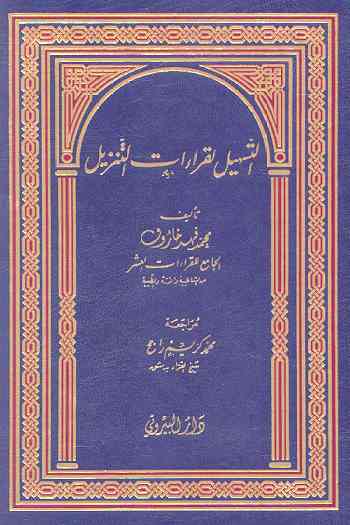
The proof the Muslim claim is false, is in this book:
Click to View
Translation of front cover:Making Easy the Readings of What Has Been Sent Down
Author
Muhammad Fahd Khaaruun
The Collector of the 10 Readings
From Al-Shaatebeiah and Al-Dorraah and Al-Taiabah
Revised by
Muhammad Kareem Ragheh
The Chief Reader of Damascus
Daar Beirut
Click photos for enlargement
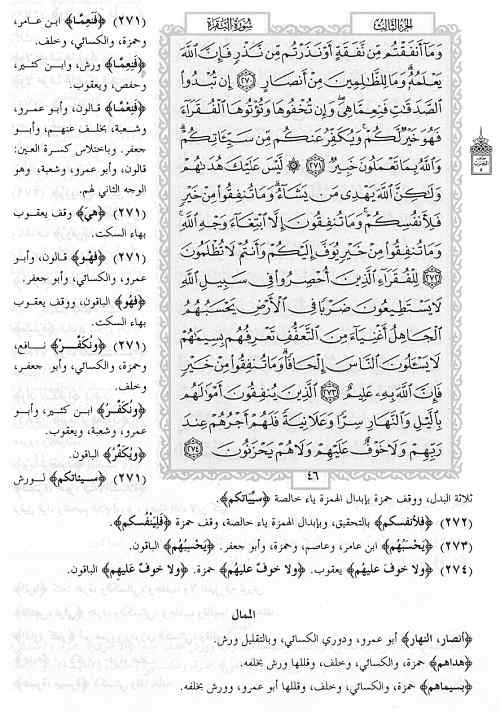
As you can see, the boxed text is the text of the Qur'an and the margins at the left and the bottom are variant readings. There are more known variants than this book includes. Even worse, there are more than readers in existence, but this book limits the variants to only these 10 readers.
Click photos for enlargement
Click to View
What Muslim and non-Muslim scholars say about the known variations/versions within the Qur'an being used in the world today:
  • "owing to the fact that the kufic script in which the Koran was originally written contained no indication of vowels or diacritical points, variant readings are recognized by Muslims as of equal authority." (N.J. Dawood, The Koran, Middlesex, England: Penguin Books, 1983, p 10, introduction to Dawood's translation of the Koran)
  • "Lists of the differences between the two transmissions are long, ... (however) The simple fact is that none of the differences, whether vocal (vowel and diacritical points) or graphic (basic letter), between the transmission of Hafs and the transmission of Warsh has any great effect on the meaning. Many are differences which do not change the meaning at all, and the rest are differences with an effect on meaning in the immediate context of the text itself, but without any significant wider influence on Muslim thought. One difference (Q. 2/184) has an effect on the meaning that might conceivably be argued to have wider ramifications." (Adrian Brockett, `The Value of the Hafs and Warsh transmissions for the Textual History of the Qur'an', Approaches to the History of the Interpretation of the Qur'an, ed. Andrew Rippin; Oxford: Clarendon Press, 1988, p 34,37)
  • "the Reading of Abu `Amr in the version of al-Duri ... prevails in the Sudan, Nigeria, and Central Africa." (Labib as-Said, The Recited Koran: A History of the First Recorded Version, tr. B. Weis, et al, Princeton, New Jersey: The Darwin Press, 1975, p. 84)
(C)ertain variant readings existed and, indeed, persisted and increased as the Companions who had memorised the text died, and because the inchoate (basic) Arabic script, lacking vowel signs and even necessary diacriticals to distinguish between certain consonants, was inadequate. ... In the 4th Islamic century, it was decided to have recourse (to return) to "readings" (qira'at) handed down from seven authoritative "readers" (qurra'); in order, moreover, to ensure accuracy of transmission, two "transmitters" (rawi, pl. ruwah) were accorded to each. There resulted from this seven basic texts (al-qira'at as-sab', "the seven readings"), each having two transmitted versions (riwayatan) with only minor variations in phrasing, but all containing meticulous vowel-points and other necessary diacritical marks. ... The authoritative "readers" are:
Nafi (from Medina; d.169/785)
Ibn Kathir (from Mecca; d.119/737)
Abu `Amr al-'Ala' (from Damascus; d.53/770)
Ibn `Amir (from Basra; d.118/736)
Hamzah (from Kufah; d.156/772)
al-Qisa'i (from Kufah; d.189/804)
Abu Bakr `Asim (from Kufah; d.158/778)
The predominant reading today, spread by Egyptian Koran readers, is that of `Asim in the transmission (riwayah) of Hafs (d. 190/805). In Morocco, however, the reading is that of Nafi` in the riwayah of Warsh (d. 197/812) and Maghrebin Korans are written accordingly. (Cyril Glassé, The Concise Encyclopedia of Islam, San Francisco: Harper & Row, 1989, p 324)
20 versions of the Qur'an!
Here is a list of the ten readers, each of which have two versions
The Readers and their Transmitted Versions
The Reader
The Transmitter
"The Seven" readers
Nafi`
Warsh
Qalun
Ibn Kathir
al-Bazzi
Qunbul
Abu `Amr al-'Ala'
Al-Duri
al-Suri
Ibn `Amir
Hisham
Ibn Dhakwan
Hamzah
Khalaf
Khallad
al-Qisa'i
al-Duri
Abu'l-Harith
Abu Bakr `Asim
Hafs
Ibn `Ayyash
"The Three" readers
Abu Ja`far
Ibn Wardan
Ibn Jamaz
Ya`qub al-Hashimi
Ruways
Rawh
Khalaf al-Bazzar
Ishaq
Idris al-Haddad
There are even more Readers than these but these are considered the most authoritative.
Seven different version of the Koran:
  • "What is said about Al-Mutaawwilin (those who form wrong opinions of disbelief about their Muslim brothers). Umar bin Al-Khattab said, "I heard Hisham bin Al-Hakim reciting Surat-al-Furqan during the lifetime of Allah's Apostle (SAW). I listened to his recitation and noticed that he recited it in several different ways which Allah's Apostle (SAW) had not taught me. So I was about to jump over him during his prayer but I waited till he finished his prayer whereupon I put, either his upper garment or my upper garment, around his neck and seized him by it and asked him, "Who has taught you this Sura?" He replied, "Allah's Apostle (SAW) has taught it to me." I said (to him), "You have told a lie! By Allah, Allah's Apostle (SAW) has taught me this Sura which I have heard you reciting." So I dragged him, to Allah's Apostle (SAW), I said, "O Allah's Apostle! I have heard this man reciting Surat-al-Furqan in a way which you have not taught me, and you did teach me Surat-al-Furqan." On that Allah's Apostle (SAW) said, "O Umar, release him! Recite, O Hisham." So Hisham recited before him in the way as I had heard him reciting. Allah's Apostle (SAW) said, "It has been revealed like this." Then Allah's Apostle (SAW) said, "Recite O Umar." So I recited it. The Prophet (SAW) said, "It has been revealed like this." And then he added, "This Quran has been revealed to be recited in seven different ways, so recite it which ever way easier for you." (See Hadith No. 514 Vol. 6) Vol. 9 - Apostates - Chapter 9 27/30)


Click to View

Pastor who was arrested in North Korea, shared the gospel with prison officials


Pastor who was arrested in North Korea, shared the gospel with prison officials.


Kim Hak Song, an American pastor released last Month from North Korea after spending a year in prison, recently spoke about his detention under one of the most brutal regimes on the planet and explained how he was able to share God's Word despite the circumstances. 

Kim, who was arrested in 2017 while he was teaching rice growing at a private university in Pyongyang founded by evangelical Christians, shared his experiences after a service at the Oriental Mission Church in East Hollywood, his home congregation. 

Religion News Service reports that Kim spoke through a translator to offer his "first extended public comments" since being welcomed back to the United States by President Donald Trump, along with fellow imprisoned Americans Tony Kim and Kim Dong Chul. According to Kim, he was told when he was detained in May 2017 that his crime was prayer. 

In proving their case, Kim said the regime's officials showed him evidence that he had led a worship group in morning prayer. Additionally, they showed him an email that he sent to elders at his home church asking for prayer for the North Korean people. Although many who are sent to prison for religious-related offenses in North Korea are tortured, Kim explained that he was spared of torture during his imprisonment. Yet, Kim still feels "the pain and struggle," his wife told RNS, saying that her husband still deals with some trauma from his detention. 

Kim said that he spent a lot of time in prayer while he was in prison. He used his time to confess sins and to ask God to protect his family. Although his time working on an experimental farm in hopes of helping the North Korean people have a more sustainable food source was cut short, Kim explained that he doesn't believe his time in prison was spent in vain. 

Kim said that at one point during his detention an official asked him to write about Christianity. This gave Kim an outlet to share his faith openly with a representative of a regime that for 16 years has been ranked as the worst persecutor of Christians in the world by persecution watchdog group Open Doors USA. 

Kim said that he began by sharing the book of Genesis. "I was grateful and thankful that at this time I was able to share God's message to this person," Kim was quoted as saying. President Donald Trump announced on May 9 that Secretary of State Mike Pompeo was on his way back to the U.S. with Kim and the other prisoners who were released by the regime of Kim Jong Un. 

he next day, their plane landed at Joint Base Andrews and they were greeted by Trump and Vice President Mike Pence. Kim said that at the time he had no idea that discussions were ongoing for his release and was a bit surprised on the day he was released. He recalled that on the day of his release, he believed he was being moved to another cell. 

He said that when the guards asked him if he needed anything else before leaving the cell, he said that he needed to bring his Bible. To Kim's shock, he later found himself on a U.S. government plane. Kim admitted that he had dreams while in prison of being in Trump's car while the American people applauded. "The dream became reality," Kim was quoted as saying. "God is walking with us." On the day that Kim, Tony Kim and Kim Dong Chul arrived at Joint Base Andrews, they handed Pence a handwritten note that quoted Psalm 26. "It was an amazing moment I'll never forget ... when three Americans stepped onto the tarmac at Joint Base Andrews and gave me a signed personal note with Psalm 126 on the back," Pence tweeted at the time. "To these men of faith and courage — God bless you and welcome home!" 

RNS reports that Kim told his congregation during his sermon that "miracles still happen" and "prayer is still very important." As appeared in christianpost.com.

Iranian student contemplating suicide cries out to God for help and the Lord Jesus Christ answers. “No man on earth can truly hurt me or cause me to give up my faith.”


Iranian student contemplating suicide cries out to God for help and the Lord Jesus Christ answers.
“No man on earth can truly hurt me or cause me to give up my faith.”

One night in a cold, dark room a University of California student reached out to God and she says Christ appeared to her. Nikta “Nikki” Taylebian, an Iranian born, young woman says she was on a trip to her homeland of Iran when Jesus interrupted her life.  

While visiting family in Tehran, Nikki recounts a time of hopelessness where she considered suicide to relieve her feelings of anxiety and self-loathing.  She says she was at a point where panic gripped her and she “couldn’t breathe” but in that instant she cried out for help and the God of the universe answered. Nikita shared her story with CBN News producer Emily Jones on CWN Now. Nikki, who was raised a Muslim, believed “Christianity was a fake religion, that people worshiped a “false God.”   

She was taught “there was no way God would have a son” so she didn’t even consider Jesus but according to Nikki, Jesus was thinking of her. She says in that moment of desperation, Jesus appeared to her with brown hair wearing a blue robe and simply said “follow Me.”  Nikki says a feeling of peace overwhelmed her and she jumped up to search for more information on Jesus.  Since then Nikki has returned to the United States where she joined a church, got baptized and continues to learn about the love of God.  

Though her conversion experience was not accepted by her family Nikki says she is confident in her God and that “no man on Earth can truly hurt me or cause me to give up my faith.” Nikki is enjoying her new walk with Christ and proudly proclaims “Yes, I am healed and loved by Jesus.”

The Angelic Guardianship in Psalm 91:11: A Scholarly and Inspirational Exploration

The Angelic Guardianship in Psalm 91:11: A Scholarly and Inspirational Exploration By Dr. Maxwell Shimba Shimba Theological Institute A...

TRENDING NOW