Tuesday, May 26, 2020

WHY FORMER MUSLIMS SAID NDUNDI AND WAZIRI RAJAB REVERT BACK TO ISLAM

Image may contain: 2 people
In the recent past our social media walls have been awash with the alleged going back to Islam by the public confession of Said Ndundi and Wazir Rajab.

I have also exchanged with the two a lot privately and I wish to leave the details of our conversation private, but in the past day or so, I have taken time to think carefully about this matter. First and foremost, I wish to inform the religious fraternity that the Adventist Church is the number one world promoter of religious liberty.

Therefore, Said and Wazir are at liberty to make their personal religious choices. Some of us have vilified the two for going back to Islam, but I am of the view that we need to respect their choice. We also have seen a video of their own admission of their exact reasons, which is financial gain. The Church does not buy converts as Wazir falsely claimed. Conversion is God’s work and the Church is his business. Saidi Ndundi a former madrassa teacher left Islam 23 years ago and Wazir Rajab denied Muhammad 11 years ago.

These local evangelists served God of the Church diligently and brought hundreds of Muslims and people of other faiths to the saving grace of our Lord Jesus Christ. The two exposed shortcomings of Islam to Christ’s church. We Praise the Lord for those fruitful years of service and their energy in fighting their former religion of Islam.

I want to remind fellow Christians that Said Ndundi left Islam in 1997 and followed the Christian faith. At the time Saidi Ndundi was a madrassa teacher at Tudor, Mombasa and he lived at Makande Railway houses with his mother, wife, and daughter. When Saidi Ndundi left Islam and Muhammad and embraced the Bible truth in Jesus Christ, Muslims did not call him names or say anything about him.

I wish to commend Muslims for their patience with Murtad Ndundi for 23 years. The first Muhadhara/ Public dialogue that Ndundi participated in, was at Perani near the Lunga Lunga border, South Coast of Kenya. Ever since Ndundi wholeheartedly preached against Islam and promoted the truth of Jesus Christ. At the time of returning back to Islam he had put in 23 years of active service and he did good work. His SDA leaders at the time advised Ndundi not to use his Muslim name Saidi but to take a Bible name. He chose Paul as a Pseudonym and he loved to preach the cross.

Unfortunately, Ndundi’s Kamba wife rejected Christianity and she never became a Christian to date, neither his mother nor his daughter. Therefore, Ndundi struggled to convince his family members to convert to Christianity.

In the course of time and to be precise in the last ten years Ndundi has struggled with his personal life and keeping himself pure before His savior Jesus Christ. Church leaders supported him and stood with him in his turbulent years. He also had numerous challenges from his immediate family. And having reached a point where it dawned on him that it was a matter of time before his life would run divergent to the expectations of the Adventist Church, he opted to surprise everyone by announcing that he is now Muslim.

Let me educate Saidi Ndundi my Mentor and other Muslim apostates who dream of returning back to Islam. A Murtad is gladly received back into the fold of Islam but is viewed suspiciously as a munafiq, therefore in ideal Islam and particularly in shariah states, he or she is killed and buried as a Muslim. The reasoning is that for someone like Ndundi who is deemed to have “insulted” and “demeaned” Islam and the prophet for 23 years cannot be trusted in the ummah. It is feared that he might infect other Muslims with his “poisonous” teachings which he acquired for the 23 years away from Islam.

Much more when Ndundi and Wazir claim that they are going back to their former faith of Islam for monetary gain. In my opinion Saidi Ndundi and Wazir Rajab have one viable option which is to stay in the Church and rebuild their lives other than living in constant fear. The Muslims of Nairobi will not house you and finance you forever. Anyway, that is their freedom of choice, I wish they leaned from some Murtad who quietly went back to Islam without making noise and insulting the Church.

Wazir Rajab a Digo from the South Coast of Kenya left Islam in 2009 and made fellowship with the Adventist Church. Around this time I worked in the same area in Mombasa and came to know Wazir and I have seen him grow in the field of Evangelism. It was at the big Muhadhara that took place in January 2009 at Ukunda in Kwale County.

A number of Digos left Islam at that time. Wazir’s knowledge in debating Islam did not reach Ndundi’s level but he worked as a lay preacher among the Digo people. I have been shocked to hear him being introduced as Pastor Joseph Kolla. As far as I know Wazir never adopted a Christian name. Both Saidi Ndundi and Wazir received basic training but never attained the level of Pastors. We have seen in social media the two claiming that they were big pastors in the Adventist Church. The truth is that they were lay evangelists.

Evangelists work under pastors, like me, I am an evangelist and I cannot claim that I am a pastor although I may look like one.

By the way Muslims, if an Adventist comes to you claiming that they are pastors just ask them to show you their ministerial credential and then check their names online in the SDA yearbook that lists all the names of the pastors in the whole world.

For example, Wazir told Muslims that he was the pastor in charge of the entire South Coast. You are at liberty to look at the list of all SDA pastors at the Kenya Coast Field whether his name appears there. It is like in the mid-1990s when a compound watchman of the Ukunda Church called Onsongo converted to Islam and duped Muslims that he was the Big pastor of the entire Coast. The fake story was published in the al-Imam paper (If I still remember the name correctly).

Onsongo was received with a lot of fanfare, he was given wealth and even taken for hajj to Mecca. Only for Muslims to learn that he lied to them and they spent so much money on him. He never lived long but died suddenly and in mysterious circumstances, he was buried within hours.

Wazir ran into moral issues a few years ago and he was excommunicated. After a while he repented and returned into the fold of Christ. Ever since he has struggled on his moral path, but the SDA community stood by him. Then a few days ago we saw him on social media denouncing his Christian faith and purporting to go back to him former faith of Islam.

Having said this, I wish to implore my Christian brothers and sisters not to throw harsh words at the two, just like Muslims never made any noise when Ndundi and Wazir denied Islam and the prophet. So, let us allow the two to live their choices. Of course, no one ever went back and succeeded. To put the record right for Omar Al Bashir and the likes of Hidaya Channels Anwarish Anwar who got excited for the supposedly big catch, Saidi Ndundi, and Wazir Rajab were local SDA evangelists and not Pastors.

They never pastored any church in their lives and all the SDA records are in the public domain for anyone to see.

Evangelists do an important function in the mission of the Church and we appreciate it. In closing I ask my brothers and sisters in Christ to desist from attacking Ndundi and Wazir negatively, but give them words of courage. I wonder how they function in Muslim society and whether they will gain the full trust of the ummah. Pray for them and their families.

Pray that the living Christ will trouble their spirits until they submit to his authority and that they will find no peace outside our savior. Pray that the loving Church of Christ will receive them back the day they come to their senses and opt like the prodigal son to return home. Pray that the Lord will prepare for the second coming of Jesus Christ.

To you Ndundi my elder brother and Kiriwacho Waziri my Son in the LORD, kindly probe your own selves and be honest and tell the world why you went back to your former faith of Islam. Ndundi you were a Madrassa teacher at Tudor, what made you abandon Islam? Tell Muslims what truth you saw. And for 23 years you consistently fought Islam using your madrassa knowledge, so at what point and what exactly did you discover is now the truth in Islam?

Please be truthful to your rediscovered faith of Islam, tell them your exact reasons. For us we know exactly why you jumped back into Islam. You too Wazir be truthful to Islam as you go back tell them why you left in 2009.

Trying to lie to Islam and Christianity will only establish as solid hypocrites, the worst sin in Islam. Our sincere prayers are with you and may the LORD be gracious to you.

Shalom

Monday, May 25, 2020

MKE WA KAINI NA ABELI WALITOKA WAPI IKIWA ADAMU NA EVA WALIKUWA NA WANA WAWILI?


Hili ndilo swali linalo wavuruga watu wengi, ingawa jibu lake lipo wazi na tena lipo ndani ya Biblia Takatifu.
Ikiwa Adamu na Eva walikuwa na wana wawili, Kaini na Abeli, mke wa Kaini alitoka wapi?” Ingawa mara nyingi wachambuzi wa Biblia huuliza swali hilo ili tu kuwavuruga watu, Biblia ina habari za kutosha kujibu swali hilo kwa njia inayofaa.
Mapema katika historia ya wanadamu, lilikuwa jambo la kawaida kuoa mtu wa karibu wa ukoo. Kwa mfano, mwanamume mwaminifu Abrahamu alimwoa binti ya baba yake aliyezaliwa na mama mwingine. (Mwanzo 20:12) Sheria ya Musa ndiyo iliyokataza kwa mara ya kwanza ndoa kama hizo. Sheria hiyo ilitungwa karne nyingi baada ya siku za Kaini. (Mambo ya Walawi 18:9, 12, 13) Inaonekana kwamba nyakati hizo watoto waliozaliwa kutokana na watu wa ukoo wa karibu hawakuwa na madhara ya kuzaliwa kama ilivyo leo.
Katika Mwanzo sura ya 3 na ya 4 tunapata habari zifuatazo: (1) Eva alikuwa “mama ya kila mtu anayeishi.” (2) Muda fulani ulipita kuanzia wakati Kaini alipozaliwa mpaka wakati alipotoa dhabihu ambayo ilikataliwa na Mungu. (3) Baada ya kufukuzwa na kuwa “mwenye kutanga-tanga na mkimbizi,” Kaini alikuwa na wasiwasi kwamba huenda ‘mtu yeyote akakutana naye’ na kujaribu kumuua. (4) Mungu aliweka ishara ya kumlinda Kaini, jambo lililoonyesha kwamba ndugu au dada zake, au watu wengine wa ukoo wangejaribu kumuua. (5) “Baadaye” Kaini alilala na mke wake “katika nchi ya Ukimbizi.”—Mwanzo 3:20; 4:3, 12, 14-17.
WAKE WA KAINI NA SETHI WALITOKA KWENYE HII AYA
Mwanzo 5: 4 Siku za Adamu baada ya kumzaa Sethi zilikuwa miaka mia nane, akazaa wana, waume na wake.
Biblia inasema Adam akazaa WAUME NA WAKE.
Kutokana na habari hizo, tunaweza kusema kwamba mke wa Kaini, ambaye haijulikani alizaliwa wakati gani, alikuwa mzao wa Eva. Andiko la Mwanzo 5:4 linasema kwamba katika miaka 930 ambayo Adamu aliishi, ‘alizaa wana na mabinti.’ Bila shaka, Biblia haisemi waziwazi kwamba mke wa Kaini alikuwa binti ya Eva. Hata hivyo, kwa kuwa mke wa Kaini anatajwa baada ya Kaini kufukuzwa, jambo hilo linaonyesha kwamba wakati wa kutosha ulikuwa umepita na angeweza kuwa mmoja wa wajukuu wa Adamu na Eva. Kwa hiyo, tafsiri ya Biblia The Amplified Old Testament inasema tu kwamba mke wa Kaini alikuwa “mmoja wa watoto wa Adamu.”
Mfafanuzi wa Biblia wa karne ya 19 Adam Clarke, alionelea kwamba hatua ya Mungu ya kuweka ishara kwa sababu Kaini aliogopa kuuawa, ilitokana na kuwapo kwa vizazi kadhaa vya wazao wa Adamu—vizazi vingi vya kutosha “kuanzisha vijiji kadhaa.”
Wazo la kwamba Kaini alimwoa dada yake au mzao wa baadaye wa Adamu kupitia mmoja wa wana au mabinti zake, ni jambo lisilokubalika katika jamii fulani leo. Sababu ni kuwa jamii hizo huliona hilo kuwa jambo lisilokubalika au huogopa kwamba litasababisha kasoro za kimaumbile. Hata hivyo, F. LaGard Smith anasema hivi katika kitabu The Narrated Bible in Chronological Order: “Inaelekea kwamba ndugu na dada hao wa karibu walioana ingawa ndoa kama hiyo ingeonekana kuwa jambo lisilofaa katika vizazi vya baadaye.” Inafaa kuzingatia kwamba ngono kati ya watu wa ukoo haikukatazwa waziwazi mpaka Musa alipopokea sheria za Mungu kwa ajili ya taifa la Israeli mwaka wa 1513 K.W.K.—Mambo ya Walawi 18:9, 17, 24.
Leo, maelfu ya miaka imepita tangu wazazi wetu wa kwanza wapoteze ukamilifu wao. Huenda matatizo yanayotokana na chembe za urithi leo hayangewapata. Isitoshe, uchunguzi wa hivi karibuni, kama ule uliochapishwa katika jarida Journal of Genetic Counseling, unaonyesha kwamba watoto wanaozaliwa katika ndoa kati ya binamu wa karibu, hawana kasoro nyingi za urithi kama inavyowaziwa na wengi. Kwa kweli, hayo hayangekuwa mambo yenye kutia wasiwasi mwingi siku za Adamu au hata kabla ya siku za Noa. Kwa hiyo, tunaweza kukata kauli kwamba mke wa Kaini alikuwa mmoja kati ya watu wake wa ukoo.
Nasaba zinazorudi nyuma hadi kwa Adamu zinapatikana katika kitabu cha Mwanzo, kilichoandikwa na Musa na pia katika maandishi ya wanahistoria wengine kama vile Ezra na Luka. (Mwanzo 5:3-5; 1 Mambo ya Nyakati 1:1-4; Luka 3:38) Waandikaji wa Biblia wanataja hadithi ya Kaini kuwa tukio halisi la kihistoria.​—Waebrania 11:4; 1 Yohana 3:12; Yuda 11.
USIKOSE SOMA LA "KIZAZI CHA ADAMU"
Shalom
Max Shimba mtumwa wa Yesu Kristo Mungu Mkuu. Tito 2:13

Sunday, May 17, 2020

Christian Boy in Uganda Strangled, Threatened with Death for Refusing to Convert to Islam

uganda-news


While Uganda’s constitution and other laws provide for religious freedom, Christians in eastern Uganda suffer continual attacks by non-government figures and Muslim extremist groups like Al-shabab Abandoned-Orphaned

Radical Muslims in eastern Uganda left a 12-year-old Christian boy unconscious on Thursday (Oct. 25) after threatening to strangle him to death unless he converted to Islam, sources said.
Emmanuel Nyaiti was on his way to pick up some plates from his grandmother’s house 200 meters from his home in Moru village, Kiryolo parish in Kaderuna Sub-County, Budaka District, when four area extremists ambushed him shortly after 9 p.m. and took him to a cassava plantation less than a mile away, his father said.
The boy said he was able to identify one attacker as Ali Lukuman and another as Abdul.
“Ali Lukuman tried to persuade me to become a Muslim, which I refused, and he slapped me and I started screaming,” Emmanuel told Morning Star News last week from his bed at Budaka Health Centre, his speech made difficult from strangulation and possible chloroform the assailants used on him. “They continued threatening me that they will kill me if I will not convert to Islam.”
His father, Kauta Yokosofat, said there was a smell around his mouth that a doctor suspected was a kind of chloroform. Doctors also identified strangulation marks.
“My son’s words could not be constructed well, as he looked confused and could not turn his neck with the strangulation marks,” Yokosofat told Morning Star News.

Lukuman had previously sent Yokosofat threatening messages, both by phone texts and face-to-face, Yokosofat said.
“If you want to stay with us in our village, then you have to become a Muslim, but if not then you have to leave,” Lukuman would tell him, according to Yokosofat, a member of Kiryolo Church of Uganda.
He and neighbors had formed a search team and were looking for the missing boy when they heard a loud cry from the cassava plantation, he said. The assailants had already fled when they found the boy “unconscious and half-dead,” he said.
The attack has instilled fear in Christians in predominantly Muslim Kaderuna Sub-County.
Yokosofat has reported the case to Budaka police, who say they are investigating while the assailants have yet to be found.
“I know the perpetrators will be caught and punished in the courts of law,” Yokosofat told Morning Star News.
The assault was the latest of many in eastern Uganda that Morning Star News has documented in the past six years.
Uganda’s constitution and other laws provide for religious freedom, including the right to propagate one’s faith and convert from one faith to another.
Muslims make up no more than 12 percent of Uganda’s population.

Muslim Brothers Turn to Christ After Watching Slain Mother Beaten for Converting to Christianity


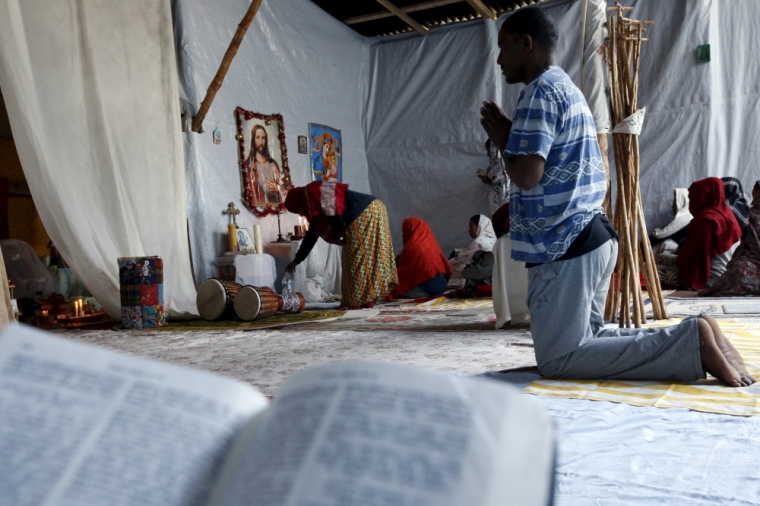
Christian migrants from Eritrea and Ethiopia pary and read the bible before Sunday mass at the makeshift church in "The New Jungle" near Calais, France, August 2, 2015. Some 3,000 migrants live around the tunnel entrance in a makeshift camp known as "The Jungle", making the northern French port one of the frontlines in Europe's wider migrant crisis. REUTERS/Pascal Rossignol | (Photo: REUTERS/Pascal Rossignol)
The sons of a slain Ethiopian woman who was beaten mercilessly by her husband after she converted from Islam to Christianity last year have given their lives to Christ after witnessing their mother's strong faith in Jesus.
According to global Christian persecution watchdog Open Doors USA, a Christian convert named Workitu, a mother in her 50s, was killed by her husband and a neighbor at the end of March in the Addis Ababa after she refused her husband's demands to sell government drought relief aid.
Christians in the Muslim-dominated town told Open Doors that prior to Workitu's fatal beating in March, she had already endured a number of relentless beatings from her husband after she converted to Christianity last August.
Not only did she endure regular beatings from her husband, she also received threats from community members who demanded her to return to Islam. The local Christians also explained that Workitu's husband, who spent most of his time with his other wife, had promised to kill Workitu unless she renounced Christ and returned to Islam.
Church officials in the town urged Workitu to tell the local police about the threats that she had received. She did so by writing a letter to police in February that explained how the threats made her fearful for her life.
Open Doors' report states, however, that local police ignored her letter and denied they ever received it.
After Workitu was beaten badly by her husband and neighbor in March, she was taken to a clinic located in a nearby town. After spending a few days in the clinic, she was referred to a hospital. Unfortunately, Workitu succumb to her injuries while being transported to the hospital. Police have arrested the husband and neighbor and charged them with homicide.
Although Workitu has now perished, her devotion to her faith was not lost on her two sons.
Open Doors reports that Workitu's two sons, Mustafa and Kedir, made the decision to become Christians following her death. As Workitu was the only Christian in their family, the men told Christian leaders in the town that they wanted to learn more about the God their mother worshipped.
Along with Workitu's sons, one of Workitu's Muslim friends also decided to follow Christ.
"Workitu is like Stephen," a local evangelist told Open Doors. "Her death was honored by the bringing of her sons to new life. I know she would have been extremely delighted had she witnessed her sons' decision to follow Christ."
According to Open Doors' 2016 World Watch List of countries where Christians are the most persecuted, Ethiopia ranks as the 18th worst country in the world for Christian persecution. The watchdog gave Ethiopia a persecution rating of 67 out of 100 and explained that Ethiopian Christians face "severe" levels of persecution.
"Ethiopia has a long history with both Christianity and Islam, and over time both religions have engaged in attempts to expand their sphere of influence," an Open Doors fact sheet on Ethiopia states. "Additionally, Ethiopia has many tribes. These are not necessarily favorable to Christianity, and in some places like Afar and the Somali regions, tribes are interconnected with Islam. The ruling party in the country has blocked all the channels for freedom of expression and assembly, and has also tried to control all religious institutions in a bid to curb dissent."
Follow Samuel Smith on Twitter: @IamSamSmith

Mogadishu bishop: evangelical mission only answer to al-Shabab violence

by Simone Cantarini
Bishop Giorgio Bertin talks about the Church's witness in the land where al-Qaeda's most violent terrorists are born. For the prelate, "bearing witness to the Gospel means giving oneself to God's initiative, participating with Christians in the hopes and the suffering of the whole population."
Rome ( AsiaNews) - "From Somalia to Iraq, including Egypt and Syria, Christians are often persecuted and flee. Many consider them as something alien from the Muslim majority. Several extremist religious leaders try to hinder their presence and existence in these countries, which are often the only opposition to the hatred and violence imposed by the ideologies of Islamic extremists," said Mgr Giorgio Bertin, bishop of Djibouti and apostolic administrator of Mogadishu. For years, the bishop has cared for the small Catholic communities in the two countries, who live in an environment dominated by Islamic extremism, anarchy and terrorist violence.
"In Somalia," he said, "the population is victim of the chaos and cruelty caused by Islamic courts and the al-shabab movement, which exports terrorists all over the world."
On Saturday, the terrorist group fighting to establish an Islamic state in the Horn of Africa attacked the Westgate shopping mall in Nairobi ( Kenya), taking hundreds of hostages for three days. The assault by at least 20 terrorists ended with over 60 people dead and hundreds injured.
"From Somalia to Iraq, Christians are often considered something alien from the Muslim majority and experience strong social pressure because of their presence," Mgr Bertin noted.
"We fear," he explained, "fanatical groups that pursue a religious ideology that does not represent the thoughts and ideas of the majority of the population. Somalia is an example of how some areas of the Middle East could become in the event of a collapse of the government. If central authorities do not exert their power, they [the al-shahab] are free to do whatever they want justify their belligerence by pointing to the Christian presence."
For the prelate, people usually wonder what is the sense of the mission in these countries, where Christians risk their life, places like "Somalia where there are less than 100 Christians" or "Djibouti, which has about 5,000."
"In the West, people are often amazed by these places' numbers: no priests, less than 100 Christians, inability to convert to Christianity. Such figures apparently discourage the Church's mission. However, bearing witness to the Gospel in countries like Somalia means giving oneself to God's initiative, participating with Christians in the hopes and the suffering of the whole population."
"The mission is addressed primarily to Muslims who thanks to the Christian presence often find a new way of life, one that responds with love to the hatred and violence imposed by the ideologies of Islamic extremists," Mgr. Bertin noted.
"Unfortunately," he said, "this approach cannot be measured. Only with faith and hope can we measure the meaning of our presence."

Converted from Islam to Christianity because of love

Converted from Islam to Christianity because of love

By Christine Katende
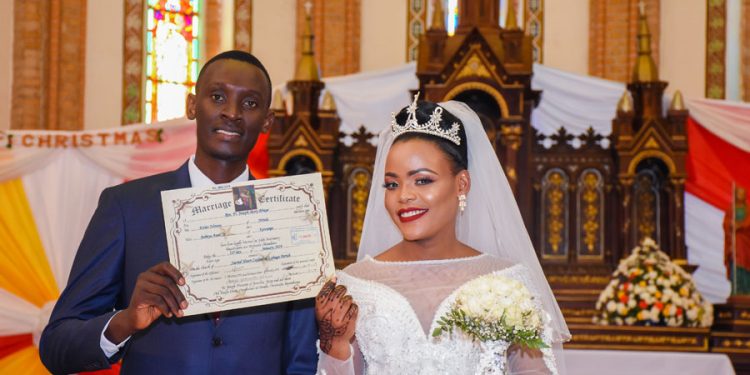
Johnson Kizito, the national deputy secretary-general of Uganda Young Democrats and Anna Marie Babirye, a businesswoman wedded earlier this year. Anna Marie, formerly Nuruh, converted from Islam and they share their story.
What was it like converting from Islam to Christianity?
Anna Marie: I decided to convert to Christianity because I wanted to prove to my husband not only how much I loved him but that I was ready to do anything for him and further I discovered Jesus is the true God and Mohammad was fake. The process was not that hard because my mother was formerly Catholic and she helped me approach my father. He asked me many questions but I was more than ready to be united with my man. My father wrote a consent letter to the Catholic Church which proved their acceptance of our union as parents.
What were the requirements?
Anna Marie:  I was taken through catechism lessons and later baptised Anna Marie. I was excited because I knew we would attend church together. I am now learning other prayers and other doctrines in the Catholic Church.
How did you get to know each other?
Johnson: I was in my final year at Makerere University Business School, Nakawa when I met Anna in 2014. She was in her first year and we met at a friend’s birthday party. We started talking after I got her contact through a friend. Although she gave me a hard time, we later became friends which progressed into a courtship of four years. During that period, we would discuss issues about culture, marriage and religion. We finally walked down the aisle on January 12 2019.
Anna Marie: We had a mutual friend. And it took me about two years to respond to his proposal.
What was your biggest worry?
Johnson: Whether her parents, especially her father, would okay our marriage given the religious differences. I thank God they allowed although it took quite some time of questioning. Anna Marie revealed that she was asked questions such as; why she chose a non-muslim of all men and whether she really loved and wanted to spend her life with me. Being non-Muslim, my father-in-law was worried about me taking their daughter to bars and pork joints but it so happened that I am not a fan of such.
How long did this take?
Johnson: It took about two months for her father to consent. We proceeded with the kukyala at her aunt’s home in Luwero in January 2019 and later the introduction despite my mother passing on a few days to the D-day. I gave my father-in-law a Quaran as mutwalo (bride price) since nothing was indicated in the consent letter.
What did you like about Johnson?
Anna Marrie: Johnson is patient, used to help me with course work and he is God-fearing.
Where did the wedding happen?
Johnson: Rubaga Cathedral. Holy Mass was presided over by the Bishop of Kasana-Luweero Diocese, Paul Ssemwogerere. We later hosted more than 550 guests at Bunga Executive Gardens on Ggaba Road.
How much did you spend on church and reception?
Johnson: About Shs1.5m on church and reception Shs3m.
Did you go for honeymoon?
Johnson: We were meant to travel out of the country immediately after the wedding but I failed to make bookings a week before the wedding because I was sick. We ended up at Speke Resort Munyonyo for three days. We are planning an extension before the year ends.
What were the most expensive items on the budget?
Johnson: Decor at Shs8.5m, food Shs11m, and clothes Shs9.5m
Did you have any disappointments on the wedding day?
Johnson: Church decoration. They used different colours from what we had agreed on. At the reception the service providers such as the decorator did not give us what I had paid for; the lighting was off, the tents old and food was served late at 6pm. The baker brought the cake late and made a shape I did not like and she disappeared immediately after placing the cake.
Anna Marie: I don’t remember any.
Did you have any fears?
Johnson: The decorator hadn’t set up anything on the wedding eve. Then, because I was ill, I feared I could collapse.
And your attire?
Johnson: I wore a navy blue suit which I bought at Shs2m, my best man and other friends, helped me get it since some of them are wedded. My shirt cost Shs150,000, the ties, Shs200,000, socks Shs50,000, 2belts at Shs200,000 and the pair of shoes at Shs700,000.
Who was your best man?
Johnson: Peter Nsubuga, one of my brothers. I wanted someone close to me. I had six groomsmen. These were my close friends, and I did not mind their physique.
Who was your matron?
Anna Marie: Brenda Nantale, she is a close friend and a workmate. I had six maids and they were all my friends, they had good bodies and could afford to facilitate themselves.
How useful was premarital counselling?
Johnson: I not only had counselling from church but even from close relatives and close married friends. However, from the sessions, I was advised to keep the true love to wife, be understanding and trust in God among other things.
Anna Marie: Among the several things that were emphasised include respect, being supportive, loving and prayerful. I promise to be a good wife to him and a good mother to our children.
What challenged you most during the preparation of the wedding?
Johnson: I was financially prepared and my family was cooperative.
Anna Marie: Moving around in the search for what I really wanted wasn’t any easy given the little time I had. Also having the maids agree on the kind and colour dresses to wear was a puzzle.
What did you consider during the search of the service providers?
Johnson:  Venue. I never wanted a reception in an enclosed place. Halls are expensive and tend to get congested. I had to consult a lot with people who knew them to get the right place.
Wedding planner
Favourites
Johnson was happy to see his father-in-law walking hand in hand with his daughter to hand her over to him. Anna Marie also loved walking with her father.
Gown: Anna Marie hired an off-white Cinderella gown at Shs2.5m from Brayan’s Bridal Boutique in Kampala.
“I was meant to change four times but ended up changing three times because of the limited time,” she says.
Cake: They had a green and white cake that reflected their theme colour. It was baked at Shs4.2m.
Tit bits
Groom: Johnson Kizito
Bride: Anna Marie Babirye
Date: January 12 2019
Church: Rubaga Cathedral
Reception: Bunga Executive Gardens
Cost: 40m

Sunday, May 3, 2020

Free online Bible program encourages virtual communal Bible reading amid lockdown


Tyndale House Publishers has teamed up with the Institute For Bible Reading to offer free resources for communal Bible reading and studying as many churches remain closed. 
“One of the things that we’ve seen recently in the midst of this is that reading the Bible by yourself can be lonely. You're there alone to wrestle with your questions. And so ... we want to bring people together," Paul Caminiti, senior director of mobilization for IFBR, told The Christian Post.
The book publisher and activist think tank have worked together for the last few years to offer the increasingly popular “Immerse Bible Reading Experience.” 
The six-volume Bible was created to provide faith communities with the “best reading experience possible” by laying out the Scripture in a “single-column setting” with each chapter displayed “according to its literary genre” without notations, chapter and verse numbers, section headings, and footnotes.
But in light of the coronavirus pandemic and stay-at-home orders, the two organizations have launched “Immerse From Home,” or 10-day virtual Bible “book clubs,” allowing believers to study Luke-Acts with fellow churchgoers online.
The new initiative provides free copies of its book Immerse Messiah (narrating the books of Luke and Acts in novel form) along with a plethora of digital resources allowing users to hold their own “book club” sessions with members of their churches, friends or family. 
“We really made a hard pivot away from Bible studies to book clubs,” Caminiti said. “So there's no participant guides. There is no filling in the blanks.”
“Immerse From Home” includes a virtual resource kit with a free PDF for Immerse Messiah.  
“This initial engagement with Scripture would be centered around the big stories of the first century: the life of Jesus, and the birth of the early church,” Caminiti said. 
“There's the audio version that goes along with it. So we had created a brand new Immerse Audio. There are several videos that are kind of like trailers of what people are going to read that week.”
While at home, the initiative calls on users to host video conference studies so that they can discuss the text with others in their community. The free resources include prompts for open-ended questions that users can discuss and instructions on how to set up an account for Zoom video conferencing. 
“We're still inviting people to read on their own but then to get together at least once a week,” Caminiti said. “And you know, what we're hearing is that some groups are doing this now in four weeks instead of two weeks. And they're still reading substantial amounts.”
“The way the two-week plan is set up is that people would read about eight or nine pages a day,” he added. “If you listen to the audio version, the average is 29 minutes a day. And it's a five-day-a-week plan.”
Caminiti said the initiative is a great fit for churches looking for ways to keep their small groups active while congregants remain at home. But even for people who are not in church small groups, he said the studies can easily be done with two or three of their closest friends or family members from across the country.
“So we're really urging people not to do this as a solo event,” he said.
Over 13 years ago, many of the big influencers in the Bible publishing movement began to have a “crisis of conscience” about how the Bible is being published and consumed by the modern church culture as many niche Bibles were being published, noted Caminiti. At the time, he was a Bible publisher for Zondervan.
“As we began doing some research about our study Bibles and our devotional Bibles, we discovered to our chagrin that people were reading the notes, and the prayers and the devotionals, but very little reading of the text,” he explained. 
“And so that sent me and several of my colleagues kind of on the tour to Christian thought leaders and scholars to ask the question, ‘How is it that when Bible access is skyrocketing (the average household in North America owns four and a half Bibles), why is Bible reading in freefall?’”
He feared that the modern church had created, in some ways, “a culture of misuse of the Scriptures.”
“In our Western individualism, Bible reading has turned into a solo sport, even amongst the devout,” he said. “We go years at a time, getting up in the morning, go into our private area, and read. It’s us and the Scriptures and the Holy Spirit. That's just far removed from the intent of the Scriptures at the beginning.”
In the early centuries, Caminiti said that “communities of faith” engaged the Scriptures together.
IFBR and Tyndale are now calling on churches across the country to “observe modern-day Ezra Moments.” In other words, “community Bible reading in this time of crisis.”
“When the people of Israel returned from captivity and began rebuilding Jerusalem, they sensed that something was still broken: themselves,” Caminiti said. “They believed that healing would come from reimmersion in their story. Ezra responded immediately by organizing corporate Scripture reading. Shaken from our usual routines and frenetic pace, the coronavirus has given us an opportunity to refocus on our founding story told in the Scriptures; to observe a modern-day Ezra Moment.”
Follow Samuel Smith on Twitter: @IamSamSmith

12 Christians killed, couple kidnapped from church during wedding in Nigeria


Muslim Fulani herdsmen in northwest Nigeria killed 12 Christians and kidnapped a couple from their church wedding ceremony in attacks this month, sources said.
In Tegina Kabata village in Niger state's Shiroro County, herdsmen attacked a church site where a wedding was taking place on April 12, abducting the couple and some church members, area resident Danjuma Iliya told Morning Star News.
"As the pastor was officiating during the wedding solemnization, the herdsmen stormed the church and took away everyone who was unable to escape from the church building, including the bride and groom," Iliya said. "In that village, five Christians were killed in the series of attacks carried out by the herdsmen."
Two other Christians were killed by herdsmen in Niger state's Gidigori village, Kusherki District, in Rafi County, on April 20, area resident James Ayuba said. They were two of seven Christians killed in three herdsmen attacks over five days in Rafi County, he said.
Others were injured in herdsmen attacks in the county's Madaka and Sabon Gari villages on April 20-21, he said.
Church Elder Abducted
Also in Niger state, five missionaries kidnapped on March 2 were released on April 22, sources said. In a short statement on April 22 that gave no details, leaders of Calvary Ministries (CAPRO) expressed joy that their missionaries had just been released.
"Please rejoice with us as the remaining five of our missionaries kidnapped in Kamuku Field, Niger state 52 days ago are now safely back to freedom," the statement read.
The missionaries were abducted when armed Muslim Fulani herdsmen on March 2 raided a school in Maruba, Shiroro County, run by CAPRO.
The announcement came the same day that a church elder in north-central Nigeria's Kaduna state had been kidnapped. Armed Fulani herdsmen abducted Emmanuel Iliya Agiya, elder and treasurer of the Evangelical Church Winning All (ECWA) in Atang village, Jema'a County on April 22, area resident Aku Joshua Shai told Morning Star News by phone.
After shooting into the air to send villagers scampering into the bushes, the herdsmen broke into Iliya's house that night and took him away at gunpoint, he said.
"The armed herdsmen first tried to forcefully gain entry into the house of the brother of the victim but were unsuccessful," Shai said. "They then proceeded to the next house, the victim's house, dragged him out, and then took him away at gunpoint."
Iliya is son of community leader Chief Iliya Agiya, Shai added.
Christian killed
Also in Kaduna state's Jema'a County, armed Fulani herdsmen on April 14 attacked Zakkan village, killing one Christian and wounding two others, Shai said.
Abel Danjuma, 40, was killed, and his two brothers, 45-year-old Henry Tuta, 50-year-old Chairman Tuta were injured. Henry Tuta was treated and discharged from Kafanchan General Hospital, while Chairman Tuta's serious injuries required that he be transferred to Jos University Teaching Hospital, Jos, Shai said.
"The three victims are members of the Catholic Church at Zakkan village," he said. "The herdsmen, too, blocked the Abuja-Jos route at Zakkan village and kidnapped two young girls who were traveling from Abuja to Taraba state. The girls were later rescued and set free by Christians from Zakkan village who went in pursuit of the herdsmen and rescued the girls."
On Jan. 30 Christian Solidarity International (CSI) issued a genocide warning for Nigeria, calling on the Permanent Member of the United Nations Security Council to take action. CSI issued the call in response to "a rising tide of violence directed against Nigerian Christians and others classified as 'infidels' by Islamist militants in the country's north and middle belt regions.'"
Nigeria ranked 12th on Open Doors' 2020 World Watch List of countries where Christians suffer the most persecution but second in the number of Christians killed for their faith, behind Pakistan.
This piece was originally published at Christian Today

Neuroplasticity, Spiritual Formation, and Holistic Redemption in Christ

Neuroplasticity, Spiritual Formation, and Holistic Redemption in Christ By Dr. Maxwell Shimba, Shimba Theological Institute Introduction ...

TRENDING NOW