Friday, March 9, 2018

Allah's Apostle forbade the eating of garlic and the meat of donkeys

Image result for Muhammad fondle Aisha

Volume 5, Book 59, Number 526:
Narrated Ibn Umar:
On the day of Khaiber, Allah's Apostle forbade the eating of garlic and the meat of donkeys.

And yet, most middle eastern dishes contain garlic. Next time a Muslim says "I cant eat pork", one should say "you can't eat garlic either but you still do!"

However, eating donkey meat is just disgusting...

Magic was worked on Allah's Apostle so that he began to imagine that he had done something although he had not


Image result for Muhammad fondle Aisha
Volume 7, Book 71, Number 661: 
Narrated 'Aisha:

Magic was worked on Allah's Apostle so that he began to imagine that he had done something although he had not.One day while he was with me, he invoked Allah and invoked for a long period and then said, "O 'Aisha! Do you know that Allah has instructed me regarding the matter I asked Him about?" I asked, "What is that, O Allah's Apostle?" He said, "Two men came to me; one of them sat near my head and the other sat near my feet. One of them asked his companion, 'What is the disease of this man?' The other replied, 'He is under the effect of magic.' The first one asked, 'Who has worked magic on him?" The other replied, 'Labid bin A'sam, a Jew from the tribe of Bani Zuraiq.' The (first one asked), 'With what has it been done?' The other replied, 'With a a comb and the hair stuck to it and a skin of the pollen of a male datepalm tree.' The first one asked, 'Where is it?' The other replied, 'In the well of Dharwan.' Then the Prophet went along with some of his companions to that well and looked at that and there were date palms near to it. Then he returned to me and said, 'By Allah the water of that well was (red) like the infusion of Henna leaves and its date-palms were like the heads of devils" I said, O Allah's Apostle! Did you take those materials out of the pollen skin?" He said, 'No! As for me Allah has healed me and cured me and I was afraid that (by Showing that to the people) I would spread evil among them when he ordered that the well be filled up with earth, and it was filled up with earth "

This passage is interesting in that Mohammad clearly admits that he was cursed, as he would be the first prophet in the history of mankind to be have an evil curse on him (assuming he is a prophet, seeing how Mohammad did not prophesize anything, and he himself said his greatest and only miracle was the quran (ofcourse it would be the greatest miracle if it was your only miracle, and where it is a miracle or not can clearly be argued).

But, the passage sheds light on Mohammad as an individual, and his entire credibility should be examined, once again.

1) If Mohammad bragged about things he imagined, how can any of his accomplishments be taken seriously if there is no one to corroborate those actions?
a) What things did Mohammad imagine?
b) Is Islam based on deception if Mohammad imagined his actions, and islam was based on his actions and deeds?
2) Why would a Jew put a curse on Mohammad?
a) What curse did he put on Mohammad with a comb, of all things?
3) If Mohammad had been cursed, why did he not remove those "materials out of the pollen skin?"
a) Mohammad's answer was that he was cured by Allah. But, couldnt he have imagined being cured by Allah, especially when the magic was to cause him to imagine things?

As we will see, Mohammad was a man cursed many times by demonic spirits, (by his own admissions), which must make one question how any holy deity could call him their messenger when this messenger was in the clutches of satanic spirits.

Moses and Allah making fun of Mohammad?

Image result for Muhammad fondle Aisha

Source Sahih Muslim


Ok, this passage is very long. So I will underline the part I am referring to below.

Chapter 75: NIGHT JOURNEY OF THE MESSENGER OF ALLAH (MAY PEACE BE UPON HIM) TO HEAVEN, AND THE PRAYER MADE OBLIGATORY
Book 001, Number 0309: 

It is narrated on the authority of Anas b. Malik that the Messenger of Allah (may peace be upon him) said: I was brought al-Buraq Who is an animal white and long, larger than a donkey but smaller than a mule, who would place his hoof a distance equal to the range of version. I mounted it and came to the Temple (Bait Maqdis in Jerusalem), then tethered it to the ring used by the prophets. I entered the mosque and prayed two rak'ahs in it, and then came out and Gabriel brought me a vessel of wine and a vessel of milk. I chose the milk, and Gabriel said: You have chosen the natural thing. Then he took me to heaven. Gabriel then asked the (gate of heaven) to be opened and he was asked who he was. He replied: Gabriel. He was again asked: Who is with you? He (Gabriel) said: Muhammad. It was said: Has he been sent for? Gabriel replied: He has indeed been sent for. And (the door of the heaven) was opened for us and lo! we saw Adam. He welcomed me and prayed for my good. Then we ascended to the second heaven. Gabriel (peace be upon him) (asked the door of heaven to be opened), and he was asked who he was. He answered: Gabriel; and was again asked: Who is with you? He replied: Muhammad. It was said: Has he been sent for? He replied: He has indeed been sent for. The gate was opened. When I entered 'Isa b. Maryam and Yahya b. Zakariya (peace be upon both of them), cousins from the maternal side. welcomed me and prayed for my good Then I was taken to the third heaven and Gabriel asked for the opening (of the door). He was asked: Who are you? He replied: Gabriel. He was (again) asked: Who is with you? He replied Muhammad (may peace be upon him). It was said: Has he been sent for? He replied He has indeed been sent for. (The gate) was opened for us and I saw Yusuf (peace of Allah be upon him) who had been given half of (world) beauty. He welcomed me prayed for my well-being. Then he ascended with us to the fourth heaven. Gabriel (peace be upon him) asked for the (gate) to be opened, and it was said: Who is he? He replied: Gabriel. It was (again) said: Who is with you? He said: Muhammad. It was said: Has he been sent for? He replied: He has indeed been sent for. The (gate) was opened for us, and lo! Idris was there. He welcomed me and prayed for my well-being (About him) Allah, the Exalted and the Glorious, has said:" We elevated him (Idris) to the exalted position" (Qur'an xix. 57). Then he ascended with us to the fifth heaven and Gabriel asked for the (gate) to be opened. It was said: Who is he? He replied Gabriel. It was (again) said: Who is with thee? He replied: Muhammad. It was said Has he been sent for? He replied: He has indeed been sent for. (The gate) was opened for us and then I was with Harun (Aaron-peace of Allah be upon him). He welcomed me prayed for my well-being. Then I was taken to the sixth heaven. Gabriel (peace be upon him) asked for the door to be opened. It was said: Who is he? He replied: Gabriel. It was said: Who is with thee? He replied: Muhammad. It was said: Has he been sent for? He replied: He has indeed been sent for. (The gate) was opened for us and there I was with Musa (Moses peace be upon him) He welcomed me and prayed for my well-being. Then I was taken up to the seventh heaven. Gabriel asked the (gate) to be opened. It was said: Who is he? He said: Gabriel It was said. Who is with thee? He replied: Muhammad (may peace be upon him.) It was said: Has he been sent for? He replied: He has indeed been sent for. (The gate) was opened for us and there I found Ibrahim (Abraham peace be upon him) reclining against the Bait-ul-Ma'mur and there enter into it seventy thousand angels every day, never to visit (this place) again. Then I was taken to Sidrat-ul-Muntaha whose leaves were like elephant ears and its fruit like big earthenware vessels. And when it was covered by the Command of Allah, it underwent such a change that none amongst the creation has the power to praise its beauty.


Then Allah revealed to me a revelation and He made obligatory for me fifty prayers every day and night. Then I went down to Moses (peace be upon him) and he said: What has your Lord enjoined upon your Ummah? I said: Fifty prayers. 

He said: Return to thy Lord and beg for reduction (in the number of prayers), for your community shallnot be able to bear this burden. as I have put to test the children of Isra'il and tried them (and found them too weak to bear such a heavy burden). He (the Holy Prophet) said: I went back to my Lord and said: My Lord, make things lighter for my Ummah. (The Lord) reduced five prayers for me. I went down to Moses and said. (The Lord) reduced five (prayers) for me, He said: Verily thy Ummah shall not be able to bear this burden; return to thy Lord and ask Him to make things lighter. 

I then kept going back and forth between my Lord Blessed and Exalted and Moses, till He said: There are five prayers every day and night. O Muhammad, each being credited as ten, so that makes fifty prayers. He who intends to do a good deed and does not do it will have a good deed recorded for him; and if he does it, it will be recorded for him as ten; whereas he who intends to do an evil deed and does not do, it will not be recorded for him; and if he does it, only one evil deed will be recorded. 

I then came down and when I came to Moses and informed him, he said: Go back to thy Lord and ask Him to make things lighter. Upon this the Messenger of Allah remarked: I returned to my Lord until I felt ashamed before Him.


Besides the extreme length of this passage, this passage tries to show that Mohammad could argue with his allah. However, two glaring questions must be answered:

1) Did Moses know better about human nature than Allah, the alleged creator of humanity? (This conclusion is reasonable seeing how it was Moses who knew the prayer threshold human beings could take as opposed to the alleged creator, allah.) If not;
2) Were Moses and Allah making fun of Mohammad and his followers? (It is well known that Allah is a great trickster/schemer (Quran - Surah 3:55), so it is conceivable to see that Moses and Allah playing a joke on Mohammad to see how many times he would go back and forth to negotiate.

On a side note, it is ironic to see that a Jewish prophet was the person who saved Muslims from 50 prayers a day, while the Quran labels Jews as "Apes and Swine." Wonder if maybe Allah did not like Moses interfering on behalf of Muslims.

Mohammad had the sexual strength of 30 men?

Image result for Muhammad fondle Aisha

Volume 1, Book 5, Number 268:
Narrated Qatada:
Anas bin Malik said, "The Prophet used to visit all his wives in a round, during the day and night and they were eleven in number." I asked Anas, "Had the Prophet the strength for it?" Anas replied, "We used to say that the Prophet was given the strength of thirty (men)." And Sa'id said on the authority of Qatada that Anas had told him about nine wives only (not eleven).

What type of religious figure indulges in earthly pleasures?
Wouldn't a religious figure be more concerned about the welfare of his people rather than engaging in an earthly orgy of satisfying 11 women?
Why was Mohammad allowed 9 wives where his followers are allowed only 4 wives? Doesnt this scream hypocrisy, in the same way that cult leaders practice (i.e. David Koresh)?
Wouldn't it have been better for the prophet to serve his people as opposed to serving his carnal instincts?

This verse clearly shows how seriously Bukhari took Mohammad as a prophet by illustrating Mohammad's voracious desire for women.

How Mohammad cleaned himself after Janaba [Sexual discharge]

Image result for Muhammad fondle Aisha

Volume 1, Book 5, Number 248: 
Narrated 'Aisha:
Whenever the Prophet took a bath after Janaba [sexual discharge] he started by washing his hands and then performed ablution like that for the prayer. After that he would put his fingers in water and move the roots of his hair with them, and then pour three handfuls of water over his head and then pour water all over his body.

Once again, Bukhari informs faithful Muslim readers about Mohammad's habits. This time, he talks about what Mohammad would do after sexually discharging himself. Once again, the Sunnah provides Muslims the perfect method of cleansing themselves after they satisfied their carnal instincts.

However, one must ask several questions about how Bukhari describes these events:

1) Why did Mohammad perform ablution the same way he performed it for prayer?
a) Why did Bukhari make a point of highlighting this fact?
b) Does Bukhari implicitly make a connection that Mohammad's sex life is an important part of his religion (i.e. Several Quranic sources clearly show that Mohammad is a sexual libertine: Qur'an 33:51 - Mohammad can have any woman he desires; Qur'an 66:1 - Mohammad can break his vows to his consorts to add to his harem; Qur'an 66:5 - threat to his wives to behave, otherwise Allah will give Mohammad better wives; and one of the best lines coming from "Tabari VIII:110" - "When Abu Sufyan learned that the Prophet had taken her, he said, 'That stallion's nose is not to be restrained!'")

Bukhari also highlights something that must be thought of in depth. If the above questions are thought of in the converse, and that sexuality was a wrong which required a full body cleansing, why is Mohammad's idea of heaven filled with 72 virgins?

Finally, Bukhari clearly illustrates that the only method in which Mohammad knew how to purify himself was through the body.
1) If Mohammad was a prophet, a spiritual man, why was the cleansing of the body so important to him, but the cleansing of one's spirit neglected?
a) In none of the Hadiths is there a chapter dedicated to cleaning the soul. Is this omission an admission that Mohammad confused bodily purity for spiritual purity?

Mohammad had lots of semen on his clothes

Image result for Muhammad fondle Aisha
Volume 1, Book 4, Number 229:
Narrated 'Aisha:
I used to wash the traces of Janaba (semen) from the clothes of the Prophet and he used to go for prayers while traces of water were still on it (water spots were still visible).

Volume 1, Book 4, Number 230:
Narrated 'Aisha:
as above (229).

Volume 1, Book 4, Number 231:
Narrated Sulaiman bin Yasar:
I asked 'Aisha about the clothes soiled with semen. She replied, "I used to wash it off the clothes of Allah's Apostle and he would go for the prayer while water spots were still visible. "

Volume 1, Book 4, Number 232:
Narrated 'Amr bin Maimun:
I heard Sulaiman bin Yasar talking about the clothes soiled with semen. He said that 'Aisha had said, "I used to wash it off the clothes of Allah's Apostle and he would go for the prayers while water spots were still visible on them.

Volume 1, Book 4, Number 233:
Narrated 'Aisha:
I used to wash the semen off the clothes of the Prophet and even then I used to notice one or more spots on them.


Wow... Mohammad was quite the man. I am sure Bukhari included these verses because of his admiration and total respect for Mohammad.

Yet, once again, this story brings to mind several questions regarding the life and times of Mohammad.

1) If Mohammad had many wives, why was his semen on his clothes?
a) Did Mohammad withdraw and get the semen on himself?
b) Couldn't Mohammad have shot the semen somewhere else?
c) Was Mohammad the inventor of the "money shot" which resulted in his poor aim?
d) What type of sexual moves was Mohammad pioneering where Aisha was just never able to clean all the semen stains of his cloak?

2) Why didn't Mohammad use another cloak before he went to preach?
a) As a prophet who was entitled to 20% of the war booty, couldnt he have at least obtained another cloak/robe just for that reason?
b) Couldn't Mohammad have waited until the wet spots used to clean his semen were dry before he went to preach?

3) How much semen did Mohammad have on his cloak, seeing how Aisha would always find another spot?

4) Was it customary for people in 600 AD Arabia to have semen on their clothing, especially considering that Aisha made it a point to relate this story to several people, as if she were complaining about having to clean Mohammad's semen stains?

And finally, a question for modern day Muslims:

If Mohammad is the perfect human being, and should be imitated by all Muslims, shouldn't all Muslims make sure to have semen stains on their clothing, and then have their wives clean it with water before they go and work, in order to faithfully imitate their prophet?

BANGLADESHI MUSLIM strips naked and masturbates while watching porn, then assaults flight attendant during flight from Malaysia

Shortly after the Malindo Air flight departed from Kuala Lumpur on Saturday, the 20-year-old Bangladeshi took his clothes off and started watching pornography on his laptop,  before attacking a female flight attendant on board. According to Malaysian website Star Online, the man also masturbated and urinated on his seat.   

Daily Mail  The man, a student at a Malaysian university tried to hug female crew members while on his way to the toilet, and when his advances were rejected he became aggressive and attacked a female crew member. The cabin crew and passengers reportedly managed to subdue him and his hands were tied up with a piece of cloth for the rest of the flight.
The airline, a Malaysian subsidiary of an Indonesian company, declined to confirm all the details but said in a statement that a ‘disruptive passenger’ was tied up on the flight to Dhaka, and was arrested on arrival.
It explained: ‘The crew on board has followed the standard operating procedure in restraining the passenger from causing further disruption onboard the flight.
‘The disruptive passenger was accompanied by Dhaka security team upon arrival and he has been put to jail by the authorities there.
Look at this guy, he’s no 20-year old:
 

SWEDENSTAN: Does it shock you that an angry Muslim thug ordered two Swedish women to get out of their seats on the Stockholm subway so he could sit down?

NO? Well, does it shock you that the two women actually obeyed him and left? Probably not, considering no one on the train came to their defense either, even as he called the women “fuckin’ Swedes.”

h/t Marvin W

Kuwait: Dead Migrant Worker Found in Freezer…

Slain Filipina in freezer shows risks to overseas workers

MANILA, Philippines (AP) — When Joanna Demafelis' indebted family needed money to fix their typhoon-battered home, she followed in the footsteps of millions of other Filipinos and left to find work overseas. And like far too many Filipinos, her journey ended in tragedy.
Demafelis' mutilated body was found last month inside a freezer in an abandoned apartment in Kuwait, where she worked as a housemaid for a Lebanese man and his Syrian wife. She had likely been dead for more than a year.
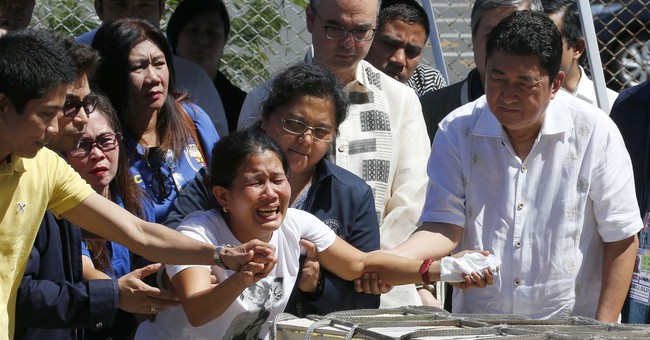
Demafelis' flower-draped coffin sat Friday in her family home in rural Sara town in central Iloilo province, where relatives, who had alerted authorities in 2016 that she was missing, honored her memory and called for justice.
"We'll miss her. She was so kind to all of us," her brother Joejet Demafelis said, adding hundreds of relatives and friends came on the eve of her burial.
Her slaying is the latest tragedy to befall an overseas worker from the Philippines, where about a tenth of the nation's 100 million people toil in more than 200 countries worldwide to provide for families back home. Last year, those workers sent home more than $31 billion, accounting for 10 percent of the country's gross domestic product.
Officials warn Demafelis' death won't be the last. They say a dangerous mix of poverty, spotty enforcement of labor laws, difficult conditions especially in Arab nations, and the logistical nightmare of watching over huge numbers of workers abroad means other tragedies are inevitable.
"You gnash your teeth and ask 'Why is this happening?'" Sen. Franklin Drilon, a former labor secretary, said in an interview, adding that laws meant to protect workers needed to be enforced. "Certainly, it can happen again."
President Rodrigo Duterte has responded to Demafelis' death by banning the deployment of Filipino workers to Kuwait, though that won't affect the more than 250,000 Filipinos still working in the oil-rich nation. The Philippine senate, meanwhile, has opened an inquiry into what went wrong.
The president, who is prone at making public outbursts, also lashed out at Middle East nations.
"The Filipino is no slave to anyone, anywhere and everywhere," an enraged Duterte said shortly after Demafelis' body was found. "We send to you a Filipino worker, hale and hearty ... do not give us back a battered worker or a mutilated corpse."
But deaths among the army of Filipino workers abroad aren't new. Nearly 200 Filipino workers died in Kuwait over the last two years, mostly due to health reasons, but 22 cases were suicides or fatal criminal attacks, said Hans Cacdac, head of the Overseas Workers Welfare Administration in Manila.
Cacdac said 45,000 to 50,000 "distress cases" are reported each year, many of them in Arab countries.
The sixth of nine children of a poor farmer, Demafelis did not go to college and flew to Kuwait in 2014. She had wanted to earn money to repair the family house, which was battered by Typhoon Haiyan the year before, reacquire a small piece of farmland that had been mortgaged, and help pay tuition for a sibling to finish a criminology course.
"Those were her dreams that prompted her to leave," her elder brother Joejet Demafelis told The Associated Press.
For more than a century Filipinos have been doing the same. Under American colonial rule in the early 1900s, Filipinos traveled to work on pineapple plantations in Hawaii and later in fish canneries in Alaska and elsewhere on the mainland until entry restrictions eased the exodus.
In the 1970s, a construction boom in the Middle East lured more workers out of the Philippines, which had heightened political and economic uncertainties under then President Ferdinand Marcos. The Philippines labor export policy at the time addressed unemployment at home and generated badly needed foreign exchange to bolster the economy.
As the number of workers climbed, so did incidents that strained Philippine ties with host countries, such as abuse of Filipinos at the hands of employers or Filipinos committing crimes.
A 1995 case in which a Filipina housemaid was convicted of murder and executed in Singapore despite her pleas of innocence, prompted outrage in Manila and fresh legislation meant to set a higher standard of protection for workers, their families and Filipinos in distress. Countries of destination needed to be able to guarantee the rights of workers by having signed agreements with the Philippines.
The law also set a policy that the country would "as soon as practicable" allow only skilled workers to be deployed overseas and would try to wean the country off of dependence on the earnings of migrant workers.
The law has clearly had mixed results and officials acknowledge that Demafelis fell through the cracks in its safety nets.
Demafelis' calls to her family were brief and scant and she did not mention any problem, according to her sister Joyce Demafelis. When she stopped calling in 2016, her family started to get worried and notified authorities in December that year, Joejet Demafelis said.
He said authorities did not take adequate steps to find out what happened.
Inquiries about Demafelis were passed on to a Filipino labor officer in Kuwait but the officer was too overwhelmed with complaints, Labor Secretary Silvestre Bello III said.
"I asked why no action was taken and I was told it was humanly impossible to attend to them ... there was too much work," Bello said, adding he did not accept that excuse and recalled the Kuwait-based officer and two others.
Demafelis' employers have reportedly been arrested, though few details surrounding her slaying are known, including when and how she was killed.
Unlike professionals who work in offices, housemaids are particularly vulnerable to abuse given that they work in the privacy of homes out of sight of authorities, said Bernard Olalia, who heads the Philippine Overseas Employment Administration, which regulates the deployment of Filipinos abroad.
In some countries, such as Kuwait, employers often keep the passports and cellphones of their maids to prevent them from fleeing, but it also cuts them off from their families and other support systems, Olalia said.
An option the government is considering is to ban Filipina maids from being deployed but continue allowing professionals to seek jobs abroad, Olalia said.
Amid the outrage over Demafelis' death, Philippine labor officials have pledged to shoulder the repair of her family's house, where relatives were preparing for her funeral Saturday. The government will also send her sibling through college and finance the reacquisition of her family's farmland.
"We wish all of these would have happened," Joejet Demafelis said. "But never at the cost of her life."

Canada Islamic Foundation Teacher Rapes 10-Year-Old Boy…

Saleh Momla, 24, of Toronto, has been arrested and charged with sexual assault and sexual interference.

A private school teacher in Scarborough is facing multiple charges after a 10-year-old boy was allegedly taken from the school grounds and sexually assaulted. 
Police allege the man, a teacher at the Islamic Foundation of Toronto, took the boy from school property just after 11 a.m. on Feb. 16.
The boy was driven to a location in the Neilson Road and McLevin Avenue area where he was allegedly sexually assaulted, before being returned to the school, police say.
Saleh Momla, 24, of Toronto has been charged with sexual assault and sexual interference.
"Everyone here is extremely shocked and we're just really concerned for all the students," Imam Yusuf Badat told CBC Toronto, who said the teacher is no longer employed at the school.
Badat says the says the school plans to hold workshops in the near future to help ensure students know what abuse looks like and how to report it.
Yusuf Badat
Imam Yusuf Badat says the school plans to hold workshops in the near future to help ensure students know what abuse looks like and how to report it. (Paul Smith/CBC)
"We don't want any of this to be kept silent if there is another victim," he said. Approximately 2,500 people come in and out of the centre, which includes not only the school but also a mosque.
Const. Allyson Douglas-Cook told CBC Toronto that the parents took exactly the right action by alerting the school and authorities when their child came forward.
"It's very concerning but we use opportunities like this to urge parents to have conversations with their children and to teach their children to trust their instincts," she said.

TRENDING NOW